Dick Cheney is Fairly Pleased With His Eight Bloody Years
Afghanistan, Dick Cheney, George W. Bush, Iraq, War Criminal
- guardian.co.uk, Wednesday 17 December 2008 01.19 GMT
The outgoing US vice-president, Dick Cheney, last night gave an unapologetic assessment of his eight years in office, defending the invasion of Iraq, the US prison camp at Guantánamo Bay, secret wiretapping and the extreme interrogation method known as waterboarding.
In his first television interview since the presidential election in November, Cheney displayed no regrets and gave no ground to his many critics within America and around the world. He summed up his record by saying: “I think, given the circumstances we’ve had to deal with, we’ve done pretty well.”

He told ABC News he stood by the most controversial policies of the Bush administration, and urged president-elect Barack Obama to think hard before undoing them. Asked about the use of torture on terror suspects, he replied: “We don’t do torture. We never have. It’s not something this administration subscribes to.”
Later in the same interview, Cheney was asked whether the use of waterboarding in the interrogation of the alleged mastermind of the September 11 attacks, Khaled Sheikh Mohammed, had been appropriate. He replied: “I do.”
Waterboarding is a technique that induces the sensation of drowning, and is widely regarded as a form of torture. It was used on three high-level al-Qaida suspects, including Mohammed, but has since been banned by the US.
Cheney was chosen in 2000 by George Bush to be his vice-president; he did not put his own name forward for the job. He has since turned into one of the most divisive and reviled vice-presidents in US history, amassing to his office enormous powers and devising a stream of controversial policies.
Despite the vitriol he has attracted, and Bush’s historically low approval rating of just 29%, Cheney was still able to joke about his term in the White House.
He referred to a comment from Hillary Clinton likening him to the Star Wars character Darth Vader. “I asked my wife about that, if that didn’t bother her. She said, no, it humanises you.”
But his lack of any introspection over the decisions made under his watch – in contrast to Bush who recently said he had been sorry about the false intelligence over Iraq – will renew Cheney’s reputation as a combatant and uncompromising vice-president.
Though no weapons of mass destruction were ever found, he insisted that Saddam Hussein had had the capability to produce them.
“He had the technology, he had the people. This was a bad actor and the country’s better off, the world’s better off with Saddam gone. We made the right decision,” he said.
On Guantánamo, he challenged the incoming Obama administration to think hard about what he claimed were the “hardcore” detainees still being held at the Cuban base.
“What are you going to do with those prisoners?” he said, adding: “I don’t know any other nation in the world that would do what we’ve done in terms of taking care of people who are avowed enemies.”
He also defended the use of secret wiretapping of suspects that was carried out without court warrant.
“It’s worked. It’s been successful. It was legal from the very beginning.”
Given the role of hate-figure that Cheney has acquired over the years among the American left, many US liberals will be dismayed to hear him say that he largely approves of the cabinet put together by the president-elect.
He praised the decision to keep Robert Gates as defence secretary as “excellent” and predicted that General Jim Jones would be “very, very effective” as national security adviser.
He even complimented his old adversary, Hillary Clinton, Obama’s choice as secretary of state, saying “she’s tough, she’s smart, she works very hard and she may turn out to be just what President Obama needs.”
Cheney has 34 days left in office. This will be his fourth transition out of government and back to private life. He said he was not ready to retire yet, but did want to spend more time with his family. “Got some rivers I want to face. Maybe write a book. I haven’t decided yet.”
Thousands Line Up For Free Food In San Francisco
George W. Bush, Homelessness, San Francisco, The Economy
Wednesday, December 17, 2008
(12-16) 13:47 PST SAN FRANCISCO — Never have so many people waited so long in San Francisco for a chicken.
Not only a chicken, but cans of pears, corn, carrots and tomatoes, plus a sack of pinto beans.
The line Tuesday for the annual grocery giveaway at Glide Memorial United Methodist Church was longer than anyone could remember. It stretched beyond the liquor store on the corner, past a half dozen residence hotels, up and down the aisles of a parking lot and along the far side of the massage parlor. It coiled back on itself like a cobra.

“We may run out of food,” said the Rev. Cecil Williams, who this year appeared to mean it. “The line is all the way around the block, twice over. We’re trying to rush things along so the line doesn’t come back on itself three times.”
Six thousand sacks of groceries were handed out. The first thousand came with a turkey. The rest came with a chicken. A lot of people were willing to show up before dawn in rainy 40-degree weather, to make sure they got the turkey instead of the less weighty, if not lesser, bird.
Four hundred volunteers in red T-shirts began passing out the food at 7 a.m., about a half hour earlier than scheduled. By 8 a.m., the turkeys were gone and it was chickens only.
Williams stood on the sidewalk in front of his fabled Tenderloin church, directing traffic. In the race for the turkeys, a woman in a motorized wheelchair nearly plowed over a woman in a walker, along with Williams.
“Just a minute here,” said Williams. “Take it easy. Please.”
Inside the church, volunteers were loading up the sacks in an assembly line that would do credit to whatever’s left of the ones in Detroit. Sarah Anderson, who was perched on two cases of canned corn while she loaded cans from a third case into the sacks, marveled at the versatility of canned corn.
“You can sit on it and then you can eat it,” she said.
Aaron Harris, who was lifting 48 cans of tomato sauce at a time, said it’s important to do something good when times are bad.
“People are hurting right now,” he said. “It’s good to give back.”
Outside, the line was so long that dozens of volunteers were required to make sure it stayed orderly. There was also a line for the three outhouses that had been set up in the middle of Ellis Street.
At the end of the food line, John Sorensen and a pal, Danny Holliday, were waiting for their sacks.
“Times are tougher than ever,” said Sorensen, an unemployed construction worker. “I used to be able to find some kind of work. Not now.”
Holliday, an out-of-work waiter, said standing in line for free groceries “is kind of a new thing to me.”
“I’m broke all the time right now,” he said. “So this really helps.”
Across Ellis Street in front of Boeddeker Park, recipients conducted the usual swapping. Homeless people without access to kitchens were less than excited about a sack of uncooked pinto beans and more than willing to trade for a can of cooked vegetables. Deals went down by the dozens.
“OK, gimme the beans and the rice,” said one man in a denim coat to another man in a knit cap. “You get the peas, corn and carrots.”
E-mail Steve Rubenstein at srubenstein@sfchronicle.com.
Captain America And Spiderman Blew Millions In Pro-Troop Propaganda Scam
Stories
EXCLUSIVE FROM W I R E D
By Noah ShachtmanWhile the Pentagon preps for a new administration, a scandal from an earlier era is rearing its head.
A Defense Department project, supposedly designed to support U.S. troops, was used instead to channel millions of dollars to personal friends and allies of its chief. The “America Supports You,” or ASY, program was led in a “questionable and unregulated manner,” according to a Department of Defense Inspector General report, obtained by Danger Room. At least $9.2 million was “inappropriately transferred” by the project’s managers. Much of that money served only to further promote ASY, instead of assisting servicemembers.

In 2004, the office of then-Secretary of Defense Donald Rumsfeld set up ASY as a six-month effort to showcase the U.S. public’s backing for the troops and their families. “If you’re serving overseas, and you watch the mainstream media coverage, sometimes you can’t tell if America knows you’re there,” one official overseeing the program says. America Supports You was seen as a way to counteract that sense.
In time, however, the program grew. Pro-troop rallies were organized. Special wristband and dog tags were made. Special-edition comic books were printed up. Processions were held on the National Mall, on the 9/11 anniversary. Sesame Street characters were enlisted to make DVDs that encouraged families with young children to talk about overseas deployments. America Supports You became a kind of umbrella group for all sorts of charity-related work for service members and military families.
Meanwhile, ASY began to spend millions — not to help the troops, the Inspector General says, but to help itself. “Instead of focusing on its primary mission of showcasing and communicating support to the troops and their families, the ASY program focus [turned to] building or soliciting support from the public,” the Inspector General’s report notes. In 2006 and 2007, for instance, more than $600,000 was spent ginning up support for America Supports You among schoolchildren. Another $165,000 went to a pro-ASY concert aboard the USS Intrepid, docked on Manhattan’s west side. And $15,000 went to actor and musician Gary Sinise’s “Lt. Dan Band” to play a separate show. The report calls all of these “questionable and unregulated actions.”
By mid-2007, allegations began to surface that the Pentagon official in charge of the program, Armed Forces Information Service chief Alison Barber (pictured, left), was improperly redirecting millions of dollars in public funds.
From fiscal years 2004 to 2007, the Inspector General’s report notes, Barber funneled $8.8 million in contracts to the public relations firm Susan Davis International — to set up the myriad events, and to promote the ASY “brand.” The work was incredibly lucrative; Davis’ executives made as much as $312,821 to $662,691 per year. “Paying a public relations contractor annual salaries approaching three-quarters of a million dollars does not appear to be a cost-effective means to support the ASY program and the war fighter,” the report observes.
But what made it even harder to stomach was that Davis was a friend of Barber’s, and a well-known Republican operative, according to former Defense Department lawyer Diane Beaver. Another half-million went to media consultant Mitch Semel, for web work.
Worse still, in the eyes of many, was that Barber used the Stars & Stripes newspaper as a kind of money-laundering service, to pay Davis and Semel. The paper is partially financed by the Pentagon, and was part of Barber’s American Forces Information Service. But Stripes has a decades-long tradition of fierce independence. Editors were galled to discover that Barber’s office was pouring money into the paper’s coffers — and then paying Davis and Semel out of accounts with less congressional oversight and fewer spending restrictions than typical Defense Department funds.
“Readers need to know that the newspaper they trust to provide them independent, accurate, credible news is not in any way operating in a compromised position,” managing editor Doug Clawson said. “If, in fact, Stripes was helping handle public relations work on behalf of a political appointee it doesn’t look good, and could taint the editorial department, and thereby the readers’ perceptions of this newspaper’s mission.”
The Department of Defense’s Inspector General had already launched investigations into financial wrongdoing and organizational mismanagement at America Supports You, the Armed Forces Information Service, and the Defense’ Secretary’s public affairs office. In October 2007, the Inspector General widened its review to include Stars & Stripes.
Barber is no longer at the Pentagon. Two months ago, she abruptly resigned as the heads of both American Supports You and of Defense Media Activity, the new organization that oversees Stars & Stripes. America Supports You has been moved under the Defense Department’s community relations office. “A lot of the big issues have been addressed — how we do contracting, how we use appropriated funds,” one member of that office tells Danger Room. “We’re back in the comfort zone, running a program in the way that the government is used to running it.”
Not Just Super Rich Getting Destroyed By "The Madoff"
Banking, Berrie Madoff, Charities, Investment Firms, Money Manager, NASDAQ, The Madoff, Wall Street
Dec 14, 6:16 PM (ET)
By JOE BEL BRUNO
NEW YORK (AP) – From a Jewish youth charity in Boston to major banks as far afield as Zurich, the list of investors who say they were duped in one of Wall Street’s biggest Ponzi schemes are streaming forward.
Around the world, investors who sunk cash into veteran Wall Street money manager Bernard Madoff’s investment pool spent the weekend calculating how much exposure they might have. The 70-year-old Madoff, well respected in the investment community after serving as chairman of the Nasdaq Stock Market, was arrested Thursday in what prosecutors say was a $50 billion scheme to defraud investors.

One thing was clear in the fallout from his arrest: The alleged victims span from the super rich, to pensioners and powerful financial institutions, to local charities. Some investors claim they’ve been wiped out, while others are still likely to come forward.
“There were a lot of very sophisticated people who were duped, and that happens a great deal when you’ve had somebody decide to be unscrupulous,” said Harvey Pitt, a former chairman of the Securities and Exchange Commission, a regulator in charge of monitoring investment funds like the one Madoff operated.
|

“It isn’t just the big investors,” he said. “There’s a lot of charitable and foundation money involved in this, which is the real tragedy.”
Charities across the country are expected to be directly affected by the collapse of Madoff’s investment fund. The assets of Bernard L. Madoff Investment Securities LLC were frozen Friday in a deal with federal regulators and a receiver was appointed to manage the firm’s financial affairs.
One of the largest financial scams to hit Wall Street has investors wondering if they’ll ever get their money back.
In Boston, the Robert I. Lappin Charitable Foundation, a charity that financed trips for Jewish youth to Israel, said on its Web site Sunday that the money for its operations was invested with Madoff.
“The money needed to fund the programs of the Lappin Foundation is gone,” it said. “The foundation staff has been terminated today.”
|

New Jersey Sen. Frank Lautenberg, one of the wealthiest members of the Senate, entrusted his family’s charitable foundation to Madoff. Lautenberg’s attorney, Michael Griffinger, said they weren’t yet sure the extent of the foundation’s losses, but that the bulk of its investments had been handled by Madoff.
Lautenberg’s foundation handed out more than $765,000 to at least 100 recipients in 2006, according to the most recent listing on Guidestar, which tracks charitable organization filings.
The foundation helps support a variety of religious, educational, civic and arts organizations in New Jersey and elsewhere, and its contributions range from a gift of than $300,000 to the United Jewish Communities of MetroWest New Jersey to a $2,000 donation to a children’s program at the Hackensack Medical Center.
Reports from Florida to Minnesota included profiles of ordinary investors who gave Madoff their money. Some had been friends with him for decades, others were able to invest because they were a friend of a friend. They told stories of losing everything from $40,000 to an entire nest egg worth well over $1 million.
They join a list of more powerful investors that have come forward, all worried about the extent of their losses. The roster of names include Philadelphia Eagles owner Norman Braman, New York Mets owner Fred Wilpon and J. Ezra Merkin, the chairman of GMAC Financial Services, among others.
Beyond U.S. hedge funds, more corporate names disclosed exposure to Madoff. Late Sunday, some of Europe’s biggest banks acknowledged they, too, were exposed to Madoff’s investment fund.
Switzerland’s Reichmuth & Co. said the private bank has $327 million at risk. It told investors that they “sincerely regret” being affected.
Other banks such as Spain’s Grupo Santander SA, Europe’s second-largest banking consortium, and France’s BNP Paribas are also left with billions of dollars in exposure, according to media reports. Both banks could not immediately be reached for comment.
__
Associated Press Writer Samantha Henry in Trenton, N.J. contributed to this report.
Theatre Company Denies Actor Cut By Real Knife In Alleged Murder Plot
Actors, Murder, Theatre
Kate Connolly in Berlin
Guardian.co.uk, Monday 15 December 2008
An earlier picture of Daniel Hoevels in the same role he was playing when he was injured.
A Hamburg theatre has denied reports that an actor suffered a life-threatening cut to his throat after a prop knife was reportedly replaced by one with a real blade.
Daniel Hoevels, 30, was said to have had blood “pouring from his neck” after he stabbed himself with the knife in a suicide scene.

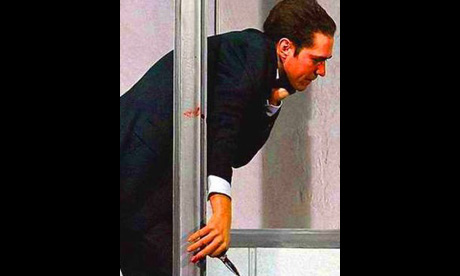
The Thalia theatre company issued a strong denial in response to reports by the Daily Telegraph, Daily Mail, Guardian and Sky TV that police were investigating a possible murder plot against the actor, who was playing the role of Mortimer in Friedrich Schiller’s Mary Stuart at Vienna’s Burgtheater.
The company admitted that a female prop manager had bought a knife for use on stage and forgotten to blunt it. The case was reported to police as a matter of course. Hoevels said he would not press charges.
“During a guest performance of Maria Stuart there was an accident,” the Thalia theatre said in a statement referring to the incident on 6 December.
“Daniel Hoevels suffered a cut to his neck, but there was no serious injury.”
On the advice of a doctor Hoevels went to hospital, received two stitches and was released immediately, then went to a party, the statement said.
According to the theatre’s managing director, who was present at the time, Hoevels completed the scene as he always had done using fake blood. He reappeared on stage the following night wearing a plaster, and not, as reported, a bandage around his neck.
A spokeswoman for the Burgtheater in Vienna said the reports had been exaggerated, including untrue accounts that the audience applauded when Hoevels accidentally cut his neck.
The police denied reports that an investigation had been launched or that DNA tests of backstage crew and cast members had been carried out.
A picture used to apparently illustrate the incident, of Hoevels clutching his bloodied neck, was said by the theatre to be two years old and not of the apparent accident with the knife.
Hoevels is now playing in Ulrich Plenzdorf’s The New Sorrows of Young Werther.
U.S. Airways Flight 1549 Crash Lands In New York City's Hudson River
Airline Travel, Flight 1549, John Tully, LaGuardia, Manhattan, Michael Bloomberg, Miracle on The Hudson, Port Imperial Ferries, U.S. AirwaysGovernor Patterson declares: “It’s the Miracle On The Hudson”
John S. Tully
The New York Herald Sun
January 15, 2008
A flock of geese is being blamed for the water-landing of U.S. Airways 1549.
More than half a dozen water-ferries immediately began to rescue the 155 people aboard.
The pilot apparently meant to land it in the water off 48th street and the West side of Manhattan.

The flight originated from Laguardia Airport.
The first call to 911 was made at 3:31
All 150 passengers were rescued including the five crew members totaling 155 people who survived the crash.
Mr. Bloomberg told me at the press conference when I questioned him* that the pilot personally told the Mayor that he went back into the plane twice to check to see if there were any remaining passengers in the cabin.
The pilot has been identified by friends as Chesley Burnett “Sully” Sullenberger III
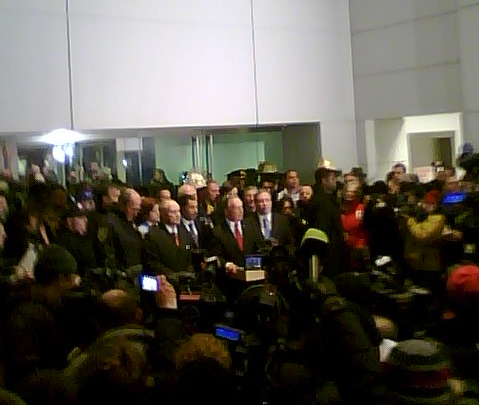

Reporter John Tully watches Governor David Patterson talk about the “Miracle on the Hudson”
*(right before the NYPD escorted Mr. Tully out for lack of press credentials)
Heath Ledger Wins Supporting Actor Golden Globe For 'The Dark Knight'
Golden Globes, Heath Ledger, Hollywood Foreign PressDirector Christopher Nolan accepted the award saying in part:
“All of us on Dark Knight accept this with an awful mixture of sadness and extreme pride”
“…A huge hole ripped in the future of cinema”
“The extraordinary response to his work all over the world helps with that gap….”
“He will be eternally missed but not forgotten”

Bruce Springsteen Wins Golden Globe For Best Song in a Motion Picture
Bruce Springsteen, Golden Globes, Mickey RourkeBruce thanked Mickey Rourke for calling and asking him to write a song about a character who invests in pain.
Springsteen: “Yeah, I know guys like that”

The Man Who Blew The Whistle on Illegal Wiretapping
Stories Issue dated Dec 22, 2008
Thomas M. Tamm was entrusted with some of the government’s most important secrets. He had a Sensitive Compartmented Information security clearance, a level above Top Secret. Government agents had probed Tamm’s background, his friends and associates, and determined him trustworthy.
It’s easy to see why: he comes from a family of high-ranking FBI officials. During his childhood, he played under the desk of J. Edgar Hoover, and as an adult, he enjoyed a long and successful career as a prosecutor. Now gray-haired, 56 and fighting a paunch, Tamm prides himself on his personal rectitude. He has what his 23-year-old son, Terry, calls a “passion for justice.” For that reason, there was one secret he says he felt duty-bound to reveal.
In the spring of 2004, Tamm had just finished a yearlong stint at a Justice Department unit handling wiretaps of suspected terrorists and spies—a unit so sensitive that employees are required to put their hands through a biometric scanner to check their fingerprints upon entering. While there, Tamm stumbled upon the existence of a highly classified National Security Agency program that seemed to be eavesdropping on U.S. citizens. The unit had special rules that appeared to be hiding the NSA activities from a panel of federal judges who are required to approve such surveillance. When Tamm started asking questions, his supervisors told him to drop the subject. He says one volunteered that “the program” (as it was commonly called within the office) was “probably illegal.”
Tamm agonized over what to do. He tried to raise the issue with a former colleague working for the Senate Judiciary Committee. But the friend, wary of discussing what sounded like government secrets, shut down their conversation. For weeks, Tamm couldn’t sleep. The idea of lawlessness at the Justice Department angered him. Finally, one day during his lunch hour, Tamm ducked into a subway station near the U.S. District Courthouse on Pennsylvania Avenue. He headed for a pair of adjoining pay phones partially concealed by large, illuminated Metro maps. Tamm had been eyeing the phone booths on his way to work in the morning. Now, as he slipped through the parade of midday subway riders, his heart was pounding, his body trembling. Tamm felt like a spy. After looking around to make sure nobody was watching, he picked up a phone and called The New York Times.
That one call began a series of events that would engulf Washington—and upend Tamm’s life. Eighteen months after he first disclosed what he knew, the Times reported that President George W. Bush had secretly authorized the NSA to intercept phone calls and e-mails of individuals inside the United States without judicial warrants. The drama followed a quiet, separate rebellion within the highest ranks of the Justice Department concerning the same program. (James Comey, then the deputy attorney general, together with FBI head Robert Mueller and several other senior Justice officials, threatened to resign.) President Bush condemned the leak to the Times as a “shameful act.” Federal agents launched a criminal investigation to determine the identity of the culprit.
The story of Tamm’s phone call is an untold chapter in the history of the secret wars inside the Bush administration. The New York Times won a Pulitzer Prize for its story. The two reporters who worked on it each published books. Congress, after extensive debate, last summer passed a major new law to govern the way such surveillance is conducted. But Tamm—who was not the Times’s only source, but played the key role in tipping off the paper—has not fared so well. The FBI has pursued him relentlessly for the past two and a half years. Agents have raided his house, hauled away personal possessions and grilled his wife, a teenage daughter and a grown son. More recently, they’ve been questioning Tamm’s friends and associates about nearly every aspect of his life. Tamm has resisted pressure to plead to a felony for divulging classified information. But he is living under a pall, never sure if or when federal agents might arrest him.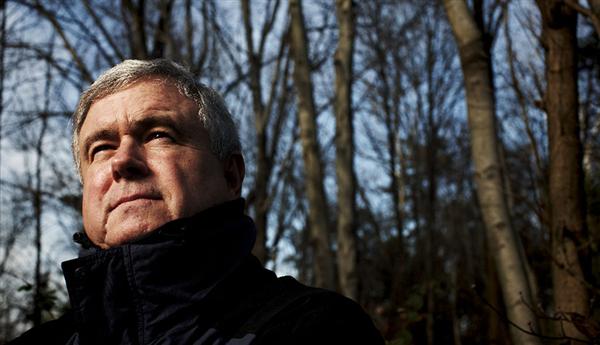
Exhausted by the uncertainty clouding his life, Tamm now is telling his story publicly for the first time. “I thought this [secret program] was something the other branches of the government—and the public—ought to know about. So they could decide: do they want this massive spying program to be taking place?” Tamm told NEWSWEEK, in one of a series of recent interviews that he granted against the advice of his lawyers. “If somebody were to say, who am I to do that? I would say, ‘I had taken an oath to uphold the Constitution.’ It’s stunning that somebody higher up the chain of command didn’t speak up.”
 The New York Herald Sun