The FCC is a Cesspool of Distrust, Suspicion and Turmoil

Comcast Corp., District Of Corruption, Kevin Martin, Time Warner Cable;Cox Communications; FCC

“a blueprint of what not to do”

Investigation finds pattern of mismanagement at FCC

Tuesday, December 9, 2008

WASHINGTON: In a scathing report released Tuesday, congressional investigators outlined a pattern of mismanagement, dysfunction and abuse of power at the Federal Communications Commission under the agency’s Republican chairman, Kevin Martin.

The report – the result of a nearly yearlong, bipartisan investigation by the House Energy and Commerce Committee – accuses Martin of manipulating data and suppressing information to influence telecommunications policy debates at the agency and on Capitol Hill.
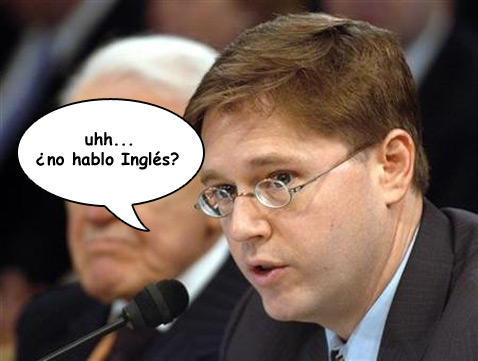
kevin-martin_fcc

The report charges that the commission has become politicized and failed to carry out some important responsibilities under Martin’s leadership. It also blames him for undermining an open and transparent regulatory process.

In addition, Martin is accused of micromanaging commission affairs, demoting agency staffers who did not agree with him and withholding information from his fellow commissioners. “Chairman Martin’s heavy-handed, opaque, and non-collegial management style has created distrust, suspicion and turmoil among the five current commissioners,” the report says.

Robert Kenny, a spokesman for Martin, said the committee “did not find or conclude that there were any violations of rules, laws or procedures.” Martin is widely expected to leave the commission after the White House changes hands.

Martin’s legacy at the FCC will be “a blueprint of what not to do,” said Bart Stupak, D-Mich., who chairs the House Commerce Committee’s Subcommittee on Oversight and Investigations.

“The findings suggest that, in recent years, the FCC has operated in a dysfunctional manner and commission business has suffered as a result,” said Commerce Committee Chairman John Dingell, D-Mich., who will be relinquishing the reins of the panel to California Democrat Henry Waxman next year.

Among the findings of the 110-page report:

– Martin manipulated the findings of an FCC inquiry into the potential consumer benefits of requiring cable companies to sell channels on an individual – or “a la carte” – basis. The House investigation concludes that Martin undermined the integrity of the FCC staff and may have improperly influenced the Congressional debate on the matter by ordering agency employees to rewrite a report to conclude that a la carte mandates would benefit consumers.

– Martin tried to manipulate the findings of an annual FCC report on the state of competition in the market for cable and other video services to show that the industry had a big enough market share to permit additional government regulation. When the full commission voted to reject that conclusion, Martin suppressed the report by withholding its release.

– Under Martin’s leadership, the FCC’s oversight of the Telecommunications Relay Service Fund, which pays for special telecommunications services for people with hearing or speech disabilities, was overly lax. This resulted in overcompensation of the companies that provide these services by as much as $100 million a year – costs that were ultimately passed along to phone company customers.

Kenny said Martin makes no apologies for his “commitment to serving deaf and disabled Americans and for fighting to lower exorbitantly high cable rates that consumers are forced to pay.” He added that Martin remains confident that pricing channels on an individual basis would bring down cable rates.

The House report is a significant victory for the cable industry, which has fought Martin’s efforts to impose a la carte requirements and other regulatory changes. At Martin’s urging, the FCC in October opened an investigation into the industry’s pricing policies, including its practice of moving analog channels into more expensive digital tiers of service.

Among the companies being investigated are Comcast Corp., Time Warner Cable Inc. and Cox Communications Inc.

Gene Kimmelman, vice president for federal policy at Consumers Union, which helped bring attention to the cable pricing practices now being probed, said the issues highlighted by the House report are not new or unique to Martin.

“The FCC processes have been an enormous problem for years,” Kimmelman said. “This is just more of the same.”
"A Senate Seat is a Fucking Valuable Thing, You Don't Just Give It Away For Nothing"

Barack Obama, District Of Corruption, Illinois Corruption, Justice Department, Patrick Fitzgerald, Politics and Corruption, Rod Blagojevich, Tribune Company

-Illinois Governor Rod Blagojevich-

What role did Blagojevich play in Tribune’s bankruptcy?

THE DEAL

A day after Sam Zell’s Tribune Co. filed for Chapter 11 bankruptcy protection, the Federal Bureau of Investigation arrested Illinois Governor Rod Blagojevich and Chief of Staff John Harris on charges of corruption, alleging that, among other transgressions, they meddled with Tribune’s troubled businesses, including the auction of the Chicago Cubs.

patrickfitzgerald2005Mr. Patrick Fitzgerald Will F#ck Your Sh*t Up Bro

The Chicago Tribune’s editorial page has been critical of the governor, and suspicious of his activities; if the government’s allegations turn out to be true, then they had plenty of reason to be wary. Interestingly, Blagojevich was equally suspicious of the Tribune’s editorial board, and allegedly sought to trade his influence in the auction of the Cubs and Wrigley Field in exchange for the Tribune firing its editorial board. Below is the Department of Justice’s allegations against Blagojevich that specifically involves the Tribune:

According to the affidavit, intercepted phone calls revealed that the Tribune Company, which owns the Chicago Tribune and the Chicago Cubs, has explored the possibility of obtaining assistance from the Illinois Finance Authority (IFA) relating to the Tribune Company’s efforts to sell the Cubs and the financing or sale of Wrigley Field. In a November 6 phone call, Harris explained to Blagojevich that the deal the Tribune Company was trying to get through the IFA was basically a tax mitigation scheme in which the IFA would own title to Wrigley Field and the Tribune would not have to pay capital gains tax, which Harris estimated would save the company approximately $100 million. Intercepted calls allegedly show that Blagojevich directed Harris to inform Tribune Owner and an associate, identified as Tribune Financial Advisor, that state financial assistance would be withheld unless members of the Chicago Tribune’s editorial board were fired, primarily because Blagojevich viewed them as driving discussion of his possible impeachment. In a November 4 phone call, Blagojevich allegedly told Harris that he should say to Tribune Financial Advisor, Cubs Chairman and Tribune Owner, “our recommendation is fire all those [expletive] people, get ’em the [expletive] out of there and get us some editorial support.”

On November 6, the day of a Tribune editorial critical of Blagojevich , Harris told Blagojevich that he told Tribune Financial Advisor the previous day that things “look like they could move ahead fine but, you know, there is a risk that all of this is going to get derailed by your own editorial page.” Harris also told Blagojevich that he was meeting with Tribune Financial Advisor on November 10.

In a November 11 intercepted call, Harris allegedly told Blagojevich that Tribune Financial Advisor talked to Tribune Owner and Tribune Owner “got the message and is very sensitive to the issue.” Harris told Blagojevich that according to Tribune Financial Advisor, there would be “certain corporate reorganizations and budget cuts coming and, reading between the lines, he’s going after that section.” Blagojevich allegedly responded. “Oh. That’s fantastic.” After further discussion, Blagojevich said, “Wow. Okay, keep our fingers crossed. You’re the man. Good job, John.” In a further conversation on November 21, Harris told Blagojevich that he had singled out to Tribune Financial Advisor the Tribune’s deputy editorial page editor, John McCormick, “as somebody who was the most biased and unfair.” After hearing that Tribune Financial Advisor had assured Harris that the Tribune would be making changes affecting the editorial board, Blagojevich allegedly had a series of conversations with Chicago Cubs representatives regarding efforts to provide state financing for Wrigley Field. On November 30, Blagojevich spoke with the president of a Chicago-area sports consulting firm, who indicated that he was working with the Cubs on matters involving Wrigley Field. Blagojevich and Sports Consultant discussed the importance of getting the IFA transaction approved at the agency’s December or January meeting because Blagojevich was contemplating leaving office in early January and his IFA appointees would still be in place to approve the deal, the charges allege.

The reference to “Tribune Owner” would seem to mean Sam Zell. If that’s the case, is Zell in hot water? Did he help the government? What impact if any will the Blagojevich allegations have on Tribune’s bankruptcy filing? In the end, it’s doubtful that Blagojevich’s alleged role in the Cubs auction, which may have slowed the sale, was directly material to its bankruptcy filing. The team, for instance, is not part of the filing. Nonetheless, it offers some colorful insight into the auction. – Matthew Wurtzel

See the DOJ’s_complaint_(pdf)

Matthew Wurtzel is the editor of Dealscape.


Musicians Want U.S. To Stop Using Their Songs To Torment Prisoners

AcDc, Guantanamo, Heavy Metal, POW

The Associated Press

GUANTÁNAMO BAY NAVAL BASE, Cuba — Blaring from a speaker behind a metal grate in his tiny cell in Iraq, the blistering rock from Nine Inch Nails hit Prisoner No. 200343 like a sonic bludgeon.

“Stains like the blood on your teeth,” Trent Reznor snarled over distorted guitars. “Bite. Chew.”

The auditory assault went on for days, then weeks, then months at the U.S. military detention center in Iraq. Twenty hours a day. AC/DC. Queen. Pantera. The prisoner, military contractor Donald Vance of Chicago, told The Associated Press he was soon suicidal.

The tactic has been common in the U.S. war on terror, with forces systematically using loud music on hundreds of detainees in Iraq, Afghanistan and Guantánamo Bay. Lt. Gen. Ricardo Sanchez, then the U.S. military commander in Iraq, authorized it on Sept. 14, 2003, “to create fear, disorient … and prolong capture shock.”

Now the detainees aren’t the only ones complaining. Musicians are banding together to demand the U.S. military stop using their songs as weapons.

A campaign being launched today has brought together groups including Massive Attack and musicians such as Tom Morello, who played with Rage Against the Machine and Audioslave. It will feature minutes of silence during concerts and festivals, said Chloe Davies, of the British law group Reprieve, which represents dozens of Guantánamo Bay detainees and is organizing the campaign.

At least Vance, who says he was jailed for reporting illegal arms sales, was used to rock music. For many detainees who grew up in Afghanistan — where music was prohibited under Taliban rule — interrogations by U.S. forces marked their first exposure to the pounding rhythms, played at top volume.

The experience was overwhelming for many. Binyam Mohammed, now a prisoner at Guantánamo Bay, said men held with him at the CIA’s “Dark Prison” in Afghanistan wound up screaming and smashing their heads against the walls, unable to endure more.

“There was loud music, (Eminem’s) ‘Slim Shady’ and Dr. Dre for 20 days. I heard this nonstop over and over,” he told his lawyer, Clive Stafford Smith. “The CIA worked on people, including me, day and night for the months before I left. Plenty lost their minds.”

The spokeswoman for Guantánamo’s detention center, Navy Cmdr. Pauline Storum, wouldn’t give details of when and how music has been used at the prison but said it isn’t used today.

FBI agents stationed at Guantánamo Bay reported numerous instances in which music was blasted at detainees, saying they were “told such tactics were common there.”

According to an FBI memo, one interrogator at Guantánamo Bay bragged he needed only four days to “break” someone by alternating 16 hours of music and lights with four hours of silence and darkness.

Ruhal Ahmed, a Briton who was captured in Afghanistan, describes excruciating sessions at Guantánamo Bay. He said his hands were shackled to his feet, which were shackled to the floor, forcing him into a painful squat for periods of up to two days.

“You’re in agony,” Ahmed, who was released without charge in 2004, told Reprieve. He said the agony was compounded when music was introduced, because “before, you could actually concentrate on something else, try to make yourself focus on some other things in your life that you did before and take that pain away.

“It makes you feel like you are going mad,” he said.

Not all of the music is hard rock. Christopher Cerf, who wrote music for “Sesame Street,” said he was horrified to learn songs from the children’s TV show were used in interrogations.

“I wouldn’t want my music to be a party to that,” he told AP.

Bob Singleton, whose song “I Love You” is beloved by legions of preschool Barney fans, wrote in a newspaper opinion column that any music can become unbearable if played loudly for long stretches.

“It’s absolutely ludicrous,” he wrote in the Los Angeles Times. “A song that was designed to make little children feel safe and loved was somehow going to threaten the mental state of adults and drive them to the emotional breaking point?”

Morello, of Rage Against the Machine, has been especially forceful in denouncing the practice. During a recent concert in San Francisco, he proposed taking revenge on President Bush.

“I suggest that they level Guantánamo Bay, but they keep one small cell and they put Bush in there … and they blast some Rage Against the Machine,” he said to whoops and cheers.

Some musicians, however, say they’re proud that their music is used in interrogations. Those include bassist Stevie Benton, whose group Drowning Pool has performed in Iraq and recorded one of the interrogators’ favorites, “Bodies.”

“People assume we should be offended that somebody in the military thinks our song is annoying enough that played over and over it can psychologically break someone down,” he told Spin magazine. “I take it as an honor to think that perhaps our song could be used to quell another 9/11 attack or something like that.”

San Francisco is Flat Broke; If Only There Was Something They Could Tax…

Budget Cuts, California, Marijuana, San Francisco

S.F. faces $575.6 million budget deficit

Tuesday, December 9, 2008

(12-08) 20:43 PST — San Francisco’s budget deficit for next year has grown to $575.6 million – equal to nearly half the city’s discretionary spending account. It’s a financial crisis Mayor Gavin Newsom called one of the worst the city has experienced since the 1930s.

Newsom will announce his plan for cutting up to $125 million from this year’s $6.6 billion budget today, but gave few details about what it will include.

“This is nothing we’ve seen before,” he told The Chronicle. “As difficult as these cuts will be, the real challenge is in the next three, four, six months.”

Today’s announcement is expected to include proposals to cancel police academy classes, lay off some high-paid attorneys and cut health services, including outpatient treatment programs for the mentally ill and drug addicted.

One thing that won’t be part of the mayor’s cuts package: slashing by 50 percent the city funds given to the Symphony, Opera and Ballet. Supervisor Aaron Peskin called for such cuts last week; if adopted, they would save the city about $1.1 million.

Peskin is also expected to present pages of cost-cutting ideas today, including the arts proposal, as a way to prevent deep cuts to the Department of Public Health and instead spread the pain around.

But Newsom said that while those three cultural institutions and the American Conservatory Theater, the Museum of Modern Art and the Exploratorium will see a 7 percent cut, the 50 percent idea is unnecessary.

“It’s more symbolic than substantive,” he said of Peskin’s proposal. “I want to deal with the real problem, which is hundreds of millions of dollars and not hundreds of thousands.”

Peskin declined to comment Monday.

Salary givebacks or wage freezes from the unions will also not be part of today’s announcement. Newsom said that will have to be part of the budget talks for the 2009-10 year, which starts July 1.

He said he doesn’t necessarily want the Police Officers Association to give back its coming 7 percent pay hike, though, because San Francisco police officers make less than those in small Bay Area cities like Berkeley, Fairfield and Fremont, making recruitment difficult.

This year the mayor had control over about $1.2 billion in discretionary spending, with the rest of the city budget required by law to be spent in specific ways.

Nani Coloretti, the mayor’s budget director, said the midyear cuts will help because programs and positions eliminated now will mean continued savings next year.

“It means you feel pain over 18 months, not over 12,” she said.

Downgrading positions and charging enterprise departments like Muni more for city services are also ways to save money without eliminating entire programs, she said.

Coloretti and Steve Kawa, the mayor’s chief of staff, have been making the rounds to supervisors’ offices in recent days to prepare them for today’s extensive budget cuts.

However, supervisors said the mayor’s representatives have not shared many specifics during these meetings and some have complained they’ve been left in the dark.

Newsom countered that “the board will have ample time to deal with the real issue, which is next year’s budget.”

Chronicle staff writer Marisa Lagos contributed to this report. E-mail Heather Knight at hknight@sfchronicle.com.

President-Elect Obama's Nuclear Decision

Barack Obama, Nuclear, Politics

Nuclear weapons decision awaits Obama

APTOPIX Democratic ConventionOAK RIDGE, Tenn. — One of the most important national security decisions facing President-elect Barack Obama will unfold in this remote valley of aging factories, where workers enriched uranium for the first atomic bomb of World War II.

The site is a linchpin in a hotly contested Bush administration plan to build the first new U.S. warheads since the end of the Cold War. Following Congress’ demand that decisions on new warheads be deferred until an assessment of U.S. nuclear weapons needs is finished next year, the issue is set to come to a head early in Obama’s presidency.

The outcome will determine whether Oak Ridge focuses on maintaining existing warheads and storing uranium from weapons pulled out of a shrinking arsenal — or whether it becomes a cornerstone in a new production enterprise. The implications go far beyond Oak Ridge and the seven other research and manufacturing compounds nationwide that make up the U.S. nuclear weapons production complex.

“This is not just a decision about the future of U.S. nuclear weapons, but about how the United States will address the challenges of … nuclear terrorism, nuclear proliferation and our entire 21st-century nuclear strategy,” says Clark Murdock, a senior adviser at the Center for Strategic and International Studies.

“These challenges have been maturing for some time, and the Obama administration is going to have to deal with them,” adds Murdock, a former staffer for the Pentagon and Congress.

During the campaign, Obama said that he seeks “a world without nuclear weapons,” but he also said that the nation must “always maintain a strong (nuclear) deterrent as long as nuclear weapons exist.”

Among other things, Obama has promised to strengthen non-proliferation programs, reach disarmament deals with Russia and bolster sanctions against North Korea, Iran and other states with rogue nuclear programs. He has vowed to seek a verifiable global ban on production of nuclear weapons material — and to “stop the development of new nuclear weapons.”

Obama’s statements offer no definitive stance on the Bush plan to build a new breed of warheads. His transition office declined to elaborate further.

Those on both sides of the issue say his comments leave room for him to support their positions.

Debating deterrence

The Bush plan focuses on producing a “Reliable Replacement Warhead,” or RRW, which the administration touts as a better, more durable substitute for warheads in the U.S. stockpile. The new warhead would have features to ensure it could not be detonated if stolen by terrorists or other foes.

The warhead “is about the future credibility of our nuclear deterrent,” Defense Secretary Robert Gates said in an October speech.

Great Britain, France, Russia and China are modernizing their nuclear arsenals, Gates said, and the United States must follow suit. As a signer of the nuclear test ban treaty, the United States cannot detonate its nuclear weapons to see whether age has weakened them. That means, he said, that sharp cuts in U.S. warheads required by disarmament treaties raise questions about the power of remaining weapons.

“There is no way we can maintain a credible deterrent and reduce the number of weapons in our stockpile without either resorting to testing or pursuing a modernization program,” Gates said.

Gates’ comments, made before he agreed to stay on as Defense secretary for Obama, don’t necessarily reflect the new administration’s views.

Congress is skeptical. After providing money previously for warhead research, it refused this year to pay for further development. Lawmakers cited recent studies that found no immediate threat that the aging of warheads and other critical weapons components has significantly eroded their capabilities.

Members of both parties said it would be wrong to embark on a major, multibillion-dollar program to produce a new warhead without determining what sort of nuclear weapons the nation will need in future years, how many will be required and how they will be used. So Congress required the independent review that’s due next year.

“We have to make certain that our nuclear deterrent is reliable … but the decision (on new production) has to be made in the context of all the national security issues we face, including non-proliferation,” says Sen. Byron Dorgan, D-N.D., head of a Senate appropriations subcommittee that controls nuclear weapons spending.

Building the warhead could affect Obama’s goal of getting other nations to curb nuclear programs, he says. “It’s our responsibility to be a leader in trying to, first, stop the spread of nuclear weapons, and second, in reducing the number of nuclear weapons on the planet.”

Indeed, any move on warhead production will come in the context of several other big, international decisions Obama will face on nuclear weapons policy during his first term. Among them: whether to extend or renegotiate the Strategic Arms Reduction Treaty with Russia, which expires at the end of 2009, and whether to push for ratification of the Comprehensive Nuclear Test Ban Treaty, which the United States complies with voluntarily.

Obama’s challenge

Obama has signaled he will give great weight to the implications that resuming warhead production might have on his non-proliferation agenda.

In an article in the July/August issue of Foreign Affairs, then-candidate Obama wrote of “de-emphasizing” the role of nuclear weapons worldwide and said “America must not rush to produce a new generation of nuclear warheads.” More recently, he chose former Georgia senator Sam Nunn, an ardent advocate of reducing global nuclear weapons inventories, to advise his transition team.

The question of whether to adopt the Bush administration’s plans “will be one of the most momentous (nuclear policy) decisions since the end of the Cold War … and Obama has spoken in support of moving toward a nuclear weapons-free world,” says Susan Gordon, president of the Alliance for Nuclear Accountability, a coalition of nuclear watchdog groups.

The new warhead has more capabilities than current warheads, she adds, and would “move us further down this road of a world of nuclear haves and have-nots.”

Advocates of the new warhead say it can help Obama’s agenda to prevent the spread of nuclear weapons.

“This isn’t about building new weapons — exotic bunker busters or suitcase bombs — but reliable, more secure and less costly weapons,” says Sen. Pete Domenici, R-N.M. The warhead “would allow deeper cuts in our nuclear stockpile” because remaining weapons would be more dependable.

“If you believe nuclear weapons are still relevant, RRW is a good thing. If you believe they should go away, it’s a great thing,” says Robert Smolen, deputy administrator of the National Nuclear Security Administration, which runs the weapons complex.

Some lawmakers who will review any decision Obama makes aren’t ready to back that argument.

“My fear is, for all our talk and our actions (on non-proliferation), the international perception will be that we simply want to proceed with a new weapon,” says Rep. Pete Visclosky, D-Ind., who chairs a House panel that oversees the weapons complex.

Obama’s challenge is working with Congress to set a weapons policy that is consistent with U.S. security needs and broader goals of limiting nuclear weapons, he adds. “It’s not just a burden, it’s a fundamental opportunity.”

Al Gore Might Get The Last Laugh, Douchebags

Al Gore, Barack Obama, Obama's People, Politics
By Alexander Mooney
CNN

goreWASHINGTON (CNN) — Former Vice President Al Gore is set to meet with President-elect Barack Obama and Vice President-elect Joe Biden Tuesday, leading to speculation Obama is eyeing Gore for a slot in his administration.

According to the Obama transition office, the meeting will focus on issues relating to energy and climate change, and how the new administration’s environmental policies can spur job creation.

Democratic officials have said Obama is not looking to tap Gore for a Cabinet-level post or any other position in the administration.

But a Gore appointment would almost certainly be greeted with celebration from members of the party’s liberal wing, many of whom are still angry he lost the White House in 2000 despite winning the popular vote.

Gore has also rocketed to stardom in the years since his failed presidential bid, winning a Nobel Peace Prize last year for his work to raise awareness on the dangers of global warming. The former vice president’s documentary on climate change, “An Inconvenient Truth,” also won two Oscars in 2007.

But Gore, who has made millions in the private sector since his days at the White House, has suggested he has little interest in returning to government.

A spokesman for Gore flatly said last week the former vice president has no interest in serving the Obama administration.

Nonetheless, Gore’s high profile visit to Chicago, Illinois, to meet Obama and Biden is raising eyebrows, even among some of Gore’s close advisers.

“The Gore trip is for more than just a chat,” a close friend of Gore told CNN’s John King. “He wouldn’t burn that much carbon flying to Chicago just to talk.”

But Obama, who eagerly courted Gore’s endorsement during the heated presidential race, has long said he would welcome the Democratic elder into his White House, at least as an informal adviser.

“I will make a commitment that Al Gore will be at the table and play a central part in us figuring out how we solve this [climate change] problem,” Obama said in April.

While this is the first time Gore is set to sit down with the president-elect since Election Day, the two regularly speak, aides have said. The meeting comes as the Obama transition team turns its focus toward naming its energy secretary and Environmental Protection Agency administrator — two key posts that remain vacant.

Gore notably sat on the sidelines during the prolonged Democratic primary process, refusing to endorse a candidate until the outcome became clear — a move viewed by some as a snub to Sen. Hillary Clinton who was engaged in a closely fought race with Obama at the time.

The former vice president made his debut on the campaign trail days after Clinton formally conceded the race, hailing Obama as a leader able to transcend Washington’s poisonous partisanship.

“For America to lead the world through the dangers we’re facing, to seize the opportunities before us, we’ve got to have new leadership,” he said then. “Not only a new president, but new policies. Not only a new head of state, but a new vision for America’s future.”

The Nationalization of the Auto Industry?

Auto Industry, Big Three, Congress, Nationalization, Senate
International Herald Tribune
Taking risks with bailout for U.S. automakers
Tuesday, December 9, 2008

WASHINGTON: When President-elect Barack Obama talked on Sunday about realigning the American automobile industry he was quick to offer a caution, lest he sound more like the incoming leader of France, or perhaps Japan.

“We don’t want government to run companies,” Obama told Tom Brokaw on “Meet the Press.” “Generally, government historically hasn’t done that very well.”

09auto550

But what Obama went on to describe was a long-term government bailout that would be conditioned on government oversight. It could mean that the government would mandate, or at least heavily influence, what kind of cars companies make, what mileage and environmental standards they must meet and what large investments they are permitted to make — to recreate an industry that Obama said “actually works, that actually functions.”

It all sounds perilously close to a word that no one in Obama’s camp wants to be caught uttering: nationalization.

Not since Harry Truman seized America’s steel mills in 1952 rather than allow a strike to imperil the conduct of the Korean War has Washington toyed with nationalization, or its functional equivalent, on this kind of scale. Obama may be thinking what Truman told his staff: “The president has the power to keep the country from going to hell.” (The Supreme Court thought differently and forced Truman to relinquish control.)

The fact that there is so little protest in the air now — certainly less than Truman heard — reflects the desperation of the moment. But it is a strategy fraught with risks.

The first, of course, is the one the president-elect himself highlighted. Government’s record as a corporate manager is miserable, which is why the world has been on a three-decade-long privatization kick, turning national railroads, national airlines and national defense industries into private companies.

The second risk is that if the effort fails, and the American car companies collapse or are auctioned off in pieces to foreign competitors, taxpayers may lose the billions about to be spent.

And the third risk — one barely discussed so far — is that in trying to save the nation’s carmakers, the United States is violating at least the spirit of what it has preached around the world for two decades. The United States has demanded that nations treat American companies on their soil the same way they treat their home-grown industries, a concept called “national treatment.”

Yet so far, there is no talk of offering aid to Toyota, Honda, BMW or the other foreign automakers that have built factories on American soil, employed American workers and managed to make a profit doing so.

“If Japan was doing this, we’d be threatening billions of dollars in retaliation,” said Jeffrey Garten, a professor at the Yale School of Management, who as under secretary of commerce in the 1990s was one of many government officials who tried in vain to get Detroit prepared for a world of international competition. “In fact, when they did something a lot more subtle, we threatened exactly that,” referring to calls for import restrictions.

Garten said he was stunned by the scope of the intervention that Washington was now considering. “I don’t know that we’ve seen anything like this since the government told the automakers what kind of tanks to make during World War II,” he said. “And that was just for the duration of the war — this could be for much, much longer.”

It is hard to measure just what kind of chances Obama may be taking with this plan, in part because so many parts of it are still in motion.

In the short term, Democrats are floating the idea of linking $15 billion in immediate loans to the designation of a “car czar” who, in doling out the money, could require or veto big transactions or investments — essentially a one-man board of directors. The White House indicates that President George W. Bush, who has spent his entire presidency proclaiming that the government’s role is to create an environment that spurs free enterprise and minimizes government regulation, would very likely sign the rescue plan.

The first $15 billion and the car czar who oversees it, however, are only the beginning. “After that, we’re in uncharted water,” said Malcolm Salter, a professor emeritus at Harvard Business School who has studied the auto industry for two decades and, until a few years ago, was an adviser to General Motors and Ford. “Think about this: Who in the federal government would have the tremendous insight needed to fix this industry?”

Depending on how the longer-term revamping of the industry proceeds, Washington could become a major shareholder in the Big Three, it could provide loans, or, in one course that Obama seemed to hint at on Sunday, it could organize what amounts to a “structured bankruptcy.” In that case, the government would convene the creditors, the unions, the shareholders and the company’s management, and apportion a share of the hit to each of them. If that “consensus building” sounds a lot like the role of the Japanese Ministry of International Trade and Industry in the 1970s and the 1980s, well, it is.

To promote the Japanese car industry on the way up, the trade ministry nudged companies toward consolidation, and even tried to mandate which parts of the market each could go into. (Soichiro Honda, the founder of the company, rebelled when bureaucrats told him he was supposed to limit himself to making motorcycles.) By the 1980s, Congress was denouncing this as “industrial policy,” and arguing that it put American makers at a competitive disadvantage — and polluted free enterprise.

Now, it is Congress doing exactly that, but this time as emergency surgery. Other nations will doubtless complain, or begin doing the same for their own companies. “We’re at this moment in history, in which the Chinese are touting that their system is better than ours” with their mix of capitalism and state control, said Garten, who has long experience in Asia. “And our response, it looks like, is to begin replicating what they’ve been doing.”

Newsflash: Dogs Get Jealous, Especially Ones That Don't Live In Venice Beach California

Austria, Dogs, Those Wacky Researchers, Venice Beach
Test reveals dogs’ jealous side
annoy

Scientists in Austria say they have found a basic form of jealousy in dogs.

The Vienna-based researchers showed that dogs will stop doing a simple task when not rewarded if another dog, which continues to be rewarded, is present.

Writing in the journal PNAS, the scientists say this shows a sensitivity in dogs that was only previously found in primates.

The researchers now plan to extend their experiments to look at co-operative behaviour in wolves.

The experiment consisted of taking pairs of dogs and getting them to present a paw for a reward. On giving this “handshake” the dogs received a piece of food.

One of the dogs was then asked to shake hands, but received no food. The other dog continued to get the food when it was asked to perform the task.

Reward value

The dog without the reward quickly stopped doing the task, and showed signs of annoyance or stress when its partner was rewarded.

To make sure that the experiment was really showing the interaction between the dogs rather than just the frustration of not being rewarded, a similar experiment was conducted where the dogs performed the task without the partner. Here they continued to present the paw for much longer.

Dr Frederike Range from the department of neurobiology and cognition research at the University of Vienna, says this shows that it was the presence of the rewarded partner which was the greater influence on their behaviour.

“The only difference is one gets food and the other doesn’t, they are responding to being unequally rewarded.” she said.

The researchers say this kind of behaviour, where one animal gets frustrated with what is happening with another, has only been observed in primates before.

Studies with various types of monkeys and chimpanzees show they react not only to seeing their partners receiving rewards when they are not, but also to the type of reward.

The dog study also looked at whether the type of reward made a difference. Dogs were given either bread or sausage, but seemed to react equally to either. Dr Range says this may be because they have been trained.

“It’s through the fact they have to work for the reward, this confers it with a higher value,” she said.

Evolution

The researchers say this behaviour, reacting to others receiving rewards, may represent an earlier stage in the evolution of co-operative behaviours seen in human and primates.

“I think it’s a precursor, simpler than in humans, it’s a selfish behaviour, they don’t react to seeing others treated unfairly. With humans they react, say it’s unfair, we can’t see anything like that in the dogs,” said Dr Range.

The researchers say the type of behaviour exhibited in the experiment is probably due to the dog’s close association with humans. Dr Range says other animals need to be studied to really show how animals naturally exhibit jealousies or cooperate.

“I’m sure that it’s not something that evolved with the dogs, we will have to test it in wolves and other cooperating species,” she said.

Dr Range is currently rearing wolf cubs in order to perform similar experiments. She says the wolves will be able to do the paw test, but that it is really the wrong experiment. She regards this as something unnatural, that dogs are taught by their owners.

“They can give the paw, but it’s not the right test. We must take the human out of the equation, then we can compare directly wolves with dogs.”

The Bizzare Dangerous World of Chuck E. Cheeses

Kids, Restaurant, Violence

Need a Real Sponsor here

Calling All Cars: Trouble at Chuck E. Cheese’s, Again

Kid-Centric Pizza Parlors Become Stage for Adult Bad Behavior, as Mama-Bear Instincts Kick In and Fights Break Out

In Brookfield, Wis., no restaurant has triggered more calls to the police department since last year than Chuck E. Cheese’s.

Officers have been called to break up 12 fights, some of them physical, at the child-oriented pizza parlor since January 2007. The biggest melee broke out in April, when an uninvited adult disrupted a child’s birthday party. Seven officers arrived and found as many as 40 people knocking over chairs and yelling in front of the restaurant’s music stage, where a robotic singing chicken and the chain’s namesake mouse perform.

chees1

Chuck E. Cheese’s bills itself as a place “where a kid can be a kid.” But to law-enforcement officials across the country, it has a more particular distinction: the scene of a surprising amount of disorderly conduct and battery among grown-ups.

“The biggest problem is you have a bunch of adults acting like juveniles,” says Town of Brookfield Police Capt. Timothy Imler. “There’s a biker bar down the street, and we rarely get calls there.”

It isn’t clear exactly how often fights break out at Chuck E. Cheese’s 538 locations. Richard Huston, executive vice president of marketing for the chain’s parent company, CEC Entertainment Inc. of Irving, Texas, describes their occurrence as “atypical,” saying he has heard of “four or five significant adult altercations” this year. But in some cities, law-enforcement officials say the number of disruptions at their local outlet is far higher than at nearby restaurants, and even many bars. “We’ve had some unfortunate and unusual altercations between adults at these locations,” Mr. Huston says. “Even one is just way too many.”

Fights among guests are an issue for all restaurants, but security experts say they pose a particular problem for Chuck E. Cheese’s, since it is designed to be a haven for children. Law-enforcement officials say alcohol, loud noise, thick crowds and the high emotions of children’s birthday parties make the restaurants more prone to disputes than other family entertainment venues.

The environment also brings out what security experts call the “mama-bear instinct.” A Chuck E. Cheese’s can take on some of the dynamics of the animal kingdom, where beasts rush to protect their young when they sense a threat.

Stepping in when a parent perceives that a child is being threatened “is part of protective parenting,” says Frank Farley, a psychologist at Temple University and former president of the American Psychological Association. “It is part of the species — all species, in fact — in the animal kingdom,” he says. “We do it all of the time.”

Now some towns are asking CEC to step into the ring. Amid pressure from local politicians, some Chuck E. Cheese’s have stopped serving alcohol and added security guards who carry pistols.

CEC has been tightening safety rules to deter fighting in other ways. In Milwaukee, the store posted a sign outlining a dress code that prohibits what it calls “gang-style apparel.” That location also implemented a code of conduct that prohibits knives, chains, screwdrivers and glass cutters. CEC is considering systemwide signs at popular games such a machine that draws digital pictures of customers to let people know there may be a time or token limit. Making the machines more expensive to use is another option, but Mr. Huston says that is “inconsistent with our value message.”

In Pennsylvania, Susquehanna Township police are searching for suspects involved in a Nov. 9 altercation at a Chuck E. Cheese’s outside Harrisburg. The police department gets called to respond to disputes at the restaurant as many as 15 times a year, Police Chief Robert Martin says.

chuck

This most recent assault, described in police reports, occurred after a woman in her 30s approached a 6-year-old boy who was playing a videogame. When the boy went to insert more tokens to continue playing, the woman grabbed the tokens out of his hand and told him to stop hogging the game. The boy went and got his 26-year-old mother, who walked over to the woman. The woman began screaming at the boy’s mother, and another suspect, a man in his 30s, grabbed the mother by the throat and pushed her against the videogame machine. CEC employees had to pull the man off the mother. Both the man and the woman fled the scene.

Chuck E. Cheese’s Blotter

Brookfield, Wisc.: April 5, 2008

Seven Brookfield Police officers broke up a fight that involved as many as 40 people, according to police reports. The altercation broke out after an uninvited guest showed up at a child’s birthday party. No one was arrested. (See police report.)

Flint, Mich.: Jan. 26, 2008

Flint Township police responded to a call about a large fight at Chuck E. Cheese’s that involved as many as 85 people, according to police reports. A fight inside the restaurant between three females erupted, pepper gas was sprayed and people flooded outside the restaurant into the back parking lot. (See police report.)

Toledo, Ohio: Feb. 4, 2007

Police responded to the scene after a fight broke out. Several parents complained about children who were having their picture drawn at one of the machines and then continued to sit there after the drawings were complete. Parents began calling names and then throwing punches. Several people were injured and several cited for disorderly conduct. (See police report.)

Matteson, Ill.: 2007-2008

Police have responded to 12 disturbance calls at Chuck E. Cheese in the last year, said a local law enforcement official. The disturbances ranged in seriousness and included one in which two men attacked another man at a birthday party.

Milwaukee, Wisc.: Aug. 11, 2006

Upon officers’ arrival at a south side Chuck E. Cheese’s, they spoke with a male who stated that during a verbal argument, an elderly female threw a shoe at him, according to police reports. He stated the fight started over someone calling his child “ugly.” He stated he was not injured, his pride was just hurt.

Topeka, Kan.: Jan. 17, 2005

Topeka Police responded to a disturbance call around 5:30 p.m., according to a department spokeswoman. Two adult females were involved in an altercation prior to police arrival. It was reported that one small child was either bumped or stuck by another child. The mothers of the girls began to argue and an altercation ensued. No one was charged.

In Toledo, Ohio, four women were charged with disorderly conduct after a melee erupted at a Chuck E. Cheese’s there last year. According to police reports, it started when parents complained to the restaurant manager that children were loitering at the drawing machine. The children were Barbie Clifton’s daughters, then 14 and 10 years old. Ms. Clifton had come out of the bathroom when she saw a woman yelling at her daughters and her friend.

“I thought, ‘Oh my God, what’s happening here?'” says the 42-year-old stay-at-home mom. “Instead of [the woman] going to the parent or going to the manager, she was calling my friend and daughters all of those names.”

That touched off a fight between more than 10 people, in which participants punched and screamed at each other. One woman removed the red rope that marks the entrance queue and handed it to another woman, who swung the metal clip attached to it at others involved in the incident.

“I thought they were going to start attacking me,” says Sheri Kellar-Raab, the first officer who responded.

CEC’s Mr. Huston says the company is working to deter these types of incidents. “It’s critically important for us to provide a safe, wholesome environment for the parents and the kids,” he says. “This is not what we’re all about.”

Reginold Bell, a 45-year-old Milwaukee social worker, says that a child “assaulted” his 8-year-old son at a local Chuck E. Cheese’s while the boy was playing in the Sky Tubes, a jungle gym with slides. Mr. Bell confronted the man who appeared to be the child’s father, setting off an argument in which the man “used some vulgar vernacular,” says Mr. Bell, who reported the incident to the police department.

“I was really angry, but I’ve got my kids here, so I kind of backed away,” Mr. Bell says. A manager asked the two men to sit down and talk out their differences, he says. They didn’t.

The first Chuck E. Cheese’s was opened in San Jose, Calif., in 1977 by Nolan Bushnell, founder of the Atari videogame company. He thought there weren’t enough places where young people could play games in a family atmosphere, according to a company history.

To appeal to adults, about 70% of the chain’s locations serve wine and beer. Some city officials have pinpointed that as the main cause of the fighting. Milwaukee Alderman Tony Zielinski called for the removal of Chuck E. Cheese’s beer-and-wine license in 2006 after he received police notification and complaints from constituents about fighting there. The company stationed armed security guards inside the restaurant in an effort to make it safer.

“It was like something out of a Quentin Tarantino film,” says Mr. Zielinski, referring to the “Pulp Fiction” director. “What parent is going to take their kids to a place where there is alcohol and pistols being brandished?”

CEC’s Mr. Huston said the armed guards were installed after the Milwaukee Police Department suggested bolstering security at the restaurant; a police department spokeswoman said the department didn’t recommend armed security.

Police officers and company officials say alcohol isn’t always a factor in altercations at Chuck E. Cheese’s. Mr. Huston says the chain’s “broad demographic appeal” means that it has restaurants in what he described as “tougher areas” where there is more potential for crime.

Mr. Zielinski held a news conference in front of the restaurant in late 2006 and threatened to push for the removal of the location’s arcade and gaming license. Shortly after that, CEC gave up the restaurant’s beer-and-wine permit. Mr. Huston says the company did stop serving alcohol to reduce fighting but not because of pressure from Mr. Zielinski. CEC also took alcohol off the menu at a Chuck E. Cheese’s in Flint, Mich., in February, a month after police responded to a fight there involving as many as 80 people.

Chuck E. Cheese’s Milwaukee location has generated substantially fewer calls to the police department since it introduced its rules about dress and contraband items last year. In Brookfield, police haven’t received reports of altercations at Chuck E. Cheese’s since it gave up its alcohol license at the end of June, implemented codes of dress and conduct and tightened parking-lot security.

Write to Anna Prior at anna.prior@wsj.com

David Gregory's Past Year Of Intense Prime-Time Bootlicking Lands Him 'Meet The Press' Job

Gregory, MTP, NBC
NBC Chief White House correspondent to replace the late Tim Russert
MSNBC
Sun., Dec. 7, 2008

David Gregory has been named moderator of NBC News’ “Meet the Press,” effective immediately. In addition, Betsy Fischer, the program’s longtime executive producer has extended her tenure with the top-rated broadcast. The announcements were made today by Steve Capus, President of NBC News.

stricklandmarch29

“For 61 years, this program has played a vital role in our nation’s political discourse and millions of Americans’ Sunday mornings,” said Capus. “We lost a legend this summer, and today we hand the program over to someone who has a true appreciation and respect for the ‘Meet the Press’ legacy, and a keen sense of what it needs to be in the future. David and Betsy are first-rate and I’m thrilled to have them in their roles at a key time in the program’s, and the country’s, history. I’d also like to thank Tom Brokaw, whose tremendous dedication has helped to lead ‘Meet the Press’ through this critical transition and extraordinary election season. He did so out of honor and respect for our friend Tim Russert, and we’ll always be grateful.”

“I’m honored and deeply humbled as I take on this role,” said Gregory. “I’m filled with a great sense of purpose as I join a superb team to cover Washington and the world from a treasured platform in our country. Above all, I want to make Tim proud.”

“It’s an exciting next chapter in the long history of ‘Meet the Press’ and I, along with the rest of the staff, am eagerly looking forward to this new era.” said Fischer. “Tim so often said one of the most important things for a good journalist to do is be prepared — and there is no doubt that David is prepared for this. Not only is he a huge talent, but his tremendous knowledge of Washington and his persistence for truth and accountability make him a natural fit to uphold the strong ideals of ‘Meet the Press.’”

“Meet the Press” has been the top-rated Sunday morning public affairs show for nearly 11 consecutive years. It’s the longest-running program ever on network television, premiering on NBC-TV on November 6, 1947. The show made its initial debut two years earlier – as a radio program with Martha Rountree and Lawrence Spivak as producers. Gregory is only the tenth person ever to be a permanent host of the program. He follows veteran NBC Newsman Tom Brokaw who served as interim moderator after the untimely death of Tim Russert on June 13, 2008.

In addition to his “Meet the Press” responsibilities, Gregory will be a regular contributor for “Today” and will continue to serve as a back-up anchor for the broadcast. He will also continue as a regular contributor and analyst on MSNBC, and lend his voice and reporting to all NBC News broadcasts including coverage of special events.

Gregory first joined NBC News in 1995. He served as White House Correspondent during the presidency of George W. Bush, reporting extensively on the 9-11 attacks as well as the wars in Afghanistan and Iraq. Gregory has also covered three presidential campaigns in 2000, 2004 and 2008.

Earning a reputation for being one of the toughest questioners of President Bush and his press secretaries, Washingtonian magazine named Gregory one of Washington’s 50 best and most influential journalists, labeling him the “firebrand in the front row.”

On the campaign trail in 2004, and during his years covering the White House Gregory was among the most heavily utilized network correspondent on television, according to the Tyndall Report.

Beyond politics, he has covered nearly every major story for the network: from the O.J. Simpson trials, to the trial of Oklahoma City bomber Timothy McVeigh, to the impeachment of President Clinton, and the death of Pope John Paul II.

Previously, Gregory worked as an NBC News correspondent based in Los Angeles and Chicago.  He began his journalism career at the age of 18 as a summer reporter for KGUN-TV in Tucson, Arizona.  Gregory also worked for NBC’s flagship West Coast affiliate KCRA-TV in Sacramento.

A native of Los Angeles, he graduated from American University in Washington, D.C. with a bachelor’s degree in International Studies.  In 2005, Gregory was named the School of International Service’s alumnus of the year and now sits on the Dean’s advisory council.

Gregory lives in Washington, D.C. with his wife Beth Wilkinson, an attorney, and their three children.

Betsy Fischer has been with “Meet the Press” for 17 years and has served as Executive Producer of the program since July 2002. Additionally, she served as Tom Brokaw’s producer for NBC News’ coverage of the 2008 Presidential Election, including the conventions, debates, and election night. Fischer served with Tim Russert in the same capacity during NBC’s coverage of Special Events, and throughout the 2000, 2004 and 2008 elections.

She has produced interviews with U.S. Presidents, key Cabinet officials, heads of state and every 2004 and 2008 presidential candidate. Fischer also created and produced an award winning series of special “Meet the Press” debates with the candidates from key 2002, 2004, 2006 and 2008 U.S. Senate races.

Prior to being named to Executive Producer, Fischer was the Senior Producer of “Meet the Press” and the NBC News Political/Polling Unit for five years. Her career at NBC News began with an internship at “Meet the Press” while in college and she became the political researcher in 1992 for the program.  Fischer was promoted to Associate Producer in 1995, and a Producer in 1997.

She has recently been awarded the honor of “Young Global Leader of the World 2008” by The World Economic Forum which recognizes 250 global young leaders for their professional accomplishments, their commitment to society and their potential to contribute to the shaping of the future world.

A native of New Orleans, Fischer did her undergraduate and graduate work at American University in Washington, DC.  She is a Cum Laude graduate of their School of Public Affairs and earned a M.A. degree in Broadcast Journalism from the AU School of Communications.

Further information on “Meet the Press,” including full bios and photos, will be available at www.mtp.msnbc.com and http://www.nbcumv.com/.