Judge Rules White House Aides Can Be Subpoenaed

Afghanistan, AIPAC, Alberto Gonzales, Ari Fleisher, Bay Buchanan, Bill Kristol, Brit Hume, Brooke Hogan, Charles Krauthammer, David Addigton, David Iglesias, Dick Cheney, Elliot Abrams, Exxon, Frodo, George Bush, Harriet Miers, Hulk Hogan, Iraq, Irving Kristol, Jesse Ventura, Joseph Wilson, Judith Miller, Justice Department, Karen Hughes, Karl Rove, Luther Campbell, Matt Cooper, Michael Mukasey, Mobil, Monica Goodling, Pam Anderson, PNAC, Robert Luskin, Robert Novak, Roger Ailes, Rupert Murdoch, Scooter Libby, Tim Russert, Tom Friedman, Valerie Plame, Viveca Novak
August 1, 2008

WASHINGTON — President Bush’s top advisers must honor subpoenas issued by Congress, a federal judge ruled on Thursday in a case that involves the firings of several United States attorneys but has much wider constitutional implications for all three branches of government.

“The executive’s current claim of absolute immunity from compelled Congressional process for senior presidential aides is without any support in the case law,” Judge John D. Bates ruled in United States District Court here.

Unless overturned on appeal, a former White House counsel, Harriet E. Miers, and the current White House chief of staff, Joshua B. Bolten, would be required to cooperate with the House Judiciary Committee, which has been investigating the controversial dismissal of the federal prosecutors in 2006.

While the ruling is the first in which a court has agreed to enforce a Congressional subpoena against the White House, Judge Bates called his 93-page decision “very limited” and emphasized that he could see the possibility of the dispute being resolved through political negotiations. The White House is almost certain to appeal the ruling.

It was the latest setback for the Bush administration, which maintains that current and former White House aides are immune from congressional subpoena. On Wednesday, the House Judiciary Committee voted along party lines to recommend that Karl Rove, a former top political adviser to President Bush, be cited for contempt for ignoring a subpoena and not appearing at a hearing on political interference by the White House at the Justice Department.

Although Judge Bates did not specifically say so, his ruling, if sustained on appeal, might apply as well to Mr. Rove and his refusal to testify.

The House has already voted to hold Ms. Miers and Mr. Bolten in contempt for refusing to testify or to provide documents about the dismissals of the United States attorneys, which critics of the administration have suggested were driven by an improper mix of politics and decisions about who should, or should not, be prosecuted.

Judge Bates, who was appointed to the bench by President Bush in 2001, said Ms. Miers cannot simply ignore a subpoena to appear but must state her refusal in person. Moreover, he ruled, both she and Mr. Bolten must provide all non-privileged documents related to the dismissals.

Ms. Miers and Mr. Bolten, citing legal advice from the White House, have refused for months to comply with Congressional subpoenas. The White House has repeatedly invoked executive privilege, the doctrine that allows the advice that a president gets from his close advisers to remain confidential.

In essence, Judges Bates held that whatever immunity from Congressional subpoenas that executive branch officials might enjoy, it is not “absolute.” And in any event, he said, it is up to the courts, not the executive branch, to determine the scope of its immunity in particular cases.

“We are reviewing the decision,” Emily Lawrimore, a White House spokeswoman, said. Before the decision was handed down, several lawyers said it would almost surely be appealed, no matter which way it turned, because of its importance.

Democrats in Congress issued statements in which they were quick to claim victory in the struggle with the administration over the dismissals of the federal prosecutors and other occurences in the Justice Department, and that they looked forward to hearing from the appropriate White House officials.

“I have long pointed out that this administration’s claims of executive privilege and immunity, which White House officials have used to justify refusing to even show up when served with congressional subpoenas, are wrong,” said Senator Patrick J. Leahy, Democrat of Vermont who is chairman of the Senate Judiciary Committee.

Mr. Leahy’s House counterpart in the House had a similar reaction.

“Today’s landmark ruling is a ringing reaffirmation of the fundamental principle of checks and balances and the basic American idea that no person is above the law,” said Representative John D. Conyers, the Michigan Democrat who is chairman of the House Judiciary Committee.

After Eighteen Months, The F.C.C. Approves Sirius/XM Merger

Stories

CNET

Posted by Steven Musil

Updated at 4:45 p.m. PDT to clarify that portable receivers are capable of receiving live program signals.

The marriage of satellite radio providers Sirius and XM has finally received the blessing of the Federal Communications Commission on Friday. Now we can all finally get the game we want.

For many prospective customers, a key sticking point was the different selections of sports programming offered exclusively by each provider. A few years back, I wanted to make a present of a Sirius subscription to a friend who spends a lot of time driving around Northern California, especially in places that don’t get AM/FM signals. After sampling XM and Sirius’ music selections, I knew that she would enjoy the Sirius offerings over the XM offerings. But XM broadcasts more games of the sports she enjoyed–just not all of them. There really wasn’t a clear winner. So, to keep from saddling her with the wrong or incomplete service, I opted against the gift. Basically, the lack of a comprehensive offering cost the industry a customer.

I suspect that this was a dilemma faced by many listeners who were in search of more than their local radio stations could offer. But the merger means that listeners will be able to choose from a menu to add programming a la carte. For subscribers, this is a big win in programming. You can also bet that the prospect of replacing existing receivers will irritate early adopters.

Critics, however, will tell you that the merger will result in a monopoly. While the elimination of immediate industry competition will create a de facto monopoly, satellite radio is not the only source of music, talk, or sports broadcasting available to consumers. People are getting their music from many sources today. Besides satellite radio, people are finding their favorite tunes on Internet radio, MP3 players, music-playing cell phones and even traditional terrestrial radio.

To tell the truth, I don’t listen to terrestrial radio, or traditional free radio, much anymore, unless there is a game I can’t get on television. Indeed, “free radio” offers one of the more exciting and attractive music options in the form of HD radio. Unfortunately, some four years after HD radio hit airwaves, consumers have not embraced the new format, which ultimately suffers in comparison with satellite radio because of its limited range. If I weren’t so pleased with Sirius’ music programming and the fact that it’s offered as part of my Dish subscription, I would probably spring for an HD receiver to plug into my A/V home receiver. But I keep waiting for an affordable A/V receiver to come on the market that has HD radio built in as part of the tuner. When that happens, expect home satellite subscriptions to wane a little.

(Disclosure: I listen to music-only Sirius at home via Dish Network and a complete subscription in my wife’s car. The only financial interest I have in either company comes in the form of monthly subscription bills.)

You might think that the satellite industry has the upper hand in broadcasting. But while we’re on the topic of things we’re waiting for, let’s look at some of the things the satellite industry can improve. While Sirius now touts portable units as being capable of receiving live signals, many users complain of spotty or poor reception while on the go. Also, while traffic and weather reports for a few metropolitan areas is great, satellite radio can’t provide the same content as local news radio stations, so it would be nice have a portable unit that also gets AM/FM radio stations.

As a prerequisite for FCC approval, the companies agreed to freeze subscription rates for three years. If they try to jack the prices on consumers, expect consumers to change the dial, especially with the wide variety of options that are available to consumers today.

Scrabble-Scrabulous Feud Heats Up

Stories

By Tom Magrino, GameSpot, News.com
Posted on ZDNet News: Jul 25, 2008 5:38:47 AM

It was only a matter of time before the Scrabble-Scrabulous feud came to a head, and that breaking point has now been reached. Hasbro said today that it has filed suit in the Southern District of New York against Rajat Agarwalla, Jayant Agarwalla, and RJ Softwares, better known as the creators of the popular Facebook application Scrabulous. As part of the suit, Hasbro said that it has served Facebook with yet another take-down notice for the application due to copyright infringement.

Though the application has been available since 2006, Hasbro began its crusade to have Scrabulous removed from Facebook earlier this year. The reason for the gamemaker’s sudden ire toward the application, which draws more than 500,000 daily average users, can be attributed to the launch of the official Scrabble online game through EA’s Pogo.com and Facebook this month. Currently, the official Scrabble Facebook application logs just under 20,000 users globally.

“Hasbro has an obligation to act appropriately against infringement of our intellectual properties,” commented Hasbro general counsel Barry Nagler. “We view the Scrabulous application as clear and blatant infringement of our Scrabble intellectual property, and we are pursuing this legal action in accordance with the interests of our shareholders, and the integrity of the Scrabble brand.”

Hasbro, which signed an exclusive licensing agreement with publishing powerhouse Electronic Arts in August 2007, has begun migrating a number of its prized casual-game properties to the digital gaming sector. Most recently, EA announced this week that Operation Mania–a spin-off of the surgeon-in-training precision puzzle game–will be available through Pogo.com and at retail for the PC beginning in August for $19.95.

Spam King Kills Wife, Child and Himself Four Days After Prison Escape

Stories

In a story by the Denver Post, Davidson, 35, was found dead in the driveway of a home near Bennett, Colo., an apparent gunshot suicide victim. In a 2006 silver Toyota Sequoia located in the driveway, authorities found the bodies of Davison’s wife and toddler, also gunshot victims. An unidentified teenager survived the killing spree, as did an infant in the backseat of the SUV.

Davidson escaped from the minimum security prison at Florence on July 25. Davidson was just two months into a 21-month federal sentence for his role in sending millions of e-mail promoting questionable penny stocks. The Rocky Mountain News reported Davidson forced his wife to help him escape from the minimum security facility.

The newspaper also reported the teenager who was wounded was Davidson’s daughter, who escaped the murder scene and was lucid enough to tell authorities what had happened.

“What a nightmare, and such a coward. Davidson imposed the death penalty on family members for his own crime,” U.S. Attorney Troy Eid told the newspaper.

Davidson was sentenced on April 28. In addition to his nearly two-year prison sentence, Davidson was ordered to pay $714,139 in restitution to the IRS. As part of the restitution, Davis has agreed to forfeit property he purchased, including gold coins, with the ill-gotten proceeds of his offense.

According to government documents, Davidson conducted his spamming operation from July 2002 through April 2007. The primary nature of Davidson’s business consisted of providing promotional services for companies by sending large volumes of unsolicited commercial e-mail.

Davidson’s original spamming activities were provided on behalf of companies to promote watches, perfume and other items. Beginning in the middle of 2005, Davidson sent spam on behalf of an unidentified Texas company to promote the sale of the company’s stock.  The company generated its income through selling stock on behalf of small companies on the public market.

Davidson, aided by several sub contractors, sent hundreds of thousands of unsolicited e-mail messages to potential purchasers throughout the United States and the world touting the excellent investment opportunities the stock offered.

The e-mail messages contained false header information, which concealed the actual sender from the recipient of the e-mail.  Davidson operated his spamming activities from his personal residence in Bennett, where he had a large network of computers and servers, which facilitated his business.

Obama dazzles over 200,000 in Berlin

Stories

THE LOCAL -GERMANY’S NEWS IN ENGLISH

Published: 24 Jul 08 19:42 CET
Online: http://www.thelocal.de/13277/

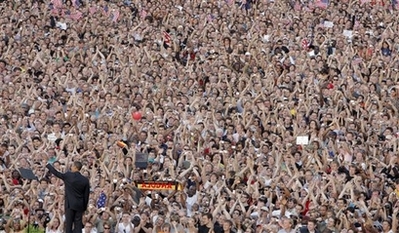
Over 200,000 jubilant Barack Obama supporters shut down the centre of Berlin on Thursday evening to listen to the US presidential candidate give an impassioned speech on the global challenges of the 21st century.

People from all walks of life streamed to the German capital’s Victory Column memorial at the heart of the city’s Tiergarten park hoping to glimpse of the popular US senator from Illinois.

“Thank you to the citizens of Berlin and to the people of Germany,” Obama told the crowd to wild applause. “Tonight, I speak to you not as a candidate for president, but as a citizen – a proud citizen of the United States, and a fellow citizen of the world.”

As the sun set on the German capital, the predominately younger audience of Berliners listened intently to Obama speak of the common problems facing Europe and America.

“As we speak, cars in Boston and factories in Beijing are melting the ice caps in the Arctic, shrinking coastlines in the Atlantic, and bringing drought to farms from Kansas to Kenya,” Obama said.

“Poorly secured nuclear material in the former Soviet Union, or secrets from a scientist in Pakistan could help build a bomb that detonates in Paris. The poppies in Afghanistan become the heroin in Berlin. The poverty and violence in Somalia breeds the terror of tomorrow. The genocide in Darfur shames the conscience of us all.”

German television broadcast the speech live, as some 1,000 police officers, US Secret Service and private security guards were mobilized for the visit.

Prior to his address, Berliners gave the event a festival atmosphere, grilling sausages and selling beer near the site of the speech, which has frequently been used for large public gatherings.

The massive show of support underscored how deeply dissatisfied many Germans are with the leadership of US President George W. Bush, who remains unpopular in Europe for his decision to invade Iraq and his apparent reluctance to tackle issues like global warming.

Uwe Bley came all the way from the northern port city of Hamburg with his wife to see Obama on Thursday. “He can’t change much from here,” the 60-year-old told The Local, expressing his desire for the presidential candidate to take America in a new direction. “But he’s the new hope now.”

Obama told the massive crowd near the former course of the old Berlin Wall that humanity faced a perilous turning point, and it was time to build “a world that stands as one.”

“The greatest danger of all is to allow new walls to divide us from one another,” said Obama, who has scorched through US politics at lightning speed to challenge Republican John McCain for the White House in November’s election.

The audacious speech took the White House race out of US borders in a way never seen before, and was designed to portray Obama as a leader with unique global appeal.

“The walls between old allies on either side of the Atlantic cannot stand,” he said, referring to festering divisions between Europe and the United States opened up by the US-led invasion of Iraq in 2003.

“The walls between the countries with the most and those with the least cannot stand. The walls between races and tribes; natives and immigrants; Christian and Muslim and Jew cannot stand. These now are the walls we must tear down,” Obama said, drawing loud cheers and applause.

Obama’s speech was a clear echo of former US president Ronald Reagan’s call to then Soviet leader Mikhael Gorbachev in Berlin in 1987 to “tear down this wall,” before the fall of communism.

“It was a good speech, nicely geared to an international audience,” American Berlin resident Michael Goodhart, 38, told The Local after the event. “It’s impressive that he can draw such a crowd here,” he said. “Obama represents such a stark change – in his age, look and policies.”

tl/afp

The Local (news@thelocal.de)

A City’s Police Force Now Doubts Terror Focus

9/11, Department of Homeland Security, FBI, Homeland Security, Politics of Fear, Providence
July 24, 2008

PROVIDENCE, R.I. — Nearly seven years after the attacks of Sept. 11, 2001, the war on terror in this city has evolved into a quiet struggle against a phantom foe.

Last year, when a sailor slipped over the side of a Turkish merchant ship in the city’s port, a Providence police detective assigned to a joint terrorism task force was quickly alerted, reflecting a new vigilance since the Sept. 11 attacks. Alerts also went out to immigration, customs, the F.B.I. and other federal agencies, but the case went cold.

Another alarm was sounded over a suspicious man of Indian descent who asked a metals dealer about buying old power tools and hair dryers. The lead petered out when the prospective buyer told a police detective in an interview that he wanted to refurbish the equipment for resale overseas.

Like most of the country’s more than 18,000 local law enforcement agencies, the Providence Police Department went to war against terror after Sept. 11, embracing a fundamental shift in its national security role. Police officers everywhere had been shaken by disclosures that the police in Oklahoma, Florida, Maryland and Virginia had stopped four of the Sept. 11 hijackers at various times for traffic violations, but had detected nothing amiss.

Over the years since, police officials in Providence joined with state and federal authorities in new information-sharing projects, met with local Muslim leaders and urged their officers to be alert for anything suspicious. Flush with federal domestic-security grants, the police department acquired millions of dollars’ worth of hardware and enrolled officers in training courses to detect and respond to a terrorist attack.

But much has changed. Now, police officials here express doubts about whether the imperative to protect domestic security has blinded federal authorities to other priorities. The department is battling homicides, robberies and gang shootings that the police in a number of cities say are as serious a threat as terrorism.

The Providence police chief, Col. Dean M. Esserman, said the federal government seemed unable to balance antiterror efforts and crime fighting.

“Our nation, that I love, is like a great giant that can deal with a problem when it focuses on it,” said Colonel Esserman, who became chief in 2003 when he was hired by Mayor David N. Cicilline. “But it seems like that giant of a nation is like a Cyclops, with but one eye, that can focus only on one problem at a time.”

“The support we had from the federal government for crime fighting seems like it is being diverted to homeland defense,” he added. “It may be time to reassess, not how to dampen one for the other, but how not to lose support for one as we address the other.”

In Washington, Attorney General Michael B. Mukasey has defended cuts in criminal justice programs. At a Senate Appropriations Committee hearing in April, Mr. Mukasey responded to a chorus of complaints from Democrats. “We’re not pretending that less money is more money,” he said. “But we’re trying to use it as intelligently as we can.”

In a recent interview, Michael Chertoff, the homeland security secretary, cautioned against using domestic security programs to help pay for day-to-day policing needs. “I don’t think we want to take a program designed for one purpose and slowly massage it into another purpose,” Mr. Chertoff said. “If you are pursuing street crime, I don’t think all the organs of national security should be involved in that.”

Some officials of the Department of Homeland Security worry about complacency given the passage of time since Sept. 11 without an attack or concrete evidence of a domestic threat. These officials say they are convinced that Al Qaeda remains determined to strike inside the United States and will find vulnerabilities if vigilance is relaxed.

In Providence, the police have girded for an attack. Flush with money from the Department of Homeland Security, the police bought a 27-foot patrol boat to monitor the city’s port, along with an automated underwater inspection and detection system and a portable small-craft intrusion barrier.

At police headquarters, the department upgraded a video surveillance system, erected 159 concrete posts and 220 feet of guardrails around the building’s perimeter. Supposed targets for attacks, like rail and air terminals, have been inventoried and assessed, and in some cases, hardened against assaults.

The department acquired a small fleet of S.U.V.’s for emergency response, a bomb containment vehicle, a bomb response canine vehicle, mobile data terminals, scuba gear, trauma kits, underwater camera and video gear and special protective suits for all officers. With a $5.6 million grant, it is developing a radio system so police, fire and other emergency responders throughout the region can communicate with one another.

Police officers have enrolled in training that would have been unlikely before Sept. 11. Officers attended a terrorist bombing school in New Mexico, learned how to interpret deceptive responses in interviews, studied unconventional weapons and clandestine explosives laboratories and attended classes in terrorism prevention and suicide bombings.

Today, the boat still patrols the harbor, especially when liquefied natural gas tankers arrive from overseas. The stanchions around police headquarters are in place. The S.U.V.’s, loaded with emergency response gear, have been distributed to field units who use them as part of regular patrols. Most officers have learned to put on and take off their emergency gear, but none of the equipment or training has been needed to respond to a terrorist threat.

From 2002 to this year, the department went from zero to more than $11.6 million in total domestic security grants, according to Police Department figures, while other criminal justice grants, like those from Justice Department programs used to pay overtime and hire more officers, dwindled to less than $4.5 million for the same period.

One Justice Department program, the Byrne Justice Action Grant, which helps the police fight violent crime by paying for overtime and other policing costs, has suffered heavy cutbacks. Providence’s Byrne grant was reduced to $118,000 this year, from $388,000 in 2007.

The Bush administration has proposed eliminating money for the program in its 2009 budget.

Larry Reall, a 21-veteran of the Providence Police Department, is the liaison to the local Joint Terrorism Task Force. He has top-secret security clearance and access to classified computer databases at the local F.B.I. office down the street from City Hall.

In Detective Reall’s six years on the job, none of the hundreds of leads he has chased have turned up a terrorist. But he keeps looking, convinced that his work has made the city safer and may have deterred a potential extremist before a threat materialized. “It’s not whether we are going to be attacked; that’s probably not going to happen,” Detective Reall said. “But I don’t think that you can let your guard down. Just because nothing has happened doesn’t mean that something won’t.”

Police experts said Providence’s experience was similar to that of other cities around the country. Looking back, local law enforcement agencies took on new counterterrorism responsibilities when violent crime rates had plunged to statistical lows.

By 2005 and 2006, while overall crime rates were stable, middle-size and larger cities began to be hit with increases in homicides, robberies and aggravated assaults, said Chuck Wexler, executive director of the Police Executive Research Forum, which studies policing issues.

The International Association of Chiefs of Police recently issued a scathing analysis of federal spending, saying, “Unfortunately, funding federal homeland security efforts at the expense of state, tribal and local law enforcement agencies weakens rather than enhances our nation’s security.”

The frustration is expressed by other Providence police officials. The deputy chief, Cmdr. Paul J. Kennedy, said the department no longer had the flexibility to use federal money to pay for overtime. “I just wish we had some discretion about how we can use this federal money,” Commander Kennedy said. “We know what our problems are. If you say to us the money can only be used for homeland security or equipment, it really limits how effective we can be in fighting crime.”

A weekly meeting of the department’s command staff, in which nearly three dozen city, state and federal officials, including representatives of social welfare and animal control agencies, assemble in a windowless third-floor conference room to discuss crime, focuses heavily on gangs like the West Side Clowns, the Chad Browns and others, mostly associated with crime in the city’s housing projects.

Providence has big-city crime problems, but is small enough so that when the police talk of shootings, assaults and robberies, they sometimes know the victims, the suspects and their families on a first-name basis. Representatives of the F.B.I. and other federal agencies are on hand, but there is little talk about terrorism.

“This is what we do,” Colonel Esserman said of how crime and violence absorbed his department. “We talk about crime. We talk about it all the time. And we try to respond to it as effectively as we know how.”

Lawn Wars

Grass, Lawnmower, Lawns

Books

Turf War

Americans can’t live without their lawns—but how long can they live with them?

by Elizabeth Kolbert July 21, 2008

Lawns in the U.S. cover an area roughly the size of New York State; each year, forty billion dollars is spent on their upkeep.

In 1841, Andrew Jackson Downing published the first landscape-gardening book aimed at an American audience. At the time, Downing was twenty-five years old and living in Newburgh, New York. He owned a nursery, which he had inherited from his father, and for several years had been publishing loftily titled articles, such as “Remarks on the Duration of the Improved Varieties of New York Fruit Trees,” in horticultural magazines. Downing was dismayed by what he saw as the general slovenliness of rural America, where pigs and poultry were allowed to roam free, “bare and bald” houses were thrown up, and trees were planted haphazardly, if at all. (The first practice, he complained, contributed to the generally “brutal aspect of the streets.”) His “Treatise on the Theory and Practice of Landscape Gardening” urged readers to improve themselves by improving their front yards. “In the landscape garden we appeal to that sense of the Beautiful and the Perfect, which is one of the highest attributes of our nature,” it declared.

Downing’s practical ideas about how to achieve the Beautiful included grouping trees in clusters, importing shrubbery of “the finest foreign sorts,” and mixing forms and colors with enough variety to “keep alive the interest of a spectator, and awaken further curiosity.” Essential to any Perfect garden, he held, was an expanse of “grass mown into a softness like velvet.” As an example of what he had in mind, Downing pointed to the Livingston estate, near Hudson, New York. (Privately, in a letter to a friend, he noted that maintaining the grounds of the Livingston estate required the labors of ten men.) “No expenditure in ornamental gardening is, to our mind, productive of so much beauty as that incurred in producing a well kept lawn,” he wrote.

By almost any measure, the “Treatise” was a success. It went through eight editions and sixteen printings, and it made Downing famous. One critic called him the “Sir Joshua Reynolds of our rural decorations.” The “Treatise,” another proclaimed, had ushered in a “new epoch in the annals both of our literature and our social history.” In 1851, Downing was invited by President Millard Fillmore to design improvements to the grounds around the Capitol. Before the project could be completed, however, Downing died in a steamboat accident on the Hudson; he was just thirty-six.

Downing’s practice was taken over by his protégé, Calvert Vaux, whom he had brought over from London as an assistant. (Vaux named his first son Downing.) Later, Vaux joined up with Frederick Law Olmsted, whose career Downing had also encouraged. The two men embraced many of Downing’s ideas. They designed Central Park, with its broad lawns, and laid out suburbs like Riverside, Illinois, and Sudbrook Park, Maryland, with their many lesser lawns. Olmsted and Vaux’s work, in turn, influenced countless suburban subdivisions. The design for Levittown little resembled the Livingston estate, except for the grassy plot surrounding every Cape Cod. “No single feature of a suburban residential community contributes as much to the charm and beauty of the individual home and the locality as well-kept lawns,” Abraham Levitt once observed.

Having migrated into many parts of the United States that did not yet belong to the United States when the “Treatise” was published, the lawn today is nearly ubiquitous. Its spread has given rise to an entire industry, or, really, complex of industries—Americans spend an estimated forty billion dollars each year on grass—and to the academic discipline of turf management, degrees in which can now be obtained from, among other schools, the University of Massachusetts and Ohio State. The lawn has become so much a part of the suburban landscape that it is difficult to see it as something that had to be invented.

This triumph has also brought into being a new tradition in landscape writing. The anti-lawn treatise attacks both the idea of the velvety expanse—David Quammen has observed, only half jokingly, that though Communism has fallen, “lawnism” continues—and the real labor that goes into pursuing it. The writer in this tradition toils in the hope (probably vain) of reversing more than a hundred and fifty years of gardening history. He envisions an American landscape that looks more like it did in Downing’s day—one covered in moss, or scrub, or, alternatively, just weeds.

Among the dozen or so main grasses that make up the American lawn, almost none are native to America. Kentucky bluegrass comes from Europe and northern Asia, Bermuda grass from Africa, and Zoysia grass from East Asia. These and other so-called turfgrasses are botanically ambidextrous; they can reproduce sexually, by putting out seeds, and asexually, by spreading laterally. (Biologists believe that they acquired this second ability some twenty million years ago, during the Miocene, when large herbivores, including the ancestors of the modern horse, switched from eating leaves to munching grass.)

Mowing turfgrass quite literally cuts off the option of sexual reproduction. From the gardener’s perspective, the result is a denser, thicker mat of green. From the grasses’ point of view, the result is a perpetual state of vegetable adolescence. With every successive trim, the plants are forcibly rejuvenated. In his anti-lawn essay “Why Mow?,” Michael Pollan puts it this way: “Lawns are nature purged of sex and death. No wonder Americans like them so much.”

In the early days of lawns—British aristocrats started planting them sometime around the start of the eighteenth century—there were two ways to mow. A landowner could use grazing animals, like sheep, which meant also employing sheepkeepers, or he could send out bands of scythe-wielding servants. Then, in 1830, Edwin Beard Budding, an engineer from Gloucestershire, came up with a third alternative—“a machine for mowing lawns, etc.” (Supposedly, Budding was inspired by the rotating blades then used to trim the nap on carpets.) Budding’s invention made the task of cutting grass faster and cheaper and, at least for the maker of the new mowers, profitable. Further mechanical improvements followed. In 1870, an American inventor named Elwood McGuire designed a lightweight mower with an innovative wheel design. By 1885, U.S. manufacturers were pumping out machines at the rate of fifty thousand a year. In 1893, the first steam-powered mower was patented, and a few decades later the gasoline-powered mower hit the market. An advertisement for an Ideal Junior Power Mower, from 1922, celebrated the exceptional efficiency of the new technology. It asserted that many property owners, “who previously had to hire two or three men to keep their grass cut, now do the work with one of these.”

A lawn may be pleasing to look at, or provide the children with a place to play, or offer the dog room to relieve himself, but it has no productive value. The only work it does is cultural. In Downing’s day, the servant-mowed lawn stood, eloquently, for the power structure that made it possible: who but the very rich could afford such a pointless luxury? As mechanical mowers enabled middle-class suburbanites to cut their own grass, this meaning was lost and a different one took hold. A lawn came to signal its owner’s commitment to a communitarian project: the upkeep of the greensward that linked one yard to the next.

“A fine carpet of green grass stamps the inhabitants as good neighbors, as desirable citizens,” Abraham Levitt wrote. (By covenant, the original Levittowners agreed to mow their lawns once a week between April 15th and November 15th.) “The appearance of a lawn bespeaks the personal values of the resident,” a group called the Lawn Institute declared. “Some feel that a person who keeps the lawn perfectly clipped is a person who can be trusted.”

Over time, the fact that anyone could keep up a lawn was successfully, though not altogether logically, translated into the notion that everyone ought to. Many communities around the country adopted “weed laws” mandating that all yards be maintained to a certain uniform standard. Such laws are, for the most part, still on the books. Homeowners who, for one reason or another, don’t toe the line have found themselves receiving citations and fines and, in some (admittedly unusual) cases, wrangling with the police. Just last summer, a seventy-year-old widow from Orem, Utah, was led in handcuffs to a holding cell, after letting her grass go brown. She became a celebrity in the blogosphere, where she was known as the Lawn Lady.

Pretty much by definition, a lawn is unnatural. Still, there are degrees of unnaturalness. Even as the American lawn was being democratized, it was also becoming more artificial.

Turfgrasses have a seasonal cycle: they grow quickly when conditions are favorable—for cool-weather species like Kentucky bluegrass, this is in spring, while for warm-weather species like Bermuda grass it’s in summer—and then they slow down. During the slow phase, the grass becomes dull-colored or, if the weather is dry, yellow or brown. In 1909, a German chemist named Fritz Haber figured out how to synthesize ammonia. One use for what became known as the Haber-Bosch process was to manufacture explosives—the process was perfected just in time for the First World War—and a second was to produce synthetic fertilizer. It was observed that repeated applications of synthetic fertilizer could counteract turfgrasses’ seasonal cycle by, in effect, tricking the plants into putting out new growth. Sensing a potential bonanza, lawn-care companies began marketing the idea of an ever-green green. The Scotts Company recommended that customers apply its fertilizer, Turf Builder, no fewer than five times a year.

With the advent of herbicides, in the nineteen-forties, still tighter control became possible. As long as a hand trowel was the only option, weeding a lawn had been considered more or less hopeless, and most guides advised against even trying. (A lawn “thickly starred with the glowing yellow blossoms” of dandelions “isn’t in itself a bad picture,” the journal Country Life in America observed consolingly.) The new herbicides allowed gardeners to kill off plants that they didn’t care for with a single spraying.

One of the most popular herbicides was—and continues to be—2,4-dichlorophenoxyacetic acid, or 2,4-D, as it is commonly known, a major ingredient in Agent Orange. Regrettably, 2,4-D killed not only dandelions but also plants that were beneficial to lawns, like nitrogen-fixing clover. To cover up this loss, any plant that the chemical eradicated was redefined as an enemy. “Once considered the ultimate in fine turf, a clover lawn is looked upon today by most authorities as not much better than a weed patch” is how one guidebook explained the change.

The greener, purer lawns that the chemical treatments made possible were, as monocultures, more vulnerable to pests, and when grubs attacked the resulting brown spot showed up like lipstick on a collar. The answer to this chemically induced problem was to apply more chemicals. As Paul Robbins reports in “Lawn People” (2007), the first pesticide popularly spread on lawns was lead arsenate, which tended to leave behind both lead and arsenic contamination. Next in line were DDT and chlordane. Once they were shown to be toxic, pesticides like diazinon and chlorpyrifos—both of which affect the nervous system—took their place. Diazinon and chlorpyrifos, too, were eventually revealed to be hazardous. (Diazinon came under scrutiny after birds started dropping dead around a recently sprayed golf course.) The insecticide carbaryl, which is marketed under the trade name Sevin, is still broadly applied to lawns. A likely human carcinogen, it has been shown to cause developmental damage in lab animals, and is toxic to—among many other organisms—tadpoles, salamanders, and honeybees. In “American Green” (2006), Ted Steinberg, a professor of history at Case Western Reserve University, compares the lawn to “a nationwide chemical experiment with homeowners as the guinea pigs.”

Meanwhile, the risks of the chemical lawn are not confined to the people who own the lawns, or to the creatures that try to live in them. Rain and irrigation carry synthetic fertilizers into streams and lakes, where the excess nutrients contribute to algae blooms that, in turn, produce aquatic “dead zones.” Manhattanites may not keep lawns, but they drink the chemicals that run off them. A 2002 report found traces of thirty-seven pesticides in streams feeding into the Croton River Watershed. A few years ago, Toronto banned the use of virtually all lawn pesticides and herbicides, including 2,4-D and carbaryl, on the ground that they pose a health risk, especially to children.

Although it was not intended as such, Rachel Carson’s “Silent Spring,” published in 1962, is often cited as the first work in the anti-lawn tradition. In her study of America’s indiscriminate use of pesticides, Carson was repeatedly led back to the front yard.

“One may get a jar-type attachment for the garden hose, for example, by which such extremely dangerous chemicals as chlordane or dieldrin are applied as one waters the lawn,” she observed. “Power mowers also have been fitted with devices for the dissemination of pesticides, attachments that will dispense a cloud of vapor as the homeowner goes about the task of mowing.” Rarely, she argued, was the homeowner aware of the dangers of what he was doing, because it was not in the interests of the manufacturer to inform him of these. “Instead, the typical illustration portrays a happy family scene, father and son smilingly preparing to apply the chemical to the lawn, small children tumbling over the grass with a dog.”

Right around the time that Carson was writing “Silent Spring,” Lorrie Otto, a mother of two from the Milwaukee suburb of Bayside, decided to restore her front lawn to prairie. One day, while she was folding laundry in her basement, some village workers arrived and, without consulting her, mowed her yard. Otto began speaking out against lawns, calling them, among other things, “sterile,” “monotonous,” and “flagrantly wasteful.” Her talks inspired the founding, in 1979, of what might be described as the nation’s first grassroots anti-grass movement, which dubbed itself Wild Ones. (Wild Ones now has chapters in twelve states, including New York and Connecticut.)

Between them, Carson and Otto introduced all the main anti-lawn arguments: toxicity, habitat destruction, resource depletion, enforced conformity. They accepted the moral interpretation of the lawn, only to perform yet another inversion. Instead of demonstrating that a homeowner cared about his neighbors, a trim and tidy stretch of turf showed that he didn’t.

“If they’re so large that you cannot use just a little hand-push lawn mower, then I truly think they are evil,” Otto once said of lawns. “Really evil.”

But what is the conscientious suburbanite supposed to do? If one accepts the idea that lawns are, in a deep sense, unethical, how does one fill the front yard?

Over the years, many alternatives to the lawn have been proposed. Pollan, in his book “Second Nature” (1991), suggests replacing parts—or all—of the lawn with garden. In “Noah’s Garden” (1993), Sara Stein, by contrast, advocates “ungardening”—essentially allowing the grass to revert to thicket. Sally and Andy Wasowski, in their “Requiem for a Lawnmower” (2004), recommend filling the yard with native trees and wildflowers. For those who don’t want to give up the look or the playing space provided by a lawn, the Wasowskis suggest using Buffalo grass, one of the very few turf species native to North America. Smaller American Lawns Today, or SALT, is a concept developed by William Niering, who for many years was a professor of botany at Connecticut College. Niering planted trees around his property, then left most of the rest of his yard unmowed, to become a meadow. “The meadow can take as much of your remaining lawn as you want,” he observes in an essay posted on SALT’s Web site. “There are some people who prefer no lawn, which is ideal!” For the past few decades, David Benner, a horticulturist from Bucks County, Pennsylvania, has been touting moss as an alternative to grass: he himself has a one-acre “moss garden.” Recently, there have been several calls to make the lawnspace productive. In “Food Not Lawns” (2006), Heather C. Flores argues that the average yard could yield several hundred pounds of fruits and vegetables per year. (If you live in an urban area and don’t have a lawn, she suggests digging up your driveway.) “Edible Estates” (2008) is the chronicle of a project by Fritz Haeg, an architect and artist, who rips up conventional front yards in order to replace them with visually striking “edible plantings.” Haeg calls his approach “full-frontal gardening.”

Of course, to advocate a single replacement for the lawn is to risk reproducing the problem. The essential trouble with the American lawn is its estrangement from place: it is not a response to the landscape so much as an idea imposed upon it—all green, all the time, everywhere. Recently, a NASA-funded study, which used satellite data collected by the Department of Defense, determined that, including golf courses, lawns in the United States cover nearly fifty thousand square miles—an area roughly the size of New York State. The same study concluded that most of this New York State-size lawn was growing in places where turfgrass should never have been planted. In order to keep all the lawns in the country well irrigated, the author of the study calculated, it would take an astonishing two hundred gallons of water per person, per day. According to a separate estimate, by the Environmental Protection Agency, nearly a third of all residential water use in the United States currently goes toward landscaping.

The Northeast is one of the relatively few regions in the country that are actually well suited to lawns. There, the simplest alternative to the modern, industrialized lawn may be a lawn that functions more or less as it did in the eighteen-forties, before herbicides or even sprinklers had been invented. In “Redesigning the American Lawn” (1993), F. Herbert Bormann, Diana Balmori, and Gordon T. Geballe dub such a lawn the Freedom Lawn. The Freedom Lawn consists of grass mixed with whatever else happens to seed itself, which, the authors note, might include:


dandelion, violets, bluets, spurrey, chickweed, chrysanthemum, brown-eyed Susan, partridge berry, Canada mayflower, various clovers, plantains, evening primrose, rushes, and wood rush, as well as grasses not usually associated with the well-manicured lawn, such as broomsedge, sweet vernal grass, timothy, quack grass, oat grass, crabgrass, and foxtail grass.

The Freedom Lawn is still mowed—preferably with a push-mower—but it is watered infrequently, if at all, and receives no chemical “inputs.” If a brown spot develops, it is likely soon to be filled by what some might call weeds, but which Bormann, Balmori, and Geballe would rather refer to as “low growing broad-leaved plants.”

The anti-lawn movement has been around now for several decades. In that time, thousands of American families have dug up their lawns and put in wildflowers or meadows or vegetable gardens. In that same period, however, millions more have put in new lawns. A recent study by researchers at Ohio State University estimates that, owing to new development, the space devoted to turfgrass in the United States is growing at the rate of almost six hundred square miles a year.

The easy explanation for the failure of the anti-lawn movement is that change is hard. People have been trained to expect lawns, and this expectation is self-reinforcing: weed laws are all but explicitly about maintaining property values. When Haeg installed an “edible estate” in the front yard of a Salina, Kansas, resident named Stan Cox, passersby kept asking Cox whether his neighbors had complained about it yet. Everyone “claims to like the new front yard, yet everyone expects others not to like it,” Cox writes. For a developer, meanwhile, putting in turfgrass is by far the easiest way to landscape; what is sometimes called “contractor’s mix” grass seed is specifically formulated to provide a fast-growing—though not necessarily long-lasting—green. (Lowe’s, which sells fifteen pounds of contractor’s-mix seed for $23.52, advertises it as an “economy mixture that provides quick grass cover.”) The lawn may be wasteful and destructive, it may even be dangerous, but it is, in its way, convenient.

This is perhaps the final stage of the American lawn. What began as a symbol of privilege and evolved into an expression of shared values has now come to represent expedience. We no longer choose to keep lawns; we just keep on keeping them. In the meantime, the familiar image of Dad cutting the grass and then, beer in hand, sitting back to admire his work, is, in many communities, a fiction: increasingly, lawn care has become another one of those jobs, like cooking dinner or playing with the kids, that’s outsourced to someone else. When my husband and I lived in Westchester County, he used to mow our minuscule Freedom Lawn—“freedom” here being understood as just another word for nothing left to lose—himself. That he did so was not a source of pride around our house but vague embarrassment.

If Downing came back today, what would he think of our lawns? Presumably, the neatness of our pigless yards would impress him. But it is hard not to feel that he would, at least, be ambivalent. Downing was passionate about landscape gardening, and even more so about its edifying possibilities. He urged his readers to improve their yards not just for the sake of their own uplift and enjoyment but in the interest of the greater good; through the “principle of imitation,” they would become models for their neighbors, and in this way a single example of refinement could transform a “graceless village.” We now have lawns smoother and more velvety than Downing could have imagined. And yet our relationship to the Beautiful remains vexed. As the anti-lawnists correctly observe, the American lawn now represents a serious civic problem. That the space devoted to it continues to grow—and that more and more water and chemicals and fertilizer are devoted to its upkeep—doesn’t prove that we care so much as that we are careless.

ILLUSTRATION: ROBERT RISKO

"The Dark Knight" Assails Box Office, Mother and Sister

Batman, Christian Bale, The Dark Knight

ABC NEWS

‘Batman’ Allegedly Turns on Mother, Sister

Actor Christian Bale Reportedly Arrested for Allegedly Assaulting His Family

By AMMU KANNAMPILLY

LONDON, July 22, 2008 —

Batman star Christian Bale was arrested today for allegedly assaulting his mother and sister, according to reports in the British media.

Scotland Yard declined to confirm the reports, but a spokesman told ABCNews.com that “a 34-year-old man was arrested in connection with allegations of assault. He currently remains in custody at a central London police station.”

The Press Association reported that the actor, 34, was questioned by police at a central London police station. He is now believed to have left the station.

Bale was allegedly arrested after attacking his mother and sister in his suite at London’s Dorchester Hotel Sunday, according to the British wire service.

The Dorchester Hotel’s public relations representative, Brett Perkins, also refused to confirm the reports, telling ABCNews.com that “we have a hotel policy of never commenting on guests, so we cannot confirm these reports.”

The actor’s U.S. representatives declined to comment on the matter.

Bale was reportedly arrested hours after attending the London premiere of his film, “The Dark Knight,” with co-stars Maggie Gyllenhaal, Aaron Eckhart and Michael Caine.

The UK’s Sun newspaper reported that detectives allowed the actor to attend the premiere, despite the complaint lodged against him.

“It was a very difficult situation but it would have been wrong to have wrecked the premiere over a complaint, which we don’t yet know is founded in truth,” a source told the Sun.

Bale’s mother Jenny, 60, and sister Sharon, 41, live in Dorset, England, and are reported to have made the complaint to a police station in Hampshire. A spokesman from Hampshire police told ABCNews.com that “we cannot confirm anything.”

A senior executive at Warner Brothers, which produced “The Dark Knight,” told ABC News that this was a personal matter and the studio would have no comment on it.

Bale’s reported arrest is only the most recent in a long string of controversies surrounding the latest Batman installment.

In January, Bale’s co-star, 28-year-old actor Heath Ledger, was found dead after an accidental drug overdose.

Last September, a special-effects technician was killed during a stunt car accident on the film’s set.

None of this has dented the film’s box-office fate: “The Dark Knight” had a record-setting opening weekend in the United States.

Bale was born in Wales, England, and spent his childhood in a variety of countries, including the United States and Portugal. His father, the late David Bale, was reportedly married to the American feminist Gloria Steinem.

Bale made his big-screen debut in Steven Spielberg’s “Empire of the Sun” at age 13. Since then, he has acted in several movies, including “American Psycho,” “The Machinist” and “Batman Begins.”

Sheila Marikar contributed to this report.

Maryland State Police Spied on Peace, Anti-Death Penalty Groups

Stories

DEMOCRACY NOW

July 21, 2008

Police Spied on Peace, Anti-Death Penalty Groups

The American Civil Liberties Union released
documents Thursday showing that undercover officers from the Maryland
State Police spied on peace groups and anti-death penalty protesters
for over a year in 2005 and 2006. The police summaries and intelligence
logs reveal that covert agents infiltrated groups like the antiwar
Baltimore Pledge of Resistance, the Baltimore Coalition Against the
Death Penalty, and the Committee to Save Vernon Evans, a death row
prisoner. We speak with antiwar activist Max Obuszewski and with
journalist Dave Zirin. Both were the target of surveillance. [includes
rush transcript]

Guests:

Max Obuszewski, longtime Baltimore
peace activist, monitored by the Maryland State Police. He is with the
peace group Baltimore Pledge of Resistance.

Dave Zirin, sportswriter and author of Welcome to the Terrordome: The Pain, Politics and Promise of Sports.
He writes a weekly column called “Edge of Sports.” His
latest article is called “COINTELPRO Comes to My Town.”

Rush Transcript

This transcript is
available free of charge. However, donations help us provide closed
captioning for the deaf and hard of hearing on our TV broadcast. Thank
you for your generous contribution.
Donate
$25,
$50, $100,
More…


Related Links

AMY GOODMAN: We turn now to Maryland, a new document
revealing police surveillance of local activists opposed to war and the
death penalty. The American Civil Liberties Union released documents
Thursday showing undercover officers from the Maryland State Police
spied on peace groups and anti-death-penalty protesters for over a year
from 2005 to 2006, when Robert Ehrlich, Jr. was governor. On Friday,
current governor, Martin O’Malley, vowed not to allow police
surveillance of peace groups.

The police summaries and
intelligence logs obtained by the ACLU under the Maryland Public
Information Act reveal that covert agents infiltrated groups like the
antiwar Baltimore Pledge of Resistance, the Baltimore Coalition Against
the Death Penalty and the Committee to Save Vernon Evans, a death row
prisoner. According to the documents, police monitored and entered the
names of activists in a law enforcement database of people suspected of
being terrorists or drug traffickers. Maryland ACLU staff attorney
David Rocah released the documents at a news conference on Thursday.

    DAVID ROCAH: What
    you see in the documents today is a particular individual, Max
    Obuszewski, sitting to my left, who is listed in the Maryland
    high-intensity drug-trafficking area database with—under the
    suspected crimes of terrorism. Mr. Obuszewski is a person who has
    devoted his entire life to nonviolent, peaceful protest activities on
    behalf of peace. If there is anyone in the world who is further from a
    terrorist, it’s hard for me to imagine them. And that the
    Maryland State Police can think that being antiwar is a subset of
    terrorism is a terrifying prospect.

AMY GOODMAN: Longtime
peace activist Max Obuszewski from the Baltimore Pledge of Resistance
joins me now from Washington, D.C. We’re also joined by another
target of the surveillance of the Maryland State Police, Dave Zirin,
the sportswriter and author of, among other books, Welcome to the Terrordome: The Pain, Politics and Promise of Sports.
He writes a weekly column called “Edge of Sports.” His
latest article for CounterPunch is called “COINTELPRO Comes to My
Town.” We welcome you both to Democracy Now!

Max Obuszewski, let’s begin with you. Tell us how you learned about what was taking place.

MAX OBUSZEWSKI: You
just played a clip of David Rocah from the Maryland ACLU speaking. He
called me. I was in court on Wednesday, last Wednesday. I’m a
member of the Ghosts of the Iraq War. We were arrested March 12,
protesting in the Senate gallery. I have a trial September 29. So I was
in court for a status hearing. When I got home, probably about 4:00
p.m., David called me to say they got this information from the
Attorney General’s office. This is the Maryland Attorney
General’s office. And he said, “I hope you’re sitting
down, because I want to tell you that you’ve been listed as a
terrorist.”

I mean, I know, as a longtime peace activist, that I’m
being surveilled. And these documents that were released is just a tip
of the iceberg. But to be labeled, put into a database and accused of
terrorism—and it’s a drug trafficking database, that was
beyond comprehension. It just indicates, in my opinion, the fallacy of
the searches that are going on by our government in putting people into
these databases. A lot of the questions at the press conference that
day was about, have you traveled internationally, do you have any
trouble getting on airplanes, and so on and so forth.

AMY GOODMAN: Can you talk about your work, Max? What do you do?

MAX OBUSZEWSKI: Well,
I’m a full-time peace activist. And I mentioned earlier that I
think this is the tip of the iceberg. 1996, July 4th, a group of us, a
fairly large group, went out to the National Security Agency to protest
the operations of the Puzzle Palace. Phil Berrigan, Jeremy Scahill and
I sat in front of a gate to protest the place. That was the first
protest at the National Security Agency since 1973, when the Jonah
House, Phil Berrigan, Elizabeth McAlister and others poured gallons of
blood at the entrance. This is noted in James Bamford’s book Puzzle Palace.
So we decided to start that up again. So this was July 4th of 1996. So
we go out there every Independence Day or a date close to Independence
Day since that time. And that’s obviously going to put you on the
radar screen. Or acting with Phil Berrigan, I’ve been arrested
with Phil Berrigan. I’ve joined him on many of the Plowshares
actions that took place that he was involved in. And all of
that’s going to cause my name to be registered someplace.

Five
of us were arrested October 4th of ’03 at the National Security
Agency. For whatever reason, three of us had our charges dropped, even
though all five of us did the same thing, tried to request a meeting
with the NSA director. Two of the people went to court the following
August, ’04, and in discovery we finally got what we knew was
going on, that the National Security Agency and other members of the
Joint Terrorism Task Force were surveilling us. And I filed a FOIA
request to try to get the information. They indicated, yes, we have
information on the Pledge of Resistance, the Jonah House and other
protest groups, but we won’t give you the information unless you
pay $1,400. We had guardian angels who were willing to pay the $1,400,
but we didn’t think that was principled. We felt we should get
this information without paying for it. So we then contacted the
American Civil Liberties Union, and they filed lawsuits through Heller
Ehrman, a Washington, D.C. law firm, who’s doing all this work pro bono with everybody, including the Maryland State Police.

The
Maryland State Police informed the ACLU that they had one document.
They will not release it, though, because it would reveal covert
operations. The Maryland ACLU then went to a federal court in June of
this year, and, lo and behold, the Attorney General’s office
released forty-four pages. I firmly believe, though, there’s
many, many more information. The Baltimore City Police, for example,
claim they have no documents on us. Well, if you carefully read the
documents that have been released, Baltimore City intelligence was
always in the loop in the surveillance and so on. And the documents
that were released in the NSA trial indicated to us that Baltimore
intelligence was involved in that operation, watching us as we gathered
at the American Friends Service Committee and then traveled out to Fort
Meade, where the National Security Agency is located.

AMY GOODMAN: Dave
Zirin, you’re a well-known sportswriter, have written a few
books. You’re writing now about the Olympics in China. How did
you get ensnared in this?

DAVE ZIRIN: Amy, they
picked on the wrong sportswriter, and they picked on the wrong group of
activists. For more than a decade, I’ve worked with an
organization called the Campaign to End the Death Penalty. It’s a
group that does remarkable work, nodeathpenalty.org.
I mean, we do such seditious activities as tabling at farmers’
markets, organizing pickets and trying to raise awareness about the
nature of the death penalty. And I had a little group that was meeting
in Takoma Park, Maryland. And if your listeners and viewers don’t
know anything about Takoma Park, Maryland, you’re far more likely
to find tie-dye than terrorists, far more likely to find vegans than
violence in Takoma Park. And yet, still, they infiltrated. Still, they
sent agents. Still, our taxpayer dollars went to pay people to
infiltrate and take notes on our meetings, and it’s absolutely
enraging.

And I can only draw two conclusions from it. I mean, the first
is that a lot of this Homeland Security funding is an absolute sham,
that it’s being used to actually crush dissent, not to keep us
safer in any real way. I mean, we were talking about farmers’
markets, for goodness sake, petitioning, doing tablings. And the second
thing I can conclude from this is that we actually posed a real threat
in Maryland. We won a moratorium against the death penalty. We had
exposed it as the most racist death row in these United States. And
yet, still, they—I think it just made them remarkably nervous,
because we were making some real headway.

AMY GOODMAN: Do you know who was spying on you?

DAVE ZIRIN: Yes,
we do. It was somebody who was known to us as Lucy. She came into our
meeting. She was very enthusiastic. She—I remember her sitting
there taking copious notes. She wasn’t the sort of person who
would raise her hand and ask incendiary questions. It all seemed very
much like this was just another person from this liberal enclave of
Takoma Park who was interested in working with us.

And I’ll tell you, that’s one of the most insidious
things about this. And this is the whole history of
counterintelligence, COINTELPRO, it’s that it breeds this sense
of paranoia. It breeds this sense of, do I really know this person
sitting next to me? Who is this person really about? And I really hope
that as activists our reaction is not to regard the people who are next
to us at demonstrations with suspicion. And it’s like my friend
Mike Stark says, hey, as long as the police agents are carrying water,
then let’s not try to be too much looking at each other and
pointing fingers at each other, because it’s far more important
that we keep our eyes on the prize. And for us, that’s ending the
death penalty in Maryland.

AMY GOODMAN: Max Obuszewski, was Lucy someone who was known to you? And did you feel like—did you feel like you were being followed?

MAX OBUSZEWSKI: Well,
let me also mention this, that Lucy—her first contact that we
have so far that we know of was actually back in February, before
these—the dates of these documents. She attended a meeting that
Bernadine Dohrn spoke at in Baltimore. This was—I believe it was
February 8th of ’05.

AMY GOODMAN: The well-known Irish activist.

MAX OBUSZEWSKI: Exactly. No, no, this is—

AMY GOODMAN: No, no, no, the—yes, the activist from Chicago.

MAX OBUSZEWSKI: Exactly,
Weather Underground. So, I got that information from Red Emma’s,
a bookstore here in Baltimore, that she was at that. But she was Anne
at that time. And I went back and looked at the emails I received from
her. She changed her name later to Shoop. And it’s very
interesting, because in the documents, a lot of this information is
redacted. Once they come to my, quote-unquote, “criminal
history,” most of that is redacted. But there’s at least
one place, maybe two places, in there where she’s identified. Do
we have a friend in the Attorney General’s office that
intentionally did that? I don’t know.

But you have to understand, though, that there was more than
just her coming to meetings watching us. We had an anti-death penalty
protest when Ehrlich was being inaugurated in Annapolis, and this
gentleman showed up and was with us, traveled with us, came back with
us. We never saw him again, never heard from him again. The presumption
is, he was also a State Police officer following us.

The sad thing is, as Dave is talking about, all of these
gatherings, there’s also the Hiroshima-Nagasaki Commemoration
Committee. They actually came to one of our rallies where we had hibakusha
speaking. The sad thing about all of this, constantly in these
documents the agents indicate that we were doing nonviolent work, that
we were doing First Amendment work, but they kept repeating, “We
think that this investigation should continue.” They logged in
288 hours. I’m a pacifist. The idea that the Maryland State
Police, the Homeland Security division, is going to be coming to
meetings that I attend is beyond comprehension. Generally, in larger
meetings, I always ask: if there’s anyone here from the FBI, the
NSA or the CIA, please identify yourself; you’re welcome to
participate in the meeting.

AMY GOODMAN: These are open meetings; you advertise them for people to come.

MAX OBUSZEWSKI: Yes,
exactly. They’re advertised. There’s fliers put up. The
rallies are all announced. We—you know, anyone can come to our
meetings. We’re trusting.

AMY GOODMAN: Mike Stark is quoted in the Washington Post,
another activist, anti-death penalty activist, if the governor,
O’Malley, will now be spied on, because he’s opposed to the
death penalty.

DAVE ZIRIN: Right. And I think this
lays out an important challenge to Governor O’Malley, because
Governor O’Malley has said—in response to this, he has
said, “Well, look, we are not going to be spying on people who
engage in lawful activities.” I would make the case that
that’s not good enough. We need a full investigation of what the
Maryland State Police have done. We need an absolutely ironclad
statement by people in power that they’re not going to spy on
people who are involved in what should be constitutionally protected
acts.

And I’ll tell you something, Robert Ehrlich,
the Governor of Maryland, he put his hand on a Bible and swore to
uphold the Constitution of the United States, and then he proceeded to
use the Constitution as a handy-wipe in surveilling people like Max,
myself and many, many others. And I think it’s got to be clear,
that we’re going to go on offense right now. We’re going to
have press conferences. We’re going to bring a lawsuit through
the ACLU. And when this is all said and done, Bob Ehrlich and the State
of Maryland, they’re going to be paying for my kid’s
braces, because this is outrageous that they’ve gone after us
like this.

AMY GOODMAN: It’s interesting, Dave Zirin, your latest piece is about China and is about the Olympics—

DAVE ZIRIN: Yeah.

AMY GOODMAN: —and about repression, about serious squelching of freedom of speech of all the different countries’ teams.

DAVE ZIRIN: Right.
That’s absolutely right. And that’s happening inside and
outside of China. I mean, recently, there have been flames of protest
in many different provinces in China, from Sichuan, where the
earthquakes were, to Hunan, Shanghai, Xizhou, and the common variable
has been, the Chinese totalitarian government has said, quote,
“We need to go on war footing to make sure that there are no
protests in Beijing during the Olympics.”

At the same time, Western powers have put out the word to their
athletes: you cannot go to China and raise issues like Darfur, like
Tibet, like issues about labor rights, even issues of the environment
and bottled water, which affect athletes directly. I mean, we’re
going to see marathon athletes perhaps running with masks on, because
they’re so scared of the environmental damage that it could do to
their lungs by running in Beijing.

And so, you’ve got this crackdown on dissent in China
that’s being mirrored by Western Olympic officials. And here at
home, those of us who just want to get together in Takoma Park and talk
about fighting the death penalty are seeing similar infiltration. It
boggles the mind.

AMY GOODMAN: The head of the
Olympic Committee has warned this, the head of the British Olympic
Committee, the Canadian Olympic Committee. Has the US Olympic Committee
told athletes not to speak out?

DAVE ZIRIN: They’re
engaging in a very interesting contradictory message. On the one hand,
they have said quite clearly, sports and politics do not mix.
They’ve laid that down. And the coach of USA basketball, for
example, Mike Krzyzewski, has said, one has nothing to do with the
other; it shouldn’t happen. At the same time, other Olympic
officials have said, well, we do sort of believe in freedom of speech,
so maybe people should say something. And I think that speaks to the
push-pull relation relationship that the US has with China, as both
people they depend on for underwriting their wars oversees and as their
global banker, but at the same time, also they’re in competition
with China for global economic supremacy. So you see those
contradictions in how the US is approaching the Olympics.

AMY GOODMAN: We’re going to leave it there. Dave Zirin, well-known sportswriter, his latest book, Welcome to the Terrordome: The Pain, Politics and Promise of Sports.
And Max Obuszewski, longtime peace activist from Baltimore. Both Dave
and Max have been the targets of a Maryland spying campaign by the
state police. They’re asking for more documents and say
they’re suing.

DAVE ZIRIN: Absolutely.


Creative Commons License
The original content of this program is licensed under a Creative Commons Attribution-Noncommercial-No Derivative Works 3.0 United States License. Please attribute legal copies of this work to democracynow.org.
Some of the work(s) that this program incorporates, however, may be
separately licensed. For further information or additional permissions,
contact us.