 ::
::  ::
::  ::
::  ::
::  ::
::  ::
::  ::
::  ::
::  ::
::  ::
:: 
Hillary Clinton on David Letterman | Feb 4 2008 | Part Two
Barack Obama, Blogs, Broadcatching, D.C., Election 2008, Film and Video, Hillary Clinton, Iraq, New York City, Obama, PNAC, TullycastI thought Hillary was pretty good tonight on David Letterman.
Obama is a great politician and an inspirational man but Hillary is going to absolutely wreak havoc in D.C. in the best of ways because she knows where all the bodies are buried and how the system can work a President and she’ll work it right back getting us all back on track as a reasonably decent nation….
Obama is a great politician and an inspirational man but Hillary is going to absolutely wreak havoc in D.C. in the best of ways because she knows where all the bodies are buried and how the system can work a President and she’ll work it right back getting us all back on track as a reasonably decent nation….
:: :: :: :: :: :: :: :: :: ::
Hillary Clinton on David Letterman | Feb 4 2008 | Part One
Barack Obama, Blogs, Broadcatching, D.C., Election 2008, Film and Video, Hillary Clinton, Iraq, John Edwards, New York City, Politics, Tullycast :: :: :: :: :: :: :: :: :: ::
Greg Palast | The Voter Caging Story | NOW
Al Gore, Barack Obama, Broadcatching, Election 2000, Election 2004, Election 2008, Election Fraud, Hillary Clinton, Voter-CagingPart Two
Heady Days, Immortalized Where the Ticker Tape Fell
Stories
September 30, 2004
BLOCKS By DAVID W. DUNLAP
 N the midst of the longest ticker-tape drought in a quarter century, lower Broadway – the Canyon of Heroes – has been paved instead with 164 granite plaques from Bowling Green to the Woolworth Building.
They commemorate ticker-tape parades from October 1886, when the Statue of Liberty was dedicated, to October 2000, when the Yankees last won the World Series. They were commissioned before 9/11 under a plan by the Alliance for Downtown New York to improve the streetscape with new sidewalks, lampposts, signs and wastebaskets.
Only in recent weeks has the parade chronology been finished from beginning to end. Thirty-six intermediate plaques will be installed as permitted by construction projects along the route.
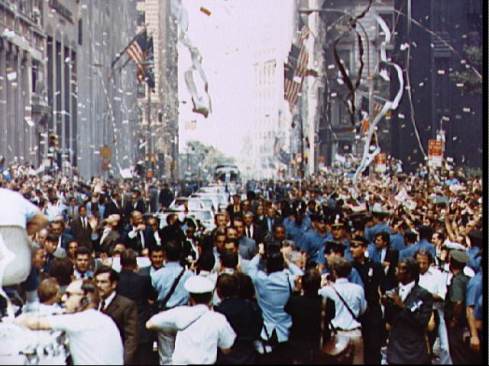
Against the shadow of Sept. 11, 2001, these plaques recall a carefree, exuberant, giddy spirit that may be difficult to conjure again downtown, even if the Yankees do their part.
Carefree? How about the parade in May 1962 when President Félix Houphouët-Boigny of the Ivory Coast was cheered as “Scott Carpenter” by spectators who mistakenly assumed he was a newly returned astronaut.
Exuberant? How about the 1,900 tons of paper showered on Douglas (Wrong Way) Corrigan in August 1938 after his flight from New York to Ireland “instead of his ‘intended’ destination of California,” as the plaque says, with quotation marks that constitute one of the few instances of editorializing.
Giddy? How about May 1950, when there was a parade every day for three days, beginning with one for Prime Minister Liaquat Ali Khan of Pakistan. He was assassinated a year later, one of many foreign leaders who were hailed in the Canyon of Heroes and then jailed, deposed or murdered back home.
“It was almost like a death sentence to get a ticker-tape parade,” said Kenneth R. Cobb, the director of the municipal archives, who has compiled a parade history.
After several spontaneous outbursts, one of the first organized uses of paper tape from stock-market tickers occurred Nov. 18, 1919, in a parade for the Prince of Wales, later the Duke of Windsor.
Grover A. Whalen, the city’s official greeter, recalled in his 1955 autobiography, “Mr. New York,” that he arranged a word-of-mouth campaign among downtown businesses to give the prince a spectacular reception with streams of ticker tape. It wound up including torn-up phone books. (Hmmm. A city official, proud of his Irish descent, contriving to welcome the Prince of Wales by inundating him with waste paper thrown out of windows in tall buildings.)
Watching the paper fall on the Yankees in 1996, Carl Weisbrod, the president of the Downtown Alliance, and Suzanne O’Keefe, the vice president for design, agreed that something should be done to commemorate the parades.
As part of the $20 million streetscape project, under the direction of Cooper, Robertson & Partners, the design studio Pentagram came up with the idea of simple granite sidewalk strips – not unlike the ticker-tape ribbons that remain after a parade, said Michael Bierut, a Pentagram partner – with the date and a few words of description.
(An illustrated brochure and map with information about all 200 parades can be picked up at kiosks outside City Hall and the World Trade Center PATH station or through the alliance, at downtownny.com or 212-835-2789.)
The plaques were made by Dale Travis Associates, the firm responsible for the silver-leaf lettering in the Freedom Tower cornerstone. The granite blocks, 8 inches wide and 3 inches deep, were cut with a water jet, Dale L. Travis said. Then the two-inch stainless-steel letters were inserted, held by pins and thermoplastic grout.
Last week, Jorge Condez and Paul Corrales of A.F.C. Enterprises set some of the last plaques, including “October 28, 1986 * New York Mets, World Series Champions,” into place near Vesey Street.
THREE years and 11 months have passed since the last parade, the longest interval since the 1978 Yankees broke a nine-year dry spell in the Canyon of Heroes.
The next parade will not be easy. The image of a paper blizzard suspended in midair among the downtown skyscrapers, once a visual metaphor for civic celebration, was transformed on Sept. 11, 2001, into a metaphor for cataclysm.
Is it still? Mr. Bierut hopes not. “Part of the resiliency of the city is retaining its own meaning for those metaphors and not surrendering them,” he said. “The post-terror condition has acclimated people to view any disruption of routine as a cause for alarm. There will come a time when the disruption of the routine of city life is seen as something wonderful.”
“Ticker-tape parades were the very essence of that,” Mr. Bierut said.
Just in case, Ms. O’Keefe said, there are 33 blank spots available on Broadway and Park Row to mark future parades. At the current pace, she figured, that ought to last a century and a half.
Bill Maher | February 1 2008
9/11, Bin Laden, Blogs, Broadcatching, Film and Video, Hillary Clinton, Hollywood, Iraq, Los Angeles, McCain, Obama, Oil, Producers, Religion, Tullycast, Video, WritersThis week Bill welcomes columnist Clarence Page, Congressman Darrell Issa, N.O.W. President Kim Gandy and Real Time reporter Matt Taibbi
TULLYCAST
:: :: :: :: :: :: :: :: :: ::
John Edwards Drops Out Of Race For President
Hillary Clinton, John Edwards, Obama, PoliticsCheck out the great second paragraph of this article: The “angry populism”
Edwards bows out of the race, altering Democratic campaign
Former senator John Edwards ended his quest for the presidency yesterday where it began, in a hurricane-ravaged neighborhood in New Orleans, declaring that he had secured commitments from Barack Obama and Hillary Clinton that they would continue his fight against poverty.
Although his angry populism enthralled crowds, and he had at times seemed on the verge of catching fire, Edwards failed to win any of the early state contests and had been written off by most political observers weeks ago. He came in second in Iowa, narrowly beating Clinton, but his distant third-place finish Saturday in South Carolina, where he was born and where he won the 2004 primary, was crushing.
Still, Edwards’s announcement came as a surprise because he had declared this week that he would stay in the race through the Democratic convention. Not only did he seem to have the stomach for a long fight, but he had the potential to play kingmaker if Clinton and Obama remain neck-and-neck in the race for delegates.
“It’s time for me to step aside so that history can – so that history can blaze its path,” he said in front of a Habitat for Humanity worksite in the Ninth Ward, with his wife and children by his side. He added later, however, that the passion of his supporters had almost made him change his mind.
Edwards did not endorse either of his rivals yesterday. In the absence of a signal from him, his supporters are expected to divide up between Obama, whose critiques of politics-as-usual are similar to Edwards’s, and Clinton, who tends to poll better among the blue-collar and white voters who made up much of Edwards’s base.
In his speech, Edwards struck an optimistic note, saying, “America’s hour of transformation is upon us.” And yet, he made it clear that his approval for the two remaining candidates was conditional.
“With our convictions and a little backbone, we will take back the White House in November and we’ll create hope and opportunity for this country,” he said.
The former North Carolina senator, his party’s nominee for vice president in 2004, had been laying the groundwork for this run virtually since the last election. He moved leftward and focused his rhetoric on the harm he said corporate America and special interests in Washington do to average people.
Edwards constantly highlighted his decision not to take money from lobbyists, tried to raise the profile of poverty in America, railed against the impact of free trade on US workers, vowed to complete a full withdrawal from Iraq, and called for universal healthcare.
Joe Trippi, Edwards’s senior adviser, said yesterday that the candidate influenced his rivals to take more progressive stances.
“He’s led on everything, from global warming – he was the first one with an economic stimulus package, he was the first to offer universal healthcare,” Trippi said. “I think he pushed both of them to move their agendas.”
But Edwards was beset by woes along the way. The first was the news last March that his wife Elizabeth’s cancer had returned and was incurable. The couple, however, vowed to fight on, and Elizabeth Edwards remained a frequent presence on the campaign trail until a few weeks ago.
With his populist rhetoric, John Edwards was called hypocritical for having worked for a hedge fund and for paying $400 for a haircut. Critics said there was little in his Senate record to back up his platform. And he struggled to raise money against his rivals, deciding in September to accept public campaign financing.
His advisers have blamed the media for ignoring him in favor of two celebrity, potentially history-making candidates – Clinton trying to become the first female commander in chief and Obama seeking to become the first black president.
“What is a white male to do running against these historic candidacies?” one news anchor asked Edwards at the debate in Las Vegas two weeks ago. Edwards said he was proud of his party’s candidates, but also pointed out that he is the son of a mill worker and the first in his family to go to college.
Edwards noted yesterday that he had spoken to both Obama and Clinton to win their promise to fight poverty, but it wasn’t clear whether he was considering lending his support to either one of them. He has been more consistently critical of Clinton than of Obama, and two months ago, he refused to say if he would support her if she became the party’s nominee.
Officials in both campaigns said they will be reaching out to the politicians, party leaders, and fund-raisers who have backed Edwards to try to win them over. Both campaigns sought to claim his mantle.
Clinton “has a lifelong history of having worked on issues of poverty,” said her chief strategist, Mark Penn.
Steve Hildebrand, Obama’s deputy campaign manager, touted the “similarity of their messages and their desire to change Washington.”
Clinton and Obama themselves effusively praised John and Elizabeth Edwards yesterday for their advocacy for the poor.
“While his campaign may have ended, this cause lives on for all of us who still believe that we can achieve that dream of one America,” Obama told supporters at a rally in Denver.
“He has made poverty a centerpiece of his candidacy and it needs to be on top of the list of American priorities,” Clinton told reporters in Arkansas.
Bombardieri can be reached at bombardieri@globe.com. 
Britney Spears Hospitalized Again Early Thursday Morning
StoriesSpears hospitalized for ‘mental health’

In the second time in a month, the pop star has been physically removed from her home by police.
By Andrew Blankstein
Los Angeles Times Staff Writer
1:53 AM PST, January 31, 2008
Los Angeles Police officers physically removed pop star Britney Spears from her home early today, placing the troubled celebrity on a “mental health evaluation hold,” authorites said.
More than a dozen motorcycle officers and a Los Angeles Fire Department ambulance swept through the front gates of Spears hilltop Studio City residence shortly before 1 a.m., as a police helicopter hovered overheard. At 1:08 a.m., officers inside the home radioed to commanders that “the package is on the way out.”
Spears was rushed from a side entrance of her home into an ambulance. As she was driven down Coldwater Canyon Boulevard, her vehicle was escorted by more than a dozen motorcycle officers, two cruisers and two police helicopters. Her final destination was the UCLA Medical Center, authorities said.
This is the second time in a month that Spears has been placed on a 72-hour welfare hold. The first occurred on Jan. 3, when Spears declined to give up custody of her children to ex-husband Kevin Federline.
The Summit, the winding street on which Spears lives in Studio City, was jammed with the vehicles of journalists and photographers for several hours prior to the police operation.
Authorities said the welfare hold was prompted by a telephone call they received from Spear’s psychiatrist. It was unclear exactly when they had received the call, but it was apparent that the operation had been carefully planned over a period of time. Unlike the first welfare hold — in which Spears’ ambulance was closely pursued by a throng of photographers — vehicles today were blocked from following the same route. The motorcade that whisked Spears to the hospital also showed a large investment in resources. The line of emergency vehicles stretched longer than a football field.
:: :: :: :: :: :: :: :: :: ::
Hitler Loves Them Cowboys
Cowbys, Eli, Humor, New York Giants, NFLFBI Targets Mortgage Industry
FBI, Mortgage, Wall Street 
From The Times Online UK
Shit, meet fan….
America’s Federal Bureau of Investigation is investigating senior banking executives for insider dealing and fraud as part of a criminal inquiry into the sub-prime crisis, the agent leading the inquiry said yesterday.
Neil Power, the head of the FBI’s economic crimes unit, is heading the most far-reaching criminal investigation into the practices of the mortgage industry since it began to melt down last year, after years of increasingly lax lending finally fed through into an increase in defaults on home loans.
The FBI is investigating every level of the conspiracy that it believes perpetuated the housing boom and ultimately resulted in millions of Americans losing their houses, investment banks losing billions of dollars and the chief executives of Citigroup, Merrill Lynch, Bear Stearns and UBS resigning.
Mr Power said: “We’re looking at the accounting fraud that goes through the securitisation of these loans. We’re dealing with the people who securitise them and then the people who hold them, such as the investment banks.”
He said he was also concerned that some banking executives might be guilty of insider trading, offloading collatoralised debt obligations (CDOs), pools of bonds and other securities backed by mortgages, before their true valuations came to light in the wake of the home loan meltdown.
The FBI suspects that the house price boom, once seemingly endless, encouraged mortgage lenders to take increasingly large risks, making loans to people with weaker and weaker credit histories as they sought new customers. These lenders, and the brokers that arranged the mortgages, often encouraged borrowers to lie about their income. They told borrowers that if they could not meet their repayments they could always refinance their property and use the proceeds.

The FBI also suspects that the Wall Street banks may have been complicit in the process, ignoring the risks posed by these home loans because they were making huge fees from packaging them into bonds and other securities and selling them on to investors.
Finally, the FBI is investigating whether the Wall Street firms, which kept many of the mortgage bonds they packaged on their own balance sheets, may have failed to warn their investors of the risks they posed.
The FBI is the main investigative arm of the US Department of Justice, working with the US Attorney General and sometimes state attorneys general to bring criminal cases to the courts. The Bureau will also share some of the information it uncovers during the course of its investigation with the Securities and Exchange Commission, which brings civil cases against alleged corporate criminals.
Adam Compton, an analyst at RCM Global Investors in San Francisco, said: “The fact that the FBI is conducting such a wide-ranging investigation shows just how seriously the is being taken. There are so many angles to pursue.”
Robert Mintz, a former federal prosecutor specialising in white collar crime, added: “Given the level of the losses associated with the sub-prime mortgage crisis, this investigation could turn out to be very significant.”
The FBI launched a mortgage task force in December as it sought to step up its investigation into the home loan industry.
In addition to the sub-prime inquiry covering 14 companies, the Bureau is investigating 1,200 separate cases of mortgage fraud. Many of these involve the sale of a house by one person, for an inflated price, to a “straw” buyer, who disappears from the scene, leaving the bank with a house worth less than the mortgage. The two people then split the proceeds.
In 2003, the FBI investigated 436 mortgage fraud cases, rising to 818 in 2006. Meanwhile, the number of so-called suspicious-activity reports the FBI receives from the banks grew from 35,000 in 2006 to 48,000 last year. The FBI expects the number to rise to about 60,000 this year.
The FBI investigation may be the most significant but it is only the latest in dozens of civil and criminal cases being prepared by the SEC, the attorneys general of various states, and class action law firms such as Coughlin Stoia Geller Rudman & Robbins and Brower Piven.
Many of these cover the same ground as the FBI investigation. Others are investigating the role played by the credit ratings agencies, which frequently granted the top AAA rating to CDOs.
Bond insurers are among the other targets of litigation. These firms, which guarantee the payment of interest and principal of the bonds they underwrite in the event of a default, stand accused of failing to inform their investors of the true extent of the dangers posed by the sub-prime securities they insured.
Sub-plots
— The City of Cleveland is suing 21 Wall Street firms, including Goldman Sachs and
Morgan Stanley, claiming they encouraged mortgage lenders to keep making loans to people who could not afford them by buying even the most suspect and packaging them into bonds. As a result, the number of foreclosures in the city jumped from 120 in 2002 to 7,500 last year
— Andrew Cuomo, New York’s Attorney-General, has issued subpoenas to big banks as he seeks to determine whether they knew more than they let on about the risks posed by the mortgage bonds they underwrote
 The New York Herald Sun