Real Time With Bill Maher | Opening Monologue | February 20, 2009
Academy Awards, bailout, Banking, Barack Obama, Comedy, Politics, Real Time, Religulous, Ron Paul, Wall StreetBizarre Rick Sanchez + Nutty Amy Holmes = Delicious Bush Legacy Project
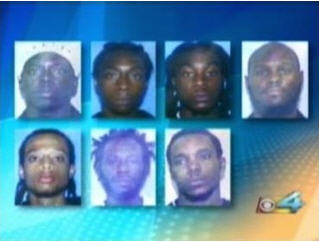
StoriesSix Homeless Men In Florida Accused of Plot to Blow Up Sears Tower on Trial For Third Time
Alberto Gonzalez. Justice Department, FBI, John Ashcroft, Liberty City Six, Osama Bin Laden, terrorism, War on TerrorSouth Florida Sun-Sentinel.com
By RASHA MADKOUR
1:50 PM EST, February 18, 2009
MIAMI (AP) — A group of Miami men accused of plotting to destroy Chicago’s Sears Tower and bomb FBI offices sold out their country for money, a federal prosecutor said Wednesday at the start of the men’s third trial.
Prosecutors are trying to convict the so-called “Liberty City Six” on four terrorism-related charges after two previous trials ended in hung juries. The men are accused of plotting terror attacks with an FBI informant they thought was an al-Qaida operative.
A defense attorney for the group’s leader, Narseal Batiste, 34, said the government’s sting operation was a setup. The FBI’s paid informants were motivated by money to manipulate the men and encourage them to take actions that could later be used against them, attorney Ana M. Jhones said.
“This case is a 100 percent setup. This is a manufactured crime,” she said.
The men took an oath of allegiance to Osama bin Laden — captured by the FBI on videotape — led by a man claiming to be an al-Qaida operative who was an informant posing as a terror financier.
Batiste has previously testified he was never serious about any terror plots and was only playing along in hopes of getting $50,000.
There has been no evidence the men ever took any steps toward pulling off an attack. When they were arrested in 2006, the Bush administration trumpeted the case as an example of heading off terrorists early.
“What’s relevant is their intention — what they wanted to do,” Assistant U.S. Attorney Jacqueline Arango said.
Prosecutors said the men took photographs and video of possible targets in Miami, including the FBI building, a courthouse complex and a synagogue. In exchange, they wanted money to build what Arango described as their paramilitary group.
“They all agreed to sell out their country for money,” Arango said. “The fact that they did so for the mighty U.S. dollar is no excuse.”
Jhones said one of the informants tricked Batiste into taking the oath and encouraged him to make a list of weapons and equipment. She said video and audio captured by authorities will show two informants were in control and calling the shots, not Batiste.
The defense attorney said Batiste, a construction worker and father of four, was repeatedly asking about the money on the recordings, not talking about blowing up buildings.
“You cannot buy your way to a conviction,” Jhones said.
The men each face 70 years in prison if convicted of four terrorism-related counts, including conspiracy to support al-Qaida and conspiracy to levy war against the U.S.
The trial is expected to last at least two months.
The group of men were named after their hometown of Liberty City, an impoverished area of Miami.
FCC, TV, Internet Set For Big Changes in 2009
Barack Obama, Broadband, Cable Television, Digital, FCC, Internet, Net Neutrality
David Ho
Cox News
via SF GATE
January 28 New York —
From an Obama administration plan to give all Americans broadband to the nation’s looming switch to digital television, the communications landscape is expected to see big shifts in 2009.
At the heart of much of the change is the Federal Communications Commission, which soon faces its own shake-up as at least one commissioner departs and Democrats take charge.
That could mean policy changes at an agency that oversees everything from cable providers and radio airwaves to public safety communications and broadcast indecency rules.
Overall, experts say, President-elect Barack Obama’s tech-savvy team will be more involved in telecommunications issues than the Bush administration was.
“Obama looks at these issues as part of the solution to unemployment challenges and as an economic stimulant,” said Andy Lipman, who leads the telecom-media practice at the Bingham McCutchen law firm in Washington.
The FCC
The new FCC will begin taking shape in early January as the term of Republican Commissioner Deborah Taylor Tate ends. The president appoints commissioners for limited terms, with the party in power getting three of five spots, including the chairmanship.
Republican Chairman Kevin Martin will likely leave the agency when the new administration takes office, and Obama is expected to appoint one of the commission’s two Democrats – Michael Copps or Jonathan Adelstein – as interim chairman. One of them could get the long-term job, but many names have circulated as potential candidates.
While Senate confirmation could take months, Obama’s FCC chairman will arrive with a well-defined agenda, said Ben Scott, policy director for the advocacy group Free Press.
“The president-elect has been so clear and detailed about what he wants to do in telecom and media policy, whoever becomes chairman is going to inherit that set of expectations,” he said.
Broadband
Perhaps the biggest expectation involves improving the availability of high-speed Internet access. That goal is likely to be a part of the huge stimulus package that Obama and his Democratic allies in Congress ambitiously want to enact soon after he takes office Jan. 20.
“It is unacceptable that the United States ranks 15th in the world in broadband adoption,” Obama said this month. “Here, in the country that invented the Internet, every child should have the chance to get online. … That’s how we’ll strengthen America’s competitiveness in the world.”
Figuring out how to make that happen has prompted considerable debate, with lawmakers, consumer groups and tech companies chiming in.
“They need to create some kind of mechanism that encourages industry to quickly start deploying faster and farther,” said David Kaut, an analyst with the Stifel, Nicolaus & Co. investment firm. “There’s going to be a lot of scrutiny that it produces jobs in the near term and not just jobs already scheduled.”
The Telecommunications Industry Association and other players favor tax breaks and grants to encourage network building.
One floated proposal involves supporting a broadband rollout through a $7 billion fund that draws on monthly phone bill fees to subsidize calling service in rural and poor communities.
Digital TV
As wrangling over broadband plays out, another mammoth change takes center stage on Feb. 17 as the nation’s TV broadcasters cut off analog signals. The goal is to offer new digital channels with improved picture and sound quality while freeing up radio airwaves for uses such as wireless broadband.
To watch digital programming on older analog sets, consumers need converter boxes. The government is offering coupons to help pay for them.
But when the digital deadline comes, “inevitably you’re going to have lots of people with problems,” Scott said. Recent surveys indicate many consumers remain confused about how it will work.
Key lawmakers told the FCC’s Martin this month that his agency should make smoothing the digital transition the No. 1 priority in the weeks before the inauguration. Martin promptly canceled a meeting on other issues.
The digital changeover has “sucked the oxygen” out of every other telecom topic before the FCC and will dwarf everything else in the first few months of 2009, Lipman said.
Net neutrality
One issue facing a priority shift is net neutrality, or the idea of an open Internet where network providers don’t interfere with Web content and treat all traffic the same.
In August, a precedent-setting FCC decision found that cable giant Comcast Corp. violated federal policies when it blocked customers from sharing online videos and other large files.
Obama has made net neutrality a top communications priority and some lawmakers would like it to be part of a national broadband strategy.
However, the urgency behind government action has faded in recent months as the online content and network sides have come closer together, Lipman said.
He said the issue could flare up if Comcast wins a legal challenge to the FCC ruling, but that decision is a year or two away.
Mergers
The Obama FCC also is expected to apply more scrutiny to mergers while resisting telecom deregulation and weaker media ownership rules.
The new commission may swing back toward President Bill Clinton’s FCC, which exerted tighter control over industry, said Jeff Kagan, an independent analyst in Atlanta. He said companies complained then that regulations could not keep pace with changing technology.
“When the Bush administration took over, the pendulum swung all the way to other side,” resulting in enormous consolidation, Kagan said. He said the challenge for the Obama administration is finding a middle ground.
Cable
One industry looking forward to change at the FCC is cable, which has battled with Martin over a variety of issues including ownership limits and his push for “a la carte” programming, where cable subscribers buy only the individual channels they want.
Some in the industry worry about new net neutrality restrictions, but many FCC watchers expect pressure on cable to ease and the a la carte issue to fade as broadband becomes the top priority.
Lipman said cable companies typically do better with Republicans in power, but without Martin “paradoxically cable will probably end up doing better in the Obama administration.”
Hamburgers Are Hummers of Food in Global Warming
Food, Global Warming, Hummer, Meat, MethaneAFP
Feb 16, 2009
When it comes to global warming, hamburgers are the Hummers of food, scientists say.Simply switching from steak to salad could cut as much carbon as leaving the car at home a couple days a week.
That’s because beef is such an incredibly inefficient food to produce and cows release so much harmful methane into the atmosphere, said Nathan Pelletier of Dalhousie University in Canada.
Pelletier is one of a growing number of scientists studying the environmental costs of food from field to plate.
By looking at everything from how much grain a cow eats before it is ready for slaughter to the emissions released by manure, they are getting a clearer idea of the true costs of food.
The livestock sector is estimated to account for 18 percent of global greenhouse gas emissions and beef is the biggest culprit.
Even though beef only accounts for 30 percent of meat consumption in the developed world it’s responsible for 78 percent of the emissions, Pelletier said Sunday at a meeting of the American Association for the Advancement of Science.
That’s because a single kilogram of beef produces 16 kilograms carbon dioxide equivalent emissions: four times higher than pork and more than ten times as much as a kilogram of poultry, Pelletier said.
If people were to simply switch from beef to chicken, emissions would be cut by 70 percent, Pelletier said.
Another part of the problem is people are eating far more meat than they need to.
“Meat once was a luxury in our diet,” Pelletier said. “We used to eat it once a week. Now we eat it every day.”
If meat consumption in the developed world was cut from the current level of about 90 kilograms a year to the recommended level of 53 kilograms a year, livestock related emissions would fall by 44 percent.
“Given the projected doubling of (global) meat production by 2050, we’re going to have to cut our emissions by half just to maintain current levels,” Pelletier said.
“Technical improvements are not going to get us there.”
That’s why changing the kinds of food people eat is so important, said Chris Weber, a professor of civil and environmental engineering at Carnegie Mellon University in Pennsylvania.
Food is the third largest contributor to the average US household’s carbon footprint after driving and utilities, and in Europe – where people drive less and have smaller homes – it has an even greater impact.
“Food is of particular importance to a consumer’s impact because it’s a daily choice that is, at least in theory, easy to change,” Weber said.
“You make your choice every day about what to eat, but once you have a house and a car you’re locked into that for a while.”
The average US household contributes about five tons of carbon dioxide a year by driving and about 3.5 tons of equivalent emissions with what they eat, he said.
“Switching to no red meat and no dairy products is the equivalent of (cutting out) 8,100 miles driven in a car … that gets 25 miles to the gallon,” Weber said in an interview following the symposium.
Buying local meat and produce will not have nearly the same effect, he cautioned.
That’s because only five percent of the emissions related to food come from transporting food to market.
“You can have a much bigger impact by shifting just one day a week from meat and dairy to anything else than going local every day of the year,” Weber said.
For more information on how to eat a low carbon diet, visit http://www.eatlowcarbon.org.
Copyright AFP 2008, AFP stories and photos shall not be published, broadcast, rewritten for broadcast or publication or redistributed directly or indirectly in any medium
Northwest Airlines Serving Penis on All Domestic Flights
CNN, Comedy, Media, Penis, Video
Apparently, Georgia is number one penis producer in the United States.
 The New York Herald Sun