The Per Capita Growth of Breakfast is Largely Gone for the Near-Term

Breakfast, Fast Food, McDonalds, Pancakes, Starbucks

3169583672_a44b51f7e1

Feb. 9 (Bloomberg) — Wendy’s/Arby’s Group Inc. is trading French toast sticks for breakfast wraps. Starbucks Corp. is introducing its first value meals. Panera Corp. spent two years developing a new coffee blend.

The restaurant chains are taking another run at more profitable morning meals as customers trim spending on lunch and dinner. Across the industry, sales during early hours have grown faster than other segments in the past five years, according to data from NPD Group, a consumer-research company.

Starbucks is “clearly in catch-up mode,” said Jeffrey Bernstein, a restaurant analyst with Barclays Capital in New York. “People weren’t happy with their breakfast. They do not want to lose significant morning traffic.”

Starbucks Chief Executive Officer Howard Schultz is introducing a $3.95 combination meal as the world’s largest chain of coffee shops competes with breakfast value menus at other restaurants. The Seattle-based company said today it will offer coffee and a choice of egg sandwiches or a caffe latte and coffee cake or oatmeal. Wendy’s is revisiting its breakfast menu ahead of a 2011 national roll-out after past offerings failed to win favor with customers.

Panera, which operates 1,300 bakery cafes, introduced a new coffee blend last month and added a yogurt parfait. Burger King Holdings Inc. added miniature breakfast sandwiches last week.

Starbucks declined 21 cents to $10.33 at 9:56 a.m. in Nasdaq Stock Market composite trading, and Panera dropped 66 cents to $46.88. Wendy’s fell 11 cents to $5.39 on the New York Stock Exchange, and Burger King lost 45 cents to $19.46.

Wendy’s may need six to nine months before the new menu gains traction with buyers, Bernstein said. The fast-food chain may lift its morning sales to as much as 10 percent of its total revenue within five years, he said, from 2.2 percent now. David Palmer, an analyst with UBS AG in New York, projects the new menu could account for 15 percent of revenue.

‘A Standout’

“You need to have longevity in the breakfast business because people don’t immediately notice,” Bernstein said.

Breakfast foods are about 25 percent more profitable than lunch and dinner items, based on the cost of ingredients, said Bob Goldin, an executive vice president with Technomic Inc., a restaurant consulting firm in Chicago.

After a failed attempt in the 1980s that centered on fresh- made omelets, Wendy’s focused its efforts on growing late-night sales instead, said spokesman Bob Bertini.

“We’re not in breakfast in a big way,” Bertini said. “This is a significant opportunity for us. We’re looking to grab more of that market.”

Starbucks’ Schultz told cafe employees today that value meals were “the right thing to do” for customers, about six months after he vowed not to offer bundled meals. The “pairings” will be available starting March 3, and add two new egg sandwiches to the line-up. Last year, the company added oatmeal and reworked its egg offerings because their aroma overpowered the scent of coffee in stores.

Breakfast Shots

Burger King said on Feb. 4 it will add mini-breakfast sandwiches to its menu. The BK Breakfast Shots, which feature eggs, cheese and a choice of ham, sausage or bacon, will be available for $1.49 for two or $2.39 for four. The Miami-based company gets about 15 percent of sales from breakfast.

“Breakfast has been a standout” for growth as customers look for ways to make mornings easier, said Malcolm Knapp, a New York-based restaurant consultant. “It’s an area that’s still under-penetrated and still the most skipped meal of the day.”

Egg McMuffins

McDonald’s Corp., the world’s largest restaurant chain, credits orders for Egg McMuffins, coffee and hash browns with lifting sales at stores open at least 13 months, and last year started opening some stores an hour earlier to attract more customers. The Oak Brook, Illinois-based company gets about 25 percent of sales and 40 percent of profit from breakfast sales, Bernstein said.

Panera offered free coffee to customers a couple of weeks ago to debut its new blend and yogurt parfaits. Stores are brewing pots every hour, twice as fast as before, to maintain freshness.

Last year, breakfast traffic climbed 2 percent, compared with traffic in the restaurant industry during other times of the day that was little changed, said Harry Balzer, vice president at Port Washington, New York-based NPD. Restaurants accounted for 8.2 percent of all breakfast options in 2008, up from 6.2 percent in 1996, while about three-quarters of all morning meals are still eaten at home, he said.

“It’s a structural change, not just a fad,” Balzer said. “For years, a hearty bowl of cereal was the most convenient food, but with drive-thrus and restaurant meals increasingly available, that’s not the case anymore.”

Without providing a specific forecast, Balzer said he expects breakfast growth to continue.

Creatures of Habit

Declining spending may crimp growth as job losses limit the number of commuters looking for a quick breakfast and pinch consumers’ wallets, Palmer and Bernstein said. Consumers who are already loyal to a particular chain are less likely to spend money to try a new product, especially during a recession, Palmer said.

“The per capita growth of breakfast is largely gone for the near-term,” Palmer said in a Jan. 30 phone interview. “It would be an awkward time to get the consumer to try something new.”

Evelyn Cortez, 47, a Manhattan video-store clerk, has been eating at the same McDonald’s on the Lower East Side nearly every weekday for the past 10 years.

“I always get the pancakes, the same thing every day,” Cortez said as she swirled her fork in leftover syrup. “I usually think about going somewhere else, but I end up coming back here.”

Paul Krugman: "On the Edge"

Barack Obama, D.C., Economy, Federal Reserve, Finance, GOP, Larry Summers, Media, Paul Krugman, Politics, Republicans, Stimulus Bill, Tim Geithner
February 6, 2009
Op-Ed Columnist
On the Edge

A not-so-funny thing happened on the way to economic recovery. Over the last two weeks, what should have been a deadly serious debate about how to save an economy in desperate straits turned, instead, into hackneyed political theater, with Republicans spouting all the old clichés about wasteful government spending and the wonders of tax cuts.

It’s as if the dismal economic failure of the last eight years never happened — yet Democrats have, incredibly, been on the defensive. Even if a major stimulus bill does pass the Senate, there’s a real risk that important parts of the original plan, especially aid to state and local governments, will have been emasculated.

Somehow, Washington has lost any sense of what’s at stake — of the reality that we may well be falling into an economic abyss, and that if we do, it will be very hard to get out again.

It’s hard to exaggerate how much economic trouble we’re in. The crisis began with housing, but the implosion of the Bush-era housing bubble has set economic dominoes falling not just in the United States, but around the world.

Consumers, their wealth decimated and their optimism shattered by collapsing home prices and a sliding stock market, have cut back their spending and sharply increased their saving — a good thing in the long run, but a huge blow to the economy right now. Developers of commercial real estate, watching rents fall and financing costs soar, are slashing their investment plans. Businesses are canceling plans to expand capacity, since they aren’t selling enough to use the capacity they have. And exports, which were one of the U.S. economy’s few areas of strength over the past couple of years, are now plunging as the financial crisis hits our trading partners.

Meanwhile, our main line of defense against recessions — the Federal Reserve’s usual ability to support the economy by cutting interest rates — has already been overrun. The Fed has cut the rates it controls basically to zero, yet the economy is still in free fall.

It’s no wonder, then, that most economic forecasts warn that in the absence of government action we’re headed for a deep, prolonged slump. Some private analysts predict double-digit unemployment. The Congressional Budget Office is slightly more sanguine, but its director, nonetheless, recently warned that “absent a change in fiscal policy … the shortfall in the nation’s output relative to potential levels will be the largest — in duration and depth — since the Depression of the 1930s.”

Worst of all is the possibility that the economy will, as it did in the ’30s, end up stuck in a prolonged deflationary trap.

We’re already closer to outright deflation than at any point since the Great Depression. In particular, the private sector is experiencing widespread wage cuts for the first time since the 1930s, and there will be much more of that if the economy continues to weaken.

As the great American economist Irving Fisher pointed out almost 80 years ago, deflation, once started, tends to feed on itself. As dollar incomes fall in the face of a depressed economy, the burden of debt becomes harder to bear, while the expectation of further price declines discourages investment spending. These effects of deflation depress the economy further, which leads to more deflation, and so on.

And deflationary traps can go on for a long time. Japan experienced a “lost decade” of deflation and stagnation in the 1990s — and the only thing that let Japan escape from its trap was a global boom that boosted the nation’s exports. Who will rescue America from a similar trap now that the whole world is slumping at the same time?

Would the Obama economic plan, if enacted, ensure that America won’t have its own lost decade? Not necessarily: a number of economists, myself included, think the plan falls short and should be substantially bigger. But the Obama plan would certainly improve our odds. And that’s why the efforts of Republicans to make the plan smaller and less effective — to turn it into little more than another round of Bush-style tax cuts — are so destructive.

So what should Mr. Obama do? Count me among those who think that the president made a big mistake in his initial approach, that his attempts to transcend partisanship ended up empowering politicians who take their marching orders from Rush Limbaugh. What matters now, however, is what he does next.

It’s time for Mr. Obama to go on the offensive. Above all, he must not shy away from pointing out that those who stand in the way of his plan, in the name of a discredited economic philosophy, are putting the nation’s future at risk. The American economy is on the edge of catastrophe, and much of the Republican Party is trying to push it over that edge.

Numerous Myths and Falsehoods Advanced by the Media in Their Coverage of the American Recovery and Reinvestment Act

American Recovery and Reinvestment Act, Banking, Beltway Groupthink, D.C., Finance, GOP, Infrastructure, Jobs, Media, Media Matters, Politics, Propaganda, Republicans, Stimulus Bill

dogchapmansp

Media Matters for America previously identified numerous myths and falsehoods advanced by the media in their coverage of the American Recovery and Reinvestment Act. As debate on the bill continues in Congress, other myths and falsehoods advanced by the media about the recovery package have risen to prominence. These myths and falsehoods include: the assertion that the bill will not stimulate the economy — including the false assertion that the Congressional Budget Office (CBO) said the bill will not stimulate the economy; that spending in the bill is not stimulus; that there is no reason for stimulus after an economic turnaround begins; that corporate tax rate cuts and capital gains tax rate cuts would provide substantial stimulus; and that undocumented immigrants without Social Security numbers could receive the “Making Work Pay” tax credit provided in the bill.

1. The bill will not stimulate the economy

In a February 1 article, The Associated Press reported an assertion by Senate Minority Leader Mitch McConnell (R-KY) that the recovery bill will not stimulate the economy without noting that the CBO disagrees. ABC World News anchor Charles Gibson echoed this assertion during his February 3 interview with President Obama, stating: “And as you know, there’s a lot of people in the public, a lot of members of Congress who think this is pork-stuffed and that it really doesn’t stimulate.” Additionally, on the January 28 edition of his show, nationally syndicated radio host Rush Limbaugh allowed Rep. Eric Cantor (R-VA) to falsely claim of the bill: “Even the Congressional Budget Office, controlled by the Democrats now, says it is not a stimulative bill.” Fox News host Sean Hannity repeated this claim on the February 2 broadcast of Fox News’ Hannity, asserting that the CBO “say[s] it’s not a stimulus bill.”

In fact, in analyzing the House version of the bill, H.R. 1, and the proposed Senate version, the CBO stated that it expects both measures to “have a noticeable impact on economic growth and employment in the next few years.” Additionally, in his January 27 written testimony before the House Budget Committee, CBO director Douglas Elmendorf said that H.R. 1 would “provide massive fiscal stimulus that includes a combination of government spending increases and revenue reductions.” Elmendorf further stated: “In CBO’s judgment, H.R. 1 would provide a substantial boost to economic activity over the next several years relative to what would occur without any legislation.”

2. Government spending in the bill is not stimulus

Several media figures, including CNN correspondent Carol Costello, CBS Evening News correspondent Sharyl Attkisson, and ABC World News anchor Charles Gibson, have all uncritically reported or aired the Republican claim that, in Gibson’s words, “it’s a spending bill and not a stimulus,” without noting that economists have said that government spending is stimulus. Indeed, in his January 27 testimony, Elmendorf explicitly refuted the suggestion that some of the spending provisions in the bill would not have a stimulative effect, stating: “[I]n our estimation — and I think the estimation of most economists — all of the increase in government spending and all of the reduction in tax revenue provides some stimulative effect. People are put to work, receive income, spend that on something else. That puts somebody else to work.” Additionally, Dean Baker, co-director of the Center for Economic and Policy Research, has said, “[S]pending is stimulus. Any spending will generate jobs. It is that simple.”

3. There is no reason for stimulus after a turnaround begins

Fairness Doctrine Hearings Sought by Congress

Debbie Stabenow, Fairness Doctrine, GOP Meltdown

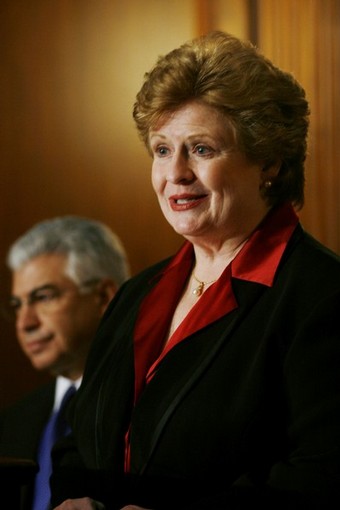
73438495JR012_liebermanSenator Debbie Stabenow (D-MI) says it’s increasingly likely that there will be congressional hearings into whether a new Constitutionally-acceptable version can be crafted. She tells the Bill Press Show, “There needs to be some accountability and standards put in place.”

LISTEN

98% of Cities in America Report Unemployment Rise

City, Labor Department, Metropolitan, U.S.A., Unemployment
skylook1
CNNMoney.com staff writer

NEW YORK (CNNMoney.com) — In a sign that job losses are felt in every corner of the nation, unemployment rates rose in 98% of metropolitan areas across the country in December, according to a recent government report.

The Labor Department reported that the unemployment rates in 363 of 369 metropolitan areas rose in December 2008, compared with the same month in the prior year. In November, 364 of 369 areas reported higher unemployment rates.

According to the report, 168 areas reported jobless rates of at least 7%, compared with just 33 a year ago, and 40 areas reported rates that were higher than 10%. Just 22 metropolitan regions had unemployment rates that were under 4%, down from 112 last year.

A total of 95 regions registered unemployment rates that were at least 3 percentage points higher than a year ago. Not one region had a jobless rate decrease of more than 0.2 percentage point during that period.

Though the rise in unemployment rates depicts the rampant job losses facing the country, the Labor Department does not adjust the rates in its metropolitan unemployment report for typical seasonal changes in employment.

Furthermore, smaller cities are usually dependent on a fewer number of employers, so layoffs can exacerbate those areas’ unemployment rates.

El Centro, Calif. continued to hold the highest rate of unemployment at 22.6%. The town on the border of Mexico is highly reliant on agricultural employment, according to economists. The unemployment rate has a tendency to rise and fall in the area depending on the farming season.

Morgantown, W.Va., had a rate of just 2.7%, the lowest in the country. Morgantown houses West Virginia University, which is the town’s largest employer. The University has a large hospital and pharmaceutical manufacturing component – areas of the economy that are actually adding jobs.

Of the 49 metropolitan areas with a population of at least 1 million, Detroit had the largest unemployment rate, at 10.6%, followed by San Bernadino, Calif., with 10.1%. Detroit’s labor force has been slammed by dreadful auto sales, and the sinking California housing market has dragged down construction jobs in that area.

Oklahoma City had the lowest unemployment rate of large metropolitan regions, at 4.6%, followed by Washington at 4.7%. Oklahoma City is benefiting from the still-booming energy industry, especially through the several large natural gas companies in the city. Washington’s employment is largely based on federal government jobs in the district.

The report comes on the same day as two independent reports showed job cut announcements and payroll reductions continued to rise in January.

The Labor Department is expected to report Friday that the economy lost another 500,000 jobs, according to a consensus estimate of economists surveyed by Briefing.com. The national unemployment rate is expected to rise to 7.5% from its current level of 7.2%, its highest rate since January 1993

Obama's Campaign Manager and Elizabeth Edwards Get Book Deals

Barack Obama, David Plouffe, Elizabeth Edwards, John Edwards, The Audacity to Win: The Inside Story and Lessons of Barack Obama's Historic Victory

CBS NEWS’ HOTSHEET

hotsheet

David Plouffe, Barack Obama’s campaign manager, and Elizabeth Edwards, whose husband John ran for president last year and later admitted an extramarital affair, have both secured book deals, the Associated Press reports.

Plouffe’s seven-figure deal is for a book on the presidential election entitled “The Audacity to Win: The Inside Story and Lessons of Barack Obama’s Historic Victory.”

In a statement, publisher Viking said it would examine “the deliberations about whether to run against long odds, the epic primary battle with Hillary Clinton, the drama of the general election campaign against John McCain and the strategic roads taken — and not taken.”

It will “also detail the business lessons to be learned from the formation and the functioning of an unprecedented $1 billion start-up — use of technology, crisis management, grass roots, and personnel management.”

Edwards’ book, entitled “Resilience,” will be released in May. The publisher is not releasing details about what Edwards covers in the book, but she has plenty to work with: Her continuing fight against breast cancer, her experiences during her husband’s run for the Democratic presidential nomination, and the fallout from John Edwards’ admission of an affair with a video producer.

“She has always been a kind of candid and honest writer, and people can expect that of her in her new book,” said her publisher’s publicity director.

Edwards published a book in 2006 called “Saving Graces” in which she discussed her fight against cancer and the death of her son 10 years earlier. She has not discussed her husband’s affair in detail since it was revealed last August.

Bank of England Cuts Rate to Year 1694 Levels

Bank of England, Britain, ECB, Gordon Brown, Housing Prices, Job Cuts, Monetary Policy Committee, Recession

BLOOMBERG

big_ben_85831

Feb. 5  — The Bank of England lowered the benchmark interest rate to 1 percent, extending the most aggressive round of cuts in its three-century history as officials try to limit fallout from the deepening recession.

The nine-member Monetary Policy Committee, led by Governor Mervyn King, cut the bank rate to 1 percent from 1.5 percent. That’s the lowest since the central bank was founding in 1694 by William III to fund a war against France. The move matched the median estimate of 61 economists of a Bloomberg News survey.

The U.K. economy will shrink the most since 1946 this year and faster than any other industrialized country, International Monetary Fund forecasts show. Prime Minister Gordon Brown’s government has given the central bank powers to spend up to 50 billion pounds ($73 billion) on bonds and commercial paper as interest rates lose their potency to aid economic growth.

“The global economy is in the throes of a severe and synchronized downturn,” the central bank said in a statement. “Business and household sentiment in many countries has deteriorated. The supply of credit remains constrained.” In Britain, “credit conditions faced by companies and households have tightened further,” it said.

King will present the bank’s updated economic forecasts on Feb. 11. Minutes of this month’s meeting, showing how the members voted, will be published on Feb. 18.

The pound rose against the dollar and the euro, trading at $1.4635 and 87.36 pence per euro as of 3:10 p.m. in London.

Global Rate Cuts

The Bank of England has now lowered its rate by 4 percentage points since October. The U.S. Federal Reserve has reduced its key rate to a range between zero and 0.25 percent. The European Central Bank kept its rate at 2 percent today.

ECB President Jean-Claude Trichet, speaking to reporters in Frankfurt, said he “doesn’t exclude” a half-point interest- rate cut for the 16-country euro area in March.

Central banks in South Africa and the Czech Republic joined the U.K. in cutting interest rates today to fight the global slump. South Africa’s central bank cut its benchmark rate by 1 percentage point, the biggest reduction in more than five years, to 10.5 percent. The Czech central bank lowered the key rate for the third consecutive time, by half a point to 1.75 percent.

“We have a deep recession and a credit crunch,” said Michael Saunders, chief Western European economist at Citigroup Inc. in London. “Why wait? The debate is about how the economy can ever recover, and the Bank of England has the answer to that in its hands.”

Undershoot Risk

The bank said there is “a substantial risk” that inflation will fall too far below the 2 percent target even though rate cuts since October, a 20 billion-pound package of tax cuts, cheaper commodities and a sharp drop in the value of the pound are likely to provide “a considerable stimulus.”

“The key is the line that credit conditions have tightened further,” Brian Hilliard, chief U.K. economist at Societe Generale SA in London, said on Bloomberg Television. “That’s the key emphasis for the government and the bank. They’ve got to continue to do things about it. And the asset purchase facility is the next button to press.”

King’s next step may be to pump additional money into the financial system. He said Jan. 20 that the central bank will buy “high-quality” assets within “weeks and not months” to ease market strains, a policy in line with similar measures pursued by Fed Chairman Ben S. Bernanke.

Brown and King are trying to rescue an economy that will contract 2.8 percent in 2009, according to IMF forecasts. House prices fell an annual 16.4 percent in January, mortgage lender Halifax said today.

Job Cuts

Ford Motor Co. said today it plans to cut up to 850 jobs in the U.K. as demand for autos and commercial vans slumps. As many as 5,000 British companies may file for bankruptcy this year, a report by accounting and insolvency firm KPMG showed.

The downturn is cooling inflation. Consumer prices rose 3.1 percent from a year earlier in December, compared with 4.1 percent the previous month, the biggest drop in the annual rate since records began in 1997. The central bank’s target is to keep inflation at 2 percent.

Brown said yesterday that the world is suffering a “depression,” suggesting he may increase measures to stimulate the economy. The government has already pledged hundred of billions of pounds to prop up banks, and the pound has fallen 26 percent against the dollar and 16 percent against the euro in the past year, making British exports cheaper.

‘Stimulus Factors’

“There are many stimulus factors in place, cuts in interest rates, various fiscal packages will help,” said Nick Bate, an economist at Merrill Lynch & Co. in London and a former Treasury official. “But given that we’re in a world where many central banks are cutting severely, the ability to fine tune the economy has passed.”

The Federation of Small Businesses said yesterday that recent interest rate cuts aren’t helping companies because they cannot get access to loans. More than two-thirds of small businesses wanted the central bank to keep the rate unchanged, according to an FSB poll. The Building Societies Association, representing customer-owned lenders, also called for no change.

For now, the central bank may still have little choice but to keep cutting.

“The fundamentals are still weak and there is still some scope for orthodox policy easing,” said Ross Walker, an economist at Royal Bank of Scotland Group Plc in London. “It’s preferable to nudge rates further now than to turn to the printing presses.”

Republicans Storming the Airwaves to Promote Message of Doom

Stories

torture_719b2

NPR CHECK

Are We Stimulated Yet?


There is a Santa Claus! NPR is in the gifting mode, handing out airtime to yackers from the Grand Old Party (Republicans that is) – and a reader of this blog, “Grumpy Demo” from Dallas, was so kind as to do a bit of analysis of NPR’s big tilt toward Republican talking heads in it’s economic coverage of late. Here’s what Grumpy sent me:

In Reporting On White House Economic Stimulus Package, NPR Interviews Six GOP Congressmen For Every Democrat.

Based on NPR’s own data, NPR demonstrated a preference for Republican members of Congress in its reporting on President Obama’s Economic Stimulus Package. A review of NPR’s “Morning Edition” and “All Things Considered” broadcast records for the month ending February 3, 2008 indicates in the 50 stories on the stimulus, NPR interviewed and quoted 12 GOP Congresspersons, while only quoting 2 Democrats. Numerous polls show that a majority of Americas support the White House’s stimulus package.

When viewed in context – that NPR’s sole Washington news analyst is FOX News’ employee and O’Reilly Factor guest host, Juan Williams, combined with numerous interviews with Heritage Foundation, Cato Institute, American Enterprise Institute, and National Review pundits, with no members of the progressive movement given equal time – NPR demonstrates a clear and unambiguous conservative bias in its reporting. Additionally, during this same period no White House spokesperson was interviewed or quoted by NPR.


Search Data listed below:
Month Ending February 3,2008
Total Stories: 50
Congressmen Interviewed, Quoted: 14
GOP Congressmen: 12
Democratic Congressmen: 2
White House Spokesmen: 0


Morning Edition
  • 01/07/09 Oakley D-WI
  • 01/19/09 Gingrich D-GAx
  • 01/22/09 Roehmer R-TN
  • 01/25/09 Cantor R-VA
  • 01/20/09 Pence R-I
All Things Considered
  • 01/06/09 Hoyer D-MD
  • 01/15/09 Cantor R-VA
  • 01/20/09 Pence R-IN
  • 01/26/09 Grassley R-IW
  • 01/27/09 Camp R-MI,Simpson R-ID01/29/09 Gerlach R-PA,Davis RNC,Camp R-MI
Search Links:

……………………………………………………………………………………………………………………………………………………………..

POLITICO

By: Michael Calderone
February 5, 2009 04:31 AM EST
Rachel Maddow seemed pleasantly surprised when Republican Rep. Donald A. Manzullo turned up on her show last week to talk about his vote against the Democrats’ stimulus plan.

“I can’t tell you how many times a day Republicans say no to invitations to be on this show,” said the liberal MSNBC host. “So we’re very grateful to him for saying yes tonight.” Maddow may have to get used to the experience.

If she had been monitoring MSNBC last week, she would have noticed that more congressional Republicans than Democrats appeared on the network to discuss the stimulus — by a tally of 15-9.

In fact, more congressional Republicans than Democrats appeared on all of the major cable news networks — CNN, Fox News, Fox Business and CNBC — during three days last week surrounding the House vote on the stimulus plan. That’s according to a report by Think Progress, a project of the left-leaning Center for American Progress, which added up congressional TV hits related to the stimulus bill.

The study found that Fox News struck the most balance, with eight Republicans to six Democrats; on CNN, there were two Democrats to seven Republicans.

Now out of power, congressional Republicans are turning to the power of the press, it seems.

“I think this is one of the models that we’re going to use going forward,” said Michael Steel, press secretary for House Minority Leader John A. Boehner (R-Ohio). “Our votes generally don’t matter anymore, but our voices do. Our job is to win the argument, day in and day out.”

And the Republican message offensive didn’t go unnoticed on the other side of the aisle, either.

“What happened with cable last week is that Republican House members were the only show in town,” said a House Democratic leadership aide, who similarly acknowledged that there’s a daily “battle” getting the party’s message to viewers.

Of course, it’s not as if the networks are cutting out the Democrats. But with so much network attention being paid to the Obama administration — including roughly 40 minutes a day devoted to Robert Gibbs’ press briefing — it’s understandable that bookers would seek out House Republicans to provide a counterbalance, even if it means leaving House Democrats out in the process.

CNN political director Sam Feist said simply tallying up appearances of members of Congress only — and specifically when discussing the stimulus — doesn’t offer a complete picture of a network’s coverage, he said.

“As I have looked at what CNN has done the past couple weeks over the stimulus debate, I’ve found the balance is there,” Feist said, adding that it’s never going to be a “perfect balance, minute to minute.”

Doug Thornell, communications director for Democratic Congressional Campaign Committee Chairman Chris Van Hollen, said that while it’s important to make the rounds nationally via cable news, Democratic House members have been reaching out on a local level, too.

“Republicans are hoping to keep the debate in a national partisan box, disseminating their talking points and message through cable or conservative talk radio,” Thornell said.

“Van Hollen has been urging recently elected Democrats to aggressively make the case for the recovery package to their constituents who are hurting as well as to local media,” he said. “I think at the end of the day, it’s easier for Republicans to explain their opposition to an anchor on Fox News than to a worker in their district who just lost their job.”

But it’s not only Fox News, with cable’s most conservative stable of commentators, that Republicans have visited lately. While the rank and file beats the drum over media bias, some elected Republican leaders have hit up the oft-maligned networks among conservatives: MSNBC and CNN.

“You get left out of the story more because you weren’t effectively responding than [because of] any bias,” said Rep. Mike Pence of Indiana, who serves as chairman of the House Republican Conference.

Since becoming conference chairman, Pence — who has a background in television and radio — has beefed up the press shop with additional bookers and is in the process of adding a deputy press secretary to deal specifically with Hispanic media outlets.

Pence said that because the “Republican conference exists to promote Republican members,” he’s been closely watching the morning’s headlines and then having staff reach out to media outlets with those members who can speak authoritatively on specific subjects — subjects that include the stimulus, national security and trade. About 70 members are now in the rapid response groups, which Pence has dubbed “tiger teams.”

Ron Bonjean, a former top Republican spokesman for the House and Senate leadership, drew parallels to the early days of the Clinton administration, when “the Speaker’s Lobby was packed with reporters trying to get Republicans, to get the other side of story.”

Bonjean said that while in the minority, Republicans will have less responsibility in Congress, such as management meetings, thus freeing them up in greater numbers to speak with the press.

“I think that will be a standard template going forward,” Bonjean said, “as long as Obama keeps making news and dominating the media space.”

Billions in Drug and Organized Crime 'Dirty Money' Funneled Into Bernie Madoff's Operation

Barack Obama, Wall Street
WASHINGTON, Feb. 4, 2009


(CBS) By CBS News chief investigative correspondent Armen Keteyian and Investigative Producer Laura Stricker.


main
On Capitol Hill Wednesday, the financial analyst who first blew the whistle on Bernie Madoff back in 2000 went public for the first time, stunning lawmakers with the full scope of the $50 billion fraud.
CBS News correspondent Armen Keteyian reports.

In two hours of riveting, no-holds barred testimony, Harry Markopolos revealed the depth – and danger – of his nine-year fight to expose the Madoff scandal.

Markopolos said at one point he feared for his life.

“He would have known my name and, he knew he had a team tracking him. I didn’t think I was long for this world,” he said.

One reason: Bernie Madoff was among the “most powerful men” on Wall Street.

Another: In 2002 Markopolos said he discovered billions of dollars in “dirty money” was being funneled into Madoff Securities through a series of off-shore accounts.

“When you’re that big and that secretive, you’re going to attract a lot of organized crime money, and which we … now know came from the Russian mob and the Latin-American drug cartel,” Markopolos said.


A 162-page document filed with the U.S. Bankruptcy Court in Manhattan late Wednesday lists several thousand of the people and entities that handed money over to Madoff to “invest”. Among the victims are some very well-known personalities – and Madoff’s own defense lawyer. Click here to read more.


Markopolos said he began his crusade back in late 1999, when he was asked by his employer to see if he could match an investment strategy that produced unusually steady returns – like Madoff’s.

“It took me about five minutes to figure out that he was a fraud,” Markopolos said.

Despite “gift wrapping” evidence of the largest Ponzi scheme in history, Markopolos ran into a stone wall at the SEC. It was an agency, he charged, was unwilling and incapable of following his leads.

“I gave them a road map and a flashlight to find the fraud, and they didn’t go where I told them to go,” Markopolos said.

And he wasn’t the only one warning the feds.

This anonymous letter sent in April 2006 to the head of the SEC was obtained exclusively by CBS News.

In it, SEC Chairman Christopher Cox is told that Madoff keeps two “sets of records. The most interesting of which is on his computer which is always on his person.”

The letter was sent to Cox once on Dec. 6, 2006, and then again on April 26, 2006. The second letter has a note at the top saying, “Dear Sir, this is sent in the event you did not receive the original.”

The letter is also stamped, “Received: 2006 March 31, Chairman’s Correspondence Unit.” The anonymous writer says Madoff is perpetrating a “scandal of major proportion …”

But again, nothing happened.

Hardly surprising to former SEC Commissioner Paul Atkins, who told CBS News “higher ups” pushed investigators into cases that made headlines and careers.

“They were actively discouraged from going after Ponzi schemes, pump-and-dump schemes, and things that were considered small cases,” Paul Atkins, former SEC commissioner, said. “Actively discouraged by their superiors.”

As to the question of whether Bernie Madoff pulled off $50 billion worth of fraud all by himself?

Markopolos had a very simple answer: “No.”

© MMIX, CBS Interactive Inc. All Rights Reserved.

White House: Priority Is Legislation That "Doesn't Signal A Change In Our Overall Stance on Trade

AFL-CIO, Barack Obama, Bob Baugh, CAFTA, Free Trade, Larry Summers, NAFTA, Ohio, Pennsylvania, Robert Gibbs, Trade, White House, Wisconsin, WTO