Hooked on Sonics

Music, The Beat Junkies

L.A. WEEKLY
Oliver Wang
August 22, 2002
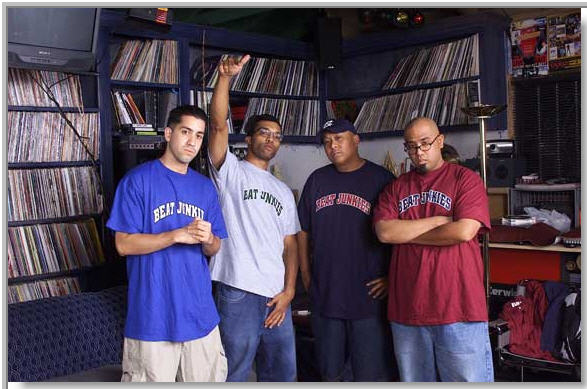
Beat Junkies

The Beat Junkies

It’s dark, concrete surrounds, and there‘s a line of riot police wearing smiley faces. London’s Banksy has painted one of his signature ”weapons of mass distraction“ murals on the walls of this downtown industrial warehouse, into which a stream of young urban bohos slowly pours. Keyboardist Money Mark is scheduled to vamp it up later, but right now the Funky President is holding court — J Rocc of the Beat Junkies. With fellow Junkie Rhettmatic waiting in the wings, J Rocc makes it look ridiculously easy, mixing one-handed so he can smoke a cigarette. Like Banksy‘s blend of pop iconography splayed on the walls, J Rocc is a one-man soundclash, bringing together everything from obscure ’70s funk to exclusive hip-hop remixes, his body in perpetual motion as he fluidly adjusts pitch, volume and fidelity.

A 15-minute trip up the I-5 later, and J Rocc‘s still in the mix, only now he’s exchanged the murky warehouse for the brightly lit DJ booth at KPWR, a.k.a. Power 106. Jurassic 5, fresh off their triumphant Smokin‘ Grooves show at the Universal Amphitheater, are tossing freestyles back and forth as J Rocc coolly bounces beats off the station’s new digital CD turntables. It‘s Friday Night Flavas, and J is hosting as part of the Fantastik 4our, alongside DJs Truly Odd, C-Minus and host Mr. Choc, the latter yet another Beat Junkie. At the same moment, across town, Junkies Icey Ice and Curse are presenting Seditious Beats on KPFK, while back downtown, Rhettmatic has taken over the mix for Banksy’s after-party. The Junkies are anywhere, everywhere in Los Angeles tonight. They don‘t belong to the city. The city belongs to them.

There has never been a DJ crew in any American city as dominant as the Beat Junkies, who celebrate their 10th anniversary on August 17. Since forming in 1992, the Junkies have helped anchor L.A.’s hip-hop scene in the clubs, on the radio and in retail, not to mention broken ground as innovative scratch DJs. True, the Bay Area‘s defunct Invisbl Skratch Piklz had more international prestige, and New York’s X-ecutioners have achieved more commercial success. But to conceive of what the Junkies have done in the ‘90s, you’d have to imagine New York‘s DJ kings of the ’80s — Red Alert, Marley Marl, Frankie Knuckles, Grandmaster Flash, etc. — all coming from the same neighborhood, forming a crew and staying intact for the next 10 years. And even then the comparison might not be adequate, since, at the end of their first decade, the Junkies are only getting better.

The Junkies inherited the mantle formerly worn by pioneering L.A. hip-hop DJs like Uncle Jam‘s Army, Dr. Dre, Greg Mack, Alladin and Joe Cooley, otherwise known as the KDAY Mixmasters. Indeed, all of the Junkies cite AM 1580 — the nation’s first 24-hour rap station — as a common inspiration. ”They actually gave the DJs a break, and gave them some time,“ says J Rocc. The problem for the Junkies was that they weren‘t from L.A. proper, but grew up behind the Orange Curtain in Cerritos. ”Coming from O.C., you had to work 10 times as hard just to prove yourself,“ says Rhettmatic. J Rocc notes that while Orange County hip-hop strongholds like Santa Ana boasted luminaries such as Alladin, ”They didn’t have the same light as L.A.,“ even though ”they were on the same shit.“

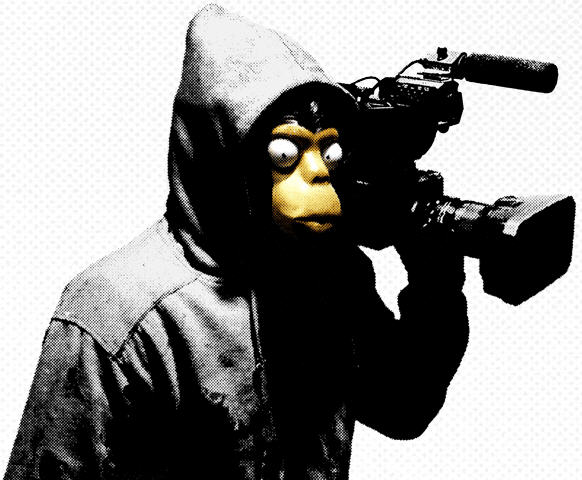
Banksy (Yes, Banksy) on Thierry, EXIT Skepticism, Documentary Filmmaking as Punk

Tullycast

ALL THESE WONDERFUL THINGS

BY A.J. SCHNACK

Banksy

Banksy

Note – The second in a series of interviews with the directors of some of our favorite nonfiction features of 2010…

Whenever the subject of EXIT THROUGH THE GIFT SHOP has come up in casual or not-so-casual conversation over the past year, a vigorous discussion has followed. I’ve seen master filmmakers, newcomers, film critics and non-pros all engage in excited, lengthy dissections of the film – sometimes about what’s real, what they suspect is not – often about the film’s profound take on art and commerce. In the end, no matter what point of view the individual holds, the conclusion seems to always be that it’s a major work in the nonfiction canon.

One would be forgiven for not expecting all this when Sundance announced EXIT as a late addition to the 2010 festival. The debut film by Banksy – the anonymous British artist who gained notoriety and fame for his often-politically charged work that would turn up in some very unusual places (inside museum galleries, on the West Bank wall that separates Israelis and Palestinians) – EXIT would leave the festival spurring numerous distribution offers and go out on its own, working with sales agent John Sloss and distributor Richard Abramowitz to bring the film to theatres in the spring. And after a somewhat surprising (relief was more like it) inclusion on the Academy’s Documentary Feature shortlist, the film finds itself smack in the middle of Best-of-the-Year conversations. It’s nominated for the Documentary prize at the Film Independent Spirit Awards and it’s up for 6 awards at next months Cinema Eye Honors, including Outstanding Feature and Outstanding Debut, not to mention the numerous film critics prizes its been garnering (yesterday, it was announced as the Best Documentary and Best First Feature on indieWIRE’s annual critics poll).

Over the past month, we’ve had the opportunity to spend some time with the team behind EXIT – producer Jaimie D’Cruz and editor Chris King – including hosting the duo at a screening here in Los Angeles at Cinefamily earlier this month. In their presence, I witnessed numerous others trying to find out what Banksy thinks of this or that.

I had my own questions and Banksy and team were kind enough to get me his answers (via email, of course)…

Mr. Brainwash Bombs L.A.

Banksy, Thierry Guetta

A DIY art spectacle only money and moxie could buy

L.A. WEEKLY

By Shelley Leopold -> June 12, 2008

The faded mocha edifice that until last year housed CBS’s Columbia Square studios looks at first glance completely abandoned. On giant placards that once displayed pristine, smiling headshots of the KCBS news team, the local newscasters now sport spray-painted Marilyn Monroe wigs, Warhol style. On another billboard, hand-scrawled letters spelling “Life Is Beautiful” drip as if they had been painted in fresh blood.


Is it good old vandalism, or signs of life?

Aficionados of Los Angeles street art might recognize the now-familiar work of one “Mr. Brainwash,” a.k.a. MBW, a.k.a. Thierry Guetta, a French filmmaker turned graffiti provocateur. Over the past few months, Mr. Brainwash images have become ubiquitous in greater Hollywood, evolving from the Banksy-style black-and-white stencils of a guy wielding a movie camera to repurposed reproductions of Elvis, Hendrix, Gandhi and other cultural icons, including the giant spray-paint can rebranded, à la Andy, as Campbell’s Tomato Spray. These MBW specials are wheat-pasted up and down the La Brea corridor, the Miracle Mile, Melrose, Fairfax . . . anyplace with an unadorned utility box or blank wall.

Now Guetta is about to unleash an art happening at Columbia Square so audacious in scale and ambition that it will either make him an instant art star or an object of derision, a high-profile lesson in the perils of the vanity DIY spectacle. Either way, the opening party is going to be fabulous.

MORE