Part Two
Add to: Facebook | Digg | Del.icio.us | Stumbleupon | Reddit | Blinklist | Twitter | Technorati | Furl | Newsvine
Part Two
Add to: Facebook | Digg | Del.icio.us | Stumbleupon | Reddit | Blinklist | Twitter | Technorati | Furl | Newsvine
By Alec MacGillis
Washington Post Staff Writer
Thursday, June 18, 2009

John Edwards says he has few illusions. He knows the picture many Americans hold of him is not a pretty one. He also knows that even before he was engulfed in tabloid scandal, his electoral appeal had limits. And he believes that President Obama, the man who stole whatever rising-star magic he once had, is doing a good job.
Yet as he spends his days in his family’s mansion on the outskirts of Chapel Hill, N.C., Edwards can’t help but fret about how Washington and the country are getting on in his absence. He worries about the concessions that may be made on health-care reform, which he was promoting more aggressively than anyone on the presidential campaign trail. He worries about who will speak out for the country’s neediest at a time when most attention is focused on the suddenly imperiled middle class.
“What happens now? If you were to ask people during the campaign who’s talking most about [poverty], it was me,” he said in an interview a few days ago. “There’s a desperate need in the world for a voice of leadership on this issue. . . . The president’s got a lot to do, he’s got a lot of people to be responsible for, so I’m not critical of him, but there does need to be an aggressive voice beside the president.”
It has been 10 months since Edwards looked into a TV camera and said that in 2006, while preparing for his second run for president and while his wife’s cancer was in remission, he had an affair with a videographer working for him, Rielle Hunter — and then decided to run for president anyway, risking a scandal that could have devastated Democrats’ chances had he won the nomination.
He has hardly been seen since. In October, he mourned the death of his close friend and biggest financial supporter, trial lawyer Fred Baron, the man who had paid to move Hunter and her baby to Santa Barbara, Calif. In December, after being contacted by anti-poverty groups, Edwards helped deliver food and medication to Haiti. He learned in the months following that federal agents were investigating whether his campaign had funneled money to Hunter, an allegation he denies.
Last month his wife Elizabeth went on a media tour for her new memoir. She told Oprah Winfrey that she had “no idea” whether her husband was the father of Hunter’s baby girl, despite his earlier avowal that it was not. Asked whether she still loved her husband, Elizabeth Edwards said, “It’s complicated.”
John Edwards had left the country for much of the book tour. He was in El Salvador, helping a group called Homes From the Heart with its work building houses and clinics and distributing sewing machines. The group’s director, Michael Bonderer, was surprised when Edwards accepted his invitation.
“Obviously he’s got some problems, but he’s a nice guy,” Bonderer said. “I kind of didn’t know that. I thought, ‘What in God’s name am I going to have when he gets here?’ But he’s a pretty down-to-earth guy.” Edwards was funny, Bonderer said. “He jokes about how it’s obvious that the American people don’t want him to be president.”
But mostly, there are the many long hours in the big house. Edwards spends time with his two younger children, taking them on a trip to the beach last weekend. He keeps company with Elizabeth, whose cancer returned in the spring of 2007. And through it all he contemplates a lifetime of recovering from a steep fall from public grace.
“The two things I’m on the planet for now are to take care of the people I love and to take care of people who cannot take care of themselves,” he said.
In agreeing to his first extended interview since confirming the affair, Edwards refused to talk about Hunter, the baby’s paternity, his wife’s memoir or the campaign investigation. But he spoke expansively over the phone for 90 minutes about his tumultuous decade in politics, which began when, after the death of his teenaged son in a car accident, he left behind a career as a trial lawyer to run for the U.S. Senate in 1998.
He said that for all the trauma that came of the 2008 campaign, he is not ready to declare that it had been a mistake to run, calling that a “very complex question.” He believed, he said, that he had pushed Obama and Hillary Rodham Clinton in a more progressive direction on issues including health care — Edwards was the first to propose an individual insurance mandate — and that the value of his run will be determined partly by what Obama achieves on these fronts.
“Did it make sense to run and stay in the race? Time will tell,” he said.
He said he has no plans to make a push to restore his name, along the lines of what former New York governor Eliot Spitzer has embarked on. Reputation “is not something I’m focused on,” he said. “The only relevance of it at all is my ability to help people. That’s the only reason it matters. I’m not engaged in, or interested in, being in a PR campaign.”
But he did not rule out a return to politics. He said it was too early to say what the future held — though an Al Gore-style advocacy role is more likely than elected office, given the scandal. He thinks “every day” about what form his future role in activism or public life could take, but “right now, a lot of that is unanswerable.”
“Sometimes you just keep your head down and work hard and see what happens,” he said.
After a strong showing in the 2004 primaries and his ultimately unsuccessful campaign as John Kerry‘s running mate, Edwards left the Senate to prepare for a second presidential run, positioning himself as the more progressive alternative to Clinton despite a voting record that was decidedly centrist on many issues. But then Obama came along. Edwards placed second behind the relative newcomer in the Iowa caucuses, then dropped out of the race in late January. He endorsed Obama in May, putting himself in the mix for vice president or attorney general.
Then came confirmation of the affair. So total has his disappearance been that there has been little accounting of what he left behind. Many of his supporters have yet even to attempt to reckon with the meaning of his campaigns in light of last year’s revelations.
Some Democrats still argue that he pushed Obama and Clinton to the left. But others say his outspoken progressive platform was flawed from the outset — it was better, they say, to frame a progressive agenda in the way Obama did, with broad themes of societal uplift, instead of an explicit appeal on behalf of the poor. These critics say the sincerity of all of Edwards’s rhetoric is in question now, potentially undermining future attempts by politicians to try to focus on poverty.
“The reaction going forward to a politician accepting the mantle of poverty the way Edwards did is that he would be dismissed as insincere,” said Margy Waller, a policy adviser in the Clinton administration. “The risk always was that that would happen to Edwards — not related to the way he treated his wife, but the way he treated the issue overall always seemed insincere. His whole history of working on the issue was fairly limited and always somewhat suspect.”
One legacy still stands: a poverty think tank that he created in 2005 at the University in North Carolina. It is now led by law professor Gene Nichol, who puts on occasional events and oversees student fellowships. The center is funded by a $2 million pledge by a Chapel Hill couple who were strong Edwards supporters. But his name has all but disappeared from the center’s Web site.
It bothers Nichol that Edwards’s many skeptics have used his troubles to justify their cynicism. It is a sentiment shared by Edwards’s former advisers, many of whom have found jobs in the Obama administration and on Capitol Hill. “People say in effect, ‘Well, John Edwards fell off a cliff so poverty obviously isn’t a question for American politics,’ ” Nichol said. “How that can be? I don’t understand.”
Edwards rejected the notion that questions about his credibility would hurt future efforts to combat poverty. “Helping the poor was never about me, and never should have been and isn’t today,” he said. “Whether I did extraordinarily superhuman things or had frailties has nothing to do with people living in the dark every day of their lives.”
Other Edwards initiatives have fallen by the wayside. One week before confirming the affair, he pulled the plug on College for Everyone, a program he started in 2005 at Greene Central High School in Snow Hill, N.C., which paid the first-year college tuition of any graduate who stayed out of trouble and worked 10 hours per week, at a total cost of about $300,000 per year. Edwards touted the program often on the campaign trail, calling it the first step toward a nationwide financial aid initiative.
But Assistant Superintendent Patricia McNeill said many had been bracing for the program’s end once Edwards dropped out of the presidential contest. “Our children today are very astute and they are cognizant of what goes on in the political world,” she said.
Among those who were taken by surprise was Lavania Edwards (no relation), a pre-kindergarten teacher who is still looking for help to cover the college costs of her son Malik, who graduated from high school last week. “We were really planning on that helping,” she said. “I was disappointed and I wondered what happened in that they couldn’t continue with the program — or why no one came out to us with a definite answer.”
Edwards said he had to pull the plug because campaign supporters were less likely to give money to the program once he was out of the race. “But it served its purpose,” he said. “A lot of kids benefited.”
Meanwhile, in New Orleans, residents who had been foreclosed on after Hurricane Katrina by subprime lenders owned by Fortress Investment Group, a hedge fund that Edwards worked for and invested with, have not received the special assistance that Edwards promised after their troubles were reported by The Washington Post and Wall Street Journal in 2007.
Edwards, who launched his campaign in a Katrina-stricken section of New Orleans, had vowed in 2007 that he would raise $100,000 to set up a fund that, administered by the anti-poverty group ACORN, would see to it that the 32 affected homeowners would be made whole.
Among the homeowners were Ernest and Ollie Grant, whose storm-damaged house faced foreclosure by Fortress-owned Nationstar Mortgage, on an adjustable rate loan that shot to $1,200 per month. The Grants said that after months of waiting for ACORN to call them, they reached out on their own and found a helpful employee, “Miss Kristi,” who got their monthly payment down to $649.
But six months ago, Nationstar started sending letters saying the payment was going back up above $900. The Grants called ACORN back, but Miss Kristi was gone, and others there provided no help. With their home finally fixed up, they are again worried about losing it. They bristle at Edwards’s name.
“I just thought he was trying to cover his tracks while he was a candidate. I even told my wife that if he didn’t win, we would feel these repercussions just like we’re doing,” said Ernest Grant. “It was probably all for show in the end.”
Another resident, Eva Comadore, said she never heard from anyone after the day a TV news crew came to ask her about the promise. Comadore had lost her home to foreclosure by Green Tree Servicing, another Fortress company, in May 2007. Since then, she has been paying $400 a month, two-thirds of her Social Security income, to rent a trailer owned by her sister.
“All I know is they were supposed to make some kind of agreement to settle with us but they never did,” she said.
ACORN spokesman Scott Levenson said the group had trouble finding the 32 homeowners. He said the group received $50,000, not $100,000, and that it went to the group’s general mortgage-counseling program in New Orleans.
Edwards said the $50,000 came from him. “I wanted to make a good faith effort,” he said. “Obviously, a problem this deep and widespread would not be solved by an individual presidential candidate.”
In 2007, Edwards said he had gone to work at Fortress because his family needed the income, despite holdings then estimated at $30 million. But in the interview, he said he was no longer fixated on finding lucrative work. “When I’m on my deathbed, I don’t think I’ll be thinking, did I work enough or earn enough money,” he said.
He plans to return to El Salvador next month. “Whether I’m digging a ditch or hammering a nail, I don’t have any pride in this anymore, I just want to help,” he said. “If I can help the most by working quietly, that’s what I’ll do. If as time goes by I can be more helpful with a public role, that’s what I will do.”
He realizes that his transgressions had only bolstered his longtime skeptics, but said that any cynicism about his motives on fighting poverty was “complete foolishness.” “There’s a reason why it’s been many years since a politician made this issue central to him — and, I might add, I didn’t get elected,” he said. “There aren’t many votes in helping poor people.”
Most of all, he wants his most ardent supporters to believe that the message that drove his campaigns was solid, despite all later revelations about the candidate himself.
“It was real, 100 percent real,” he said. “I want them to be proud of what I stood for, and of what the campaign stood for. The stands were honest and sincere and idealistic. They were what America needed then and needs now.”
By John Nichols – www.thenation.com
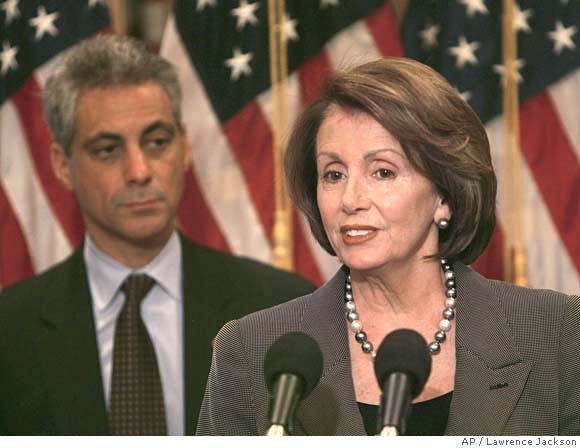
That House Speaker Nancy Pelosi has been a disappointing leader for House Democrats, few serious observers of the congressional condition will deny. But now, she appears to be something more troubling: a serious hindrance to the fight against the use of the crudest and most objectionable torture techniques.
Democrats and Republicans with a conscience have gotten a good deal of traction in recent months in their battle to identify the use by U.S. interrogators of waterboarding – a technique that simulates drowning in order to cause extreme mental distress to prisoners — as what it is: torture. Arizona Senator John McCain, a GOP presidential contender, has been particularly powerful in his denunciations of this barbarous endeavor. And Senate Intelligence Committee chair Jay Rockefeller, D-West Virginia, and key members of the Senate Judiciary Committee have effectively pressed the issue on a number of fronts.
Now, however, comes the news that Pelosi knew as early as 2002 that the U.S. was using waterboarding and other torture techniques and, far from objecting, appears to have cheered the tactics on.
The Washington Post reports that Pelosi, who was then a senior member of the House Intelligence Committee, was were informed by CIA officials at a secret briefing in September 2002, that waterboarding and other forms of torture were being used on suspected al-Queda operatives. That’s bad. Even worse is the revelation that Pelosi was apparently supportive of the initiative.
According to the news reports, Pelosi has no complaint about waterboarding during a closed-door session she attended with Florida Congressman Porter Goss, a Republican who would go on to head the Central Intelligence Agency, Kansas Republican Senator Pat Roberts and Florida Democratic Senator Bob Graham.
“The reaction in the room was not just approval, but encouragement,” recalls Goss.
How encouraging? It is reported that two of the legislators demanded to know if waterboarding and other methods that were being employed “were tough enough” forms of torture to produced the desired levels of mental anguish to force information from suspects who, under the Geneva Conventions and the U.S. Constitution, cannot be subjected to cruel or unusual punishment.
Was Pelosi one of the “tough-enough” cheerleaders for waterboarding? That is not clear, as the speaker has refused to comment directly regarding her knowledge of torture techniques and encouragement of their use. Another member of the House who is closely allied wit Pelosi did tell the Post, however, that the California Democrat attended the session, recalled that waterboarding was discussed, and “did not object” at the time to that particular torture technique.
If this is the case, Pelosi has provided aid and comfort to the Bush administration’s efforts to deviate not just from the standards set by international agreements regarding war crimes but from the provision of the Bill of Rights that establishes basic requirements with regard to the treatment of prisoners who in the custody of the United States.
Those deviations are precisely the sort of impeachable offenses that Pelosi has said are “off the table.” Her association with the administration on the matter of torture necessarily calls into question the speaker’s credibility on questions of how and when to hold the administration to account. It also begs a more mundane political question: At a point when Republicans like John McCain are earning points with their forthright stances against waterboarding, isn’t the credibility and the potential effectiveness of the House Democratic Caucus as an honest player in the debate profoundly harmed by the involvement of its leader in behind-the-scenes meetings that by all accounts encouraged the use of that technique?
 The New York Herald Sun