Pelosi
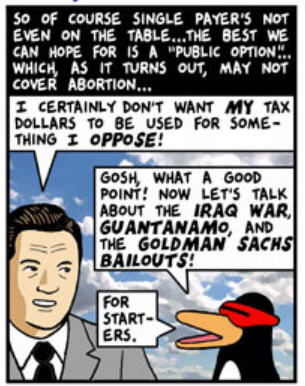
Bill Maher O V E R T I M E May 15, 2009
Politics, TullycastHow Modo Lost Her Mojo ~ Maureen Dowd and the Myth of the Parasite Bloggers
Beltway Groupthink, Bloggers, C.I.A., Dick Cheney, George W. Bush, Glenn Greenwald, Maureen Dowd, Nancy Pelosi, New York Times, Plagiarism
Monday May 18, 2009 07:41 EDT
The myth of the parasitical bloggers
(updated below)
Maureen Dowd’s wholesale, uncredited copying of a paragraph written by Josh Marshall (an act Dowd has now admitted) — for what I yesterday called her “uncharacteristically cogent and substantive column”– highlights a point I’ve been meaning to make for awhile. One of the favorite accusations that many journalists spout, especially now that they’re searching for reasons why newspapers and print magazines are dying, is that bloggers and other online writers are “parasites” on their work — that their organizations bear the cost of producing content and others (bloggers and companies such as Google) then unfairly exploit it for free.
The reality has always been far more mixed than that, and the relationship far more symbiotic than parasitical. Especially now that online traffic is such an important part of the business model of newspapers and print magazines, traffic generated by links from online venues and bloggers is of great value to them. That’s why they engage in substantial promotional activities to encourage bloggers to link to and write about what they produce. Beyond that, it is also very common — as the Dowd/Marshall episode illustrates — for traditional media outlets and establishment journalists to use and even copy content produced online and then present it as their own, typically without credit. Many, many reporters, television news producers and the like read online political commentary and blogs and routinely take things they find there.
Typically, the uncredited use of online commentary doesn’t rise to the level of blatant copying — plagiarism — that Maureen Dowd engaged in. It’s often not even an ethical breach at all. Instead, traditional media outlets simply take stories, ideas and research they find online and pass it off as their own. In other words — to use their phraseology — they act parasitically on blogs by taking content and exploiting it for their benefit.
Since I read many blogs, I notice this happening quite frequently — ideas and stories that begin on blogs end up being featured by establishment media outlets with no credit. Here’s just one recent and relatively benign example of how it often works: at the end of March, I wrote a post that ended up being featured in many places concerning the unique political courage displayed by Jim Webb in taking on the issue of criminal justice reform and the destruction wreaked by our drug laws. The following week, I was traveling and picked up a copy of The Economist in an aiport, which featured an article hailing Jim Webb’s political courage in taking on the issue of criminal justice reform and the destruction wreaked by our drug laws.
Several of the passages from the Economist article were quite familar to me, since they seemed extremely similar to what I had written — without attribution or credit:
Salon
America has easily surpassed Japan — and virtually every other country in the world — to become what Brown University Professor Glenn Loury recently described as a “a nation of jailers” whose “prison system has grown into a leviathan unmatched in human history.”
Economist
“A Leviathan unmatched in human history”, is how Glenn Loury, professor of social studies at Brown University, characterises America’s prison system.
Salon
Most notably, Webb is in the Senate not as an invulnerable, multi-term political institution from a safely blue state (he’s not Ted Kennedy), but is the opposite: he’s a first-term Senator from Virginia, one of the “toughest” “anti-crime” states in the country (it abolished parole in 1995 and is second only to Texas in the number of prisoners it executes), and Webb won election to the Senate by the narrowest of margins, thanks largely to George Allen’s macaca-driven implosion.
Economist
Mr Webb is far from being a lion of the Senate, roaring from the comfort of a safe seat. He is a first-term senator for Virginia who barely squeaked into Congress. The state he represents also has a long history of being tough on crime: Virginia abolished parole in 1994 and is second only to Texas in the number of people it executes.
Salon
Moreover, the privatized Prison State is a booming and highly profitable industry, with an army of lobbyists, donations, and other well-funded weapons for targeting candidates who threaten its interests.
Economist
Mr Webb also has some powerful forces ranged against him. The prison-industrial complex (which includes private prisons as well as public ones) employs thousands of people and armies of lobbyists.
Salon
That is an issue most politicians are petrified to get anywhere near . . . .[T]here is virtually no meaningful organized constituency for prison reform. To the contrary, leaving oneself vulnerable to accusations of being “soft on crime” has, for decades, been one of the most toxic vulnerabilities a politician can suffer.
Economist
Few mainstream politicians have had the courage to denounce any of this. People who embrace prison reform usually end up in the political graveyard. There is no organised lobby for prison reform.
I don’t consider that at all similar to what Dowd did, since there wasn’t wholesale copying. In fact, since there wasn’t really full-on copying, I don’t think there’s any ethical issue involved in this example. I don’t think the writer of that article did anything wrong at all. And anyone who spends any time writing a blog, or anything else for that matters, should consider it a good thing when their work is used, with or without credit. Nobody would engage in that activity in the absence of a belief that they have something worthwhile to say and a desire that it have some impact on political discussions.
I raise this only to illustrate how one-sided and even misleading is the complaint that bloggers are “parasites” on the work of “real journalists.” Often, the parasitical feeding happens in the opposite direction, though while bloggers routinely credit (and link to) the source of the material on which they’re commenting, there is an unwritten code among many establishment journalists that while they credit each other’s work, they’re free to claim as their own whatever they find online without any need for credit or attribution (see here for a typical example of how many of these news organizations operate in this regard).
It’s difficult to quantify, but a large percentage of political reporters, editors, television news producers, and on-air pundits read political blogs or other online venues now. Many do so precisely because blogs are a prime source for their story ideas. Contrary to the myth perpetrated by establishment media outlets, there is substantial original reporting, original analysis and the like that takes place on blogs. That’s precisely why so many journalists, editors and segment producers read them. And while some are quite conscientious about identifying the online source of the material they use — The New York Times‘ Scott Shane recently credited Marcy Wheeler for a major, front-page story on torture and previously wrote an article hailing FireDogLake as having the best coverage of any news organization of the Lewis Libby trial — credit of that sort is still rare enough that it becomes noteworthy when it happens.
The tale of the put-upon news organizations and the pilfering, parasitical bloggers has always been more self-serving mythology than reality. That’s not to say that there’s no truth to it, but the picture has always been much more complicated. After all, a principal reason for the emergence of a political blogosphere is precisely because it performed functions that establishment media outlets fail to perform. If all bloggers did was just replicate what traditional news organizations did and offered nothing original, nobody would read blogs. And especially now, as bloggers and online writers engage in much more so-called “original reporting” and punditry, the parasitical behavior is often the reverse of how it is depicted. The Maureen Dowd/Josh Marshall episode is a particularly vivid and dramatic example of that, but it is far from uncommon.
UPDATE: A blogger who writes on TPM’s open blog site, Boyd Reed, reacted to the Maureen Dowd story today by randomly entering some of his own posts in Google, and found that a reporter at Salem News, Dorsett Bennett, copied several paragraphs of Reed’s post on Michelle Bachmann verbatim for Bennett’s column on the same topic. Reed writes about his discovery today here (h/t Liberal Artist). Compare Reed’s February 20 TPM post with Bennett’s February 27 Salem News column. The copying is extensive and shameless. Parasitical indeed.
"There Will Be No Investigation of Torture" Declares Village
Abu-Ghraib, Barack Obama, C.I.A., Dick Cheney, George W. Bush, Guantanamo, Illegal Wiretapping, Jay Bubee, John Yoo, Nancy Pelosi, Steven Bradbury, Torture, Valerie PlameBill Maher | May 15, 2009 | Elizabeth Warren
Abu-Ghraib, Cheney, G.O.P., George W. Bush, Pelosi, Politics, Torture, TullycastBill Maher | May 15, 2009 | Elizabeth Warren
Vodpod videos no longer available.
New Rules From Bill Maher For May 15, 2009
Barack Obama, Dick Cheney, G.O.P., Nancy Pelosi, Politics, Torture, Tullycast, Wall Street, YoutubeBill Maher May 15, 2009 Opening Monologue
Amy Holmes, Dan Savage, David Simon, Politics, Richard Brookheiser, Tullycast, YoutubeRepublicans Defend Torture With Two Tasty Words: Nancy Pelosi
Abu Graib, Barack Obama, Dick Cheney, George W. Bush, Guantanamo, Nancy Pelosi, Torture, WaterboardingPelosi and Torture
AFTER DOWNING STREET
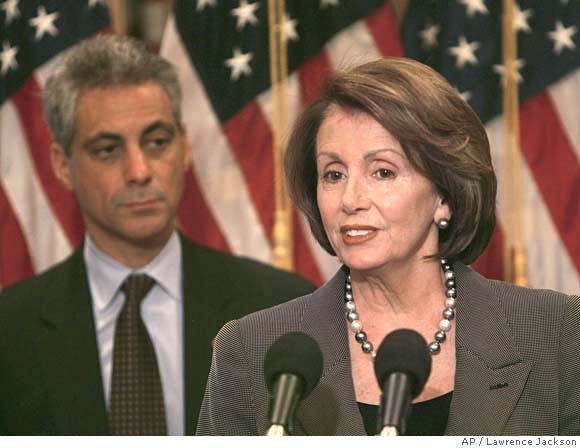
By John Nichols – www.thenation.com
That House Speaker Nancy Pelosi has been a disappointing leader for House Democrats, few serious observers of the congressional condition will deny. But now, she appears to be something more troubling: a serious hindrance to the fight against the use of the crudest and most objectionable torture techniques.
Democrats and Republicans with a conscience have gotten a good deal of traction in recent months in their battle to identify the use by U.S. interrogators of waterboarding – a technique that simulates drowning in order to cause extreme mental distress to prisoners — as what it is: torture. Arizona Senator John McCain, a GOP presidential contender, has been particularly powerful in his denunciations of this barbarous endeavor. And Senate Intelligence Committee chair Jay Rockefeller, D-West Virginia, and key members of the Senate Judiciary Committee have effectively pressed the issue on a number of fronts.
Now, however, comes the news that Pelosi knew as early as 2002 that the U.S. was using waterboarding and other torture techniques and, far from objecting, appears to have cheered the tactics on.
The Washington Post reports that Pelosi, who was then a senior member of the House Intelligence Committee, was were informed by CIA officials at a secret briefing in September 2002, that waterboarding and other forms of torture were being used on suspected al-Queda operatives. That’s bad. Even worse is the revelation that Pelosi was apparently supportive of the initiative.
According to the news reports, Pelosi has no complaint about waterboarding during a closed-door session she attended with Florida Congressman Porter Goss, a Republican who would go on to head the Central Intelligence Agency, Kansas Republican Senator Pat Roberts and Florida Democratic Senator Bob Graham.
“The reaction in the room was not just approval, but encouragement,” recalls Goss.
How encouraging? It is reported that two of the legislators demanded to know if waterboarding and other methods that were being employed “were tough enough” forms of torture to produced the desired levels of mental anguish to force information from suspects who, under the Geneva Conventions and the U.S. Constitution, cannot be subjected to cruel or unusual punishment.
Was Pelosi one of the “tough-enough” cheerleaders for waterboarding? That is not clear, as the speaker has refused to comment directly regarding her knowledge of torture techniques and encouragement of their use. Another member of the House who is closely allied wit Pelosi did tell the Post, however, that the California Democrat attended the session, recalled that waterboarding was discussed, and “did not object” at the time to that particular torture technique.
If this is the case, Pelosi has provided aid and comfort to the Bush administration’s efforts to deviate not just from the standards set by international agreements regarding war crimes but from the provision of the Bill of Rights that establishes basic requirements with regard to the treatment of prisoners who in the custody of the United States.
Those deviations are precisely the sort of impeachable offenses that Pelosi has said are “off the table.” Her association with the administration on the matter of torture necessarily calls into question the speaker’s credibility on questions of how and when to hold the administration to account. It also begs a more mundane political question: At a point when Republicans like John McCain are earning points with their forthright stances against waterboarding, isn’t the credibility and the potential effectiveness of the House Democratic Caucus as an honest player in the debate profoundly harmed by the involvement of its leader in behind-the-scenes meetings that by all accounts encouraged the use of that technique?
Stimulus: How to Know If It's Working
Barack Obama, D.C. Groupthink, Economic Stimulus, GOP, Jobs, Media Misinformation, PoliticsFebruary 11, 2009
Consumer confidence and job creation may be slow to emerge and hard to measure, but boosts in umemployment benefits and food stamps will be fast acting
By Moira Herbst
At his first prime-time press conference, President Obama was asked a central question about the $800 billion-plus economic stimulus package: How will Americans know if it’s working? “My initial measure of success is creating or saving 4 million jobs,” Obama answered.
That was on Feb. 9, a day before the Senate passed an $838 billion version of the bill by a vote of 61-37, following the Jan. 28 passage of an $819 billion version in the House. The House and Senate have begun negotiations to reconcile the measures, which Obama would like to sign into law by Feb. 16, the federal Presidents’ Day holiday. When people have a job, Obama explained, they purchase and invest, allowing companies to do the same and, in turn, to hire more workers as business expands.
Indicators of Success
Yet while job creation is arguably the most important goal of the stimulus package, other parts of the bill will have a much more immediate and visible impact. Food stamp increases and extensions of unemployment benefits will be among the first noticeable effects of the package. Tax credit payments for individuals and families would follow, along with other tax breaks and incentives. Rising consumer confidence and lower unemployment will be far more gradual, and aren’t likely to surface until late 2009 at the earliest.
There’s an understanding among many economists that the sooner a government intervenes in an economic crisis, the more effective it tends to be in getting the economy back on track. That doesn’t mean that precise measurement of success is easy, however. “The problem is, we don’t know what trajectory the economy would take without the stimulus package,” says J. Bradford DeLong, an economics professor at the University of California-Berkeley. “We can’t enter a Star Trek-like divided universe in which we compare what’s happening with the stimulus versus without it. It’s hard to precisely judge its impact.”
DeLong says that looking at interest rates will provide a clearer idea of whether the stimulus plan is working. “If interest rates stay extremely low, the plan is definitely working,” he says. “If Treasury interest rates do start to rise by more than normal levels, then we worry that [the spending] is crowding out private economic activity and discouraging investment.” Specifically, he says that if medium- to long-term Treasury bond interest rates climb two or three percentage points higher in the next year and inflation sets in, the stimulus package is not having its intended effect.
Swift Help for the Neediest
Of course, how one benefits from the stimulus package depends on several factors, including income, professional skills, and where you live. “What you’ll see [in benefit] and when you see it depends on who you are,” says Steve Ellis, vice-president at Taxpayers for Common Sense, a taxpayer advocacy group. “If you are living hand-to-mouth, you should have greater access to food stamps and other assistance right away. If you’re employed and not doing as well but hanging on, you won’t see much change unless a [federally funded] construction project starts up nearby. For them, the government hand will be less visible and less direct.”
Direct assistance for the poor and unemployed, considered as among the most effective stimulus measures, will be the first to take effect. Both the House and Senate bills offer an additional $20.2 billion to extend emergency unemployment benefits for more than 3 million people whose state benefits are set to run out after March. They also offer an extra $25 a week in jobless benefits to millions of workers through the end of the year; the current average weekly benefit is $293.
The packages also would give $7 billion to states that adopt reforms that make it easier for part-time workers, low-wage earners, and women to qualify for benefits. The proposals vary in the amounts by which they would increase food stamp benefits and additional medical assistance for low-income, unemployed workers under Medicaid, but both include spending for these items. An additional $17 billion in the stimulus bills would boost the maximum Pell Grant for higher education by $400 per applicant and provide other financial aid. Along with extended benefits, the unemployed may start to see shorter lines at the unemployment office. Both stimulus bills give states $500 million to help process unemployment applications, which have been overwhelming state systems across the country.
Tax Credits and State Aid
Working and middle-income Americans will benefit from the $82.1 billion in tax credit payments the plans offer. The House plan would give individuals earning up to $75,000 a year a tax credit of $500 and couples earning up to $150,000 a year a tax credit of $1,000. (The Senate bill lowers the income cap to $70,000 for individuals and $140,000 for couples, which critics say would reduce the stimulus effect.) Taxpayers can receive this credit either by claiming a credit on their 2009 and 2010 tax returns or by reducing their withholding from their paychecks. Other tax incentives to encourage auto and home purchases, included in the Senate bill, would be experienced by consumers at the time of purchase.
Later this year, the effects of other spending will become more visible. The bills offer states tens of billions in “state stabilization” money, to fund grants for education and to patch holes that have emerged in many state budgets. (The House bill sets aside $79 billion in state stabilization funds, the Senate bill cuts that to $39 billion.) Another $3 billion is earmarked for state and local law enforcement.
In the meantime, the stimulus plans are expected to create or save jobs in various sectors of the economy. The nonpartisan Congressional Budget Office estimated that the House version of the bill would create between 1.3 million and 3.9 million jobs by the end of 2010. While police officers and teachers might feel the effect immediately, other workers would find jobs later this year on such projects as modernizing electrical grids, building highways, and weatherizing federal buildings.
Metrics May Prove Elusive
Mark Zandi, chief economist at Moodys.com (MCO), says that if the package works according to Washington’s plan, unemployment insurance claims should start to drop in the summer and continue through the fall. He warns, however, that the unemployment rate will be slower to fall because layoffs will offset some of the gains. Some economists say that even as the unemployment rate does begin to fall, it will be hard to measure what would have happened without the economic stimulus plan.
The stimulus is likely to provoke heated “Did it work?” debates for years to come among politicians, economists, and the public. “We are throwing a rock into our nation’s economic pond, and the ripple effects will spread throughout the economy,” says Ellis of the taxpayer group. Still, he says the impact might be more muted than many would hope: the annual U.S. gross domestic product is $13 trillion, while the stimulus package is about $900 billion over several years. Says Ellis: “It’s a big rock, but it’s a very big pond.”
Herbst is a reporter for BusinessWeek in New York.

 The New York Herald Sun