Stephen Baldwin, who has threatened to move to Canada if Barack Obama is elected, has now challenged the candidate to box for charity. “I’d like to knock some good sense into Barack,” Alec’s right-wing bro said at the Printing House Gym in the Village. “I wouldn’t hurt him. But if he wins the election, he’ll hurt me. He’s a cultural terrorist.” This from the man who enriched us all with “Sex Monster” and “Snakeman.”
Republicans
The End of The Ownership Society
Banking, Broadcatching, Credit Default Swaps, George W. Bush, Hedge Funds, Lehman, Ownership Society, Politics, Wall Street
End of the ‘Ownership Society’
From the magazine issue dated Oct 20, 2008
Remember the ownership society? President George W. Bush championed the concept when he was running for re-election in 2004, envisioning a world in which every American family owned a house and a stock portfolio, and government stayed out of the way of the American Dream.
These families were, of course, conservative, or at a minimum traditional and nuclear, consisting of a heterosexual married couple and at least two kids living in a stand-alone home with a yard, a car or two and a multimedia room with a flat-screen television. The latter was a new addition to this 21st-century simulacrum of the 1950s “Leave It to Beaver” idyll. But the dream was the same.
Such a country would be more stable, Bush argued, and more prosperous. “America is a stronger country every single time a family moves into a home of their own,” he said in October 2004. To achieve his vision, Bush pushed new policies encouraging homeownership, like the “zero-down-payment initiative,” which was much as it sounds—a government-sponsored program that allowed people to get mortgages without a down payment. More exotic mortgages followed, including ones with no monthly payments for the first two years. Other mortgages required no documentation other than the say-so of the borrower. Absurd though these all were, they paled in comparison to the financial innovations that grew out of the mortgages—derivatives built on other derivatives, packaged and repackaged until no one could identify what they contained and how much they were, in fact, worth.
As we know by now, these instruments have brought the global financial system, improbably, to the brink of collapse. And as financial strains drive husbands and wives apart, Bush’s ownership ideology may end up having the same effect on the stable nuclear families conservatives so badly wanted to foster.
The dream of a better society through homeownership didn’t originate with George W. Bush. It’s as American as Manifest Destiny. The Homestead Act in 1862 offered acres to anyone willing to brave the Western frontier. During Reconstruction, freed slaves were promised “40 acres and a mule.” And after World War II, with Levittown and its cousins, affordable homes were a reward of victory. But until very recently, those hopes and dreams were connected to actual income and gainful employment. No longer.
The giddiness of the Bush years built on the promise of the New Economy era, a promise perfectly encapsulated by a 1999 billboard advertising a shiny new subdivision in Scroggins, Texas, filled with homes that most of their owners couldn’t really afford: YES, YOU CAN HAVE IT ALL! That dream took a sharp hit with the collapse of the Internet stock bubble in 2000-2001 and then with 9/11, both of which destroyed billions of dollars of wealth. But it came roaring back in 2002, encouraged by Bush’s post-9/11 exhortation that Americans could do their patriotic duty by going shopping and paying lower taxes, even as government spending exploded. Shop they did, and homes they bought.
The spree wasn’t confined to the United States. Britain has its own version of the ownership society, which received a boost from Margaret Thatcher, who promoted “a property-owning democracy” that her Labour successors, Tony Blair and Gordon Brown, endorsed. Blair liked to talk of building a “stakeholder economy” with a big role for the ordinary property-owning citizen. More recently, Brown has spoken of creating a “homeowning, asset-owning, wealth-owning democracy.” Millions were happy to buy into the vision. Tenants of government-owned properties gladly took up Thatcher’s offer to sell them their homes at knockdown prices. More than 70 percent of Britons now own their homes, compared with 40 percent of Germans and 50 percent of French.
In Britain as in the United States, the vision was about more than owning a home. It was about being a better person. With a home came traditional values, an appreciation of hard work, prudent living, civic-mindedness, patriotism and ultimately a more stable society. Or so the rhetoric went.
But eventually, it all went sour. By the turn of the century, the proliferation of easy credit and universal stock ownership combined to create anything but a conservative society of thrift. Average household debt levels are now higher in Britain than in any other major country in the developed world. In the United States, the shift away from corporate pensions to 401(k) retirement accounts plunged millions more into the equity markets and loosened the traditional connection between companies and workers, which was one element of that 1950s dream that conservatives like Bush conveniently forgot. The ownership society of the 1950s was anchored by a labor movement that made sure that workers received something resembling their share—remember Truman’s Fair Deal? The deal for the past eight years has been fair to merchants of capital, and then some. But to the tens of millions on the receiving rather than originating end of those mortgages, fairness has been in short supply.
No, this can’t be reduced to a swindle. We all bear some burden for the current morass. You can’t peddle what people don’t want to buy, and for a while it seemed a decent trade-off: Wall Street got rich, and Main Street got homes. The easy terms—and that is putting it lightly—of mortgages gave many a chance to own a home who never would have qualified for a mortgage in years past. But it also gave others the option to buy, sell and flip. Every speculator a home? That wasn’t supposed to be part of the equation.
The irony is that more homeownership and stock ownership has actually weakened traditional bonds. For the past decade, as homeownership went up, marriages continued to fail. As a percentage of the population, fewer people are getting married now than 10 years ago. Single-parent homes are on the rise. So is unemployment, which has increased to 6.1 percent, up from 4.5 percent in 2000. With foreclosures now running at more than 300,000 a month, and stock portfolios and retirement savings shrinking with the global-equity sell-off, there has been a notable increase in demand for mental-health services—which is a problem, given that many health-care plans, the ones left to the private sector, cover only a few visits. Studies have also shown a link between difficult economic straits and declining health and higher mortality. And as the editor and writer Tina Brown, a sharp tracker of social trends, recently said at NEWSWEEK’s Women & Leadership conference, “I think the financial crisis is going to put a lot of marriages under great stress. There really isn’t enough to go around, and there are choices to be made. When men lose their job they frequently feel a great loss of manly self-confidence, and that has great impact on a marriage.”
The final referendum on the ownership society will be the November election. The rhetoric of both parties and candidates for president suggests that regardless of who wins, the vision of the past eight years is being rejected in favor of hunkering down, paying off debt, regulating the anarchic world of credit and derivatives, and unraveling systemic knots that have assumed Gordian complexity. As Barack Obama recently said, “in Washington they call this the ownership society, but what it really means is, you’re on your own.”
This crisis will pass, eventually, and on the other side there will still be global electronic exchanges and computer-enhanced models; there will still be mortgages; and there will still be a deep cultural yearning for a place of one’s own. There may be less froth and more discipline in the coming years—combined with reduced circumstances and less money. Lean times are their own source of hopes and desires, and drive people to find new ways to satisfy old yearnings. There may be more prudent ways to create a world where families are stable and living in their own homes. But the gap between that dream and messy reality isn’t likely to close any time soon. Let’s hope that we have learned something about how much we can have and how quickly. For Americans in particular, that would be a real revolution.
Karabell is president of RiverTwice Research and senior adviser for Business for Social Responsibility.
Dennis Kucinich Rocks The House; Pleads With Americans to "Wake Up"
StoriesFrom John Amato’s Singular Crooks and Liars
Download | Play
Download | Play
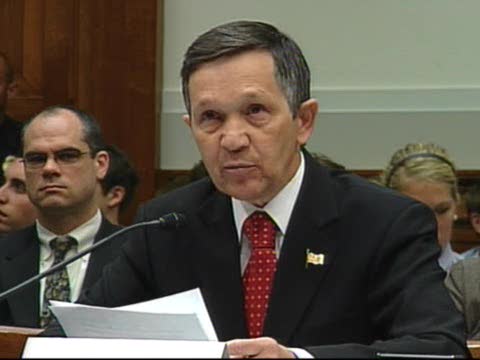
Ohio Congressman Dennis Kucinich spoke at the Democratic National Convention today and there is little doubt his was the most enthusiastic and hard hitting speech thus far. Dennis always comes armed with truth and facts, and today was no exception.
From illegal wiretapping, Iraq and high gas prices to playing the fear card, he blazed through the laundry list of Bush hackery and crimes and pounded the message home — Americans to wake up and vote for Barack Obama.
“…Wake up America! The insurance companies took over health care. Wake up America! The pharmaceutical companies took over drug pricing. Wake up America! The speculators took over Wall Street. Wake up America, they want your Social Security. Wake up America, multi-national corporations took over our trade policies, factories are closing, good paying jobs are being lost, wake up America!”
Now that’s the spirit! We need to hear more of this during the convention. The American electorate needs a good dose of reality. If this speech doesn’t get you fired up, nothing will.
Kos Jumps a Shark
Stories[Ed. note: I’ve liked Markos since I used to read his baby blog and before he basically
invented the Netroots. With that said, this may not just be his “Jump the Shark” moment but it may also be some of the worst writing in the history of the game]

Daily Kos: State of the Nation
Rewarding good behavior
by kos
Tue Jul 01, 2008 at 11:05:46 AM PDTSo many of you are upset that I pulled back my credit card last night, making a last minute decision to hold back on a $2,300 contribution to Obama. Let me explain further:
First of all, obviously Obama is a great candidate who is running a great 50-state race. That much cannot be denied. But he’s had a rough couple of weeks.
First, he reversed course and capitulated on FISA, not just turning back on the Constitution, but on the whole concept of “leadership”. Personally, I like to see presidents who 1) lead, and 2) uphold their promises to protect the Constitution.
Then, he took his not-so-veiled swipe at MoveOn in his “patriotism” speech.
Finally, he reinforced right-wing and media talking points that Wes Clark had somehow impugned McCain’s military service when, in reality, Clark had done no such thing.
All of a sudden, there was a lot of cowering when, just days ago, we got to read this:
When Mr. Wenner asked how Mr. Obama might respond to harsh attacks from Republicans, suggesting that Democrats have “cowered” in the past, Mr. Obama replied, “Yeah, I don’t do cowering.”
Could’ve fooled me, and maybe he is. Maybe what looks like cowering to me is really part of that “moving to the center” stuff everyone keeps talking about. But there is a line between “moving to the center” and stabbing your allies in the back out of fear of being criticized. And, of late, he’s been doing a lot of unecessary stabbing, betraying his claims of being a new kind of politician. Not that I ever bought it, but Obama is now clearly not looking much different than every other Democratic politician who has ever turned his or her back on the base in order to prove centrist bona fides. That’s not an indictment, just an observation.
Now I know there’s a contingent around here that things Obama can do no wrong, and he must never be criticized, and if you do, well fuck you! I respect the sentiment, but will respectfully disagree. We’re allowed to do that here. But fair notice — I will never pull a Rush Limbaugh and carry water for anyone. Not for the Democratic Congress, and not for our future Democratic president. When anyone does something I don’t care for, I will say so. I’ve never pulled my punches before, so why start now?
Obama will be fine without my contribution, and he may even still get it before this thing is said and done, but it would be at a time when he has done something positive. That’s called rewarding good behavior. And if that opportunity fails to arise because Obama goes on a Sister Souljah’ing rampage, then no worries. Chances are good that the DNC would get the money instead. But at this time, I simply have no desire to reward bad behavior. Some of you don’t care about his behavior, or don’t think it’s bad behavior, or whatever. I didn’t ask any of you to follow suit, and don’t care whether you do or not. I didn’t pull him from the Orange to Blue list. I’m not going to start praising Nader or Barr. I’ll still vote for him. Yadda, yadda, yadda. At the end of the day, I’m pretty irrelevant in the whole affair. Obama is going to raise a ton of dough and win this thing whether I send him money or not.
Ultimately, he’s currently saying that he doesn’t need people like me to win this thing, and he’s right. He doesn’t. If they’ve got polling or whatnot that says that this is his best path to victory, so much the better. I want him to win big. But when the Obama campaign makes those calculations, they have to realize that they’re going to necessarily lose some intensity of support. It’s not all upside. And for me, that is reflected in a lack of interest in making that contribution.
That’s it. No need to freak out. It is what it is. Others will happily pick up the slack. We’re headed toward a massive Democratic wave, and what I decide to do with my money means next to nothing, no matter how much hyperventilating may happen on this site’s comments and diaries about it all.
And if for some crazy hard-to-see reason my money actually is important to the Obama campaign, then they can adjust their behavior to get it.
Ann Coulter Credit Card Declined Publix Palm Beach
Coulter
Ann Coulter was left with egg all over her face in the checkout line. The chatty conservative had her credit card rejected at Publix Supermarket in Palm Beach on Saturday night.
The New York Post reports:
According to our spy, the nutty arch-conservative was caught at 9:45 p.m. Saturday night in the 10 Items or Less line at the local Publix when her card was rejected. “She was embarrassed but didn’t make a scene. She just paid with cash and ran out of there. But at least she’s eating.”
Have you seen The PopCrunch Show:

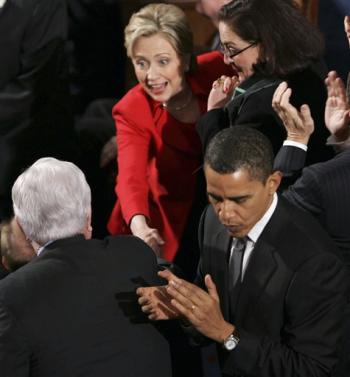
Obama Literally Turns Away From Hillary Clinton as She Attempts Handshake
Hillary, Obama, PoliticsI thought it was very gracious of her to go over to Ted Kennedy and shake his hand

 The New York Herald Sun