Florida Senate: The 27-Second Handshake

Barack Obama, GOP, Senate Races

FL-Sen: The 27-second handshake

by Markos Moulitsas

Fri Jan 29, 2010 at 11:20:09 AM PST

Poor Charlie Crist. His popularity as Florida government may be largely intact, but he’s headed for a massive defeat in the Republican Senate primary. And not massive as in “cash-flush governor gets defeated by little-known cash-strapped upstart”, but massive as in “double-digit blowout”.

Among the ammunition being used against him is this picture, from when Crist endorsed Obama’s stimulus package early last year:

Crist was in a tough spot — ignore the president’s visit, and be accused of political cowardice. The president is visiting bearing several billion in stimulus funds that Crist requested. Greet the president, and fuel the Rubio insurgency.

Of course, making it a 27-second handshake makes it that much more delicious for Crist’s right-wing tormentors. What, did Obama grab him in a vice-like grip and refuse to let go? It would be hilarious if he did.

There is a way for Crist to avoid all this heartache, of course. Switch parties. He’s dead as a Republican. Florida is too expensive for a serious independent run. Become a Democrat, and he has a fighting chance of ever serving in the Senate.

Race tracker wiki: FL-Sen

Ben Bernanke on A.I.G. March 15, 2009 [video]

AIG, Alan Greenspan, Banking Crisis, Ben Bernanke, Business Week, CNBC, Credit Default Swaps, Deep Capture, Derivatives, Federal Reserve, Financial Instryments, Hank Paulson, Hedge Funds, Jim Cramer, Joe Nocera, Lehman, Maria Bartiromo, Mortgage Crisis, Patrick Byrne, Phantom Stocks, Rick Santelli, Short Selling, Stimulus

Real Time With Bill Maher | Opening Monologue | February 20, 2009

Academy Awards, bailout, Banking, Barack Obama, Comedy, Politics, Real Time, Religulous, Ron Paul, Wall Street

Stimulus: How to Know If It's Working

Barack Obama, D.C. Groupthink, Economic Stimulus, GOP, Jobs, Media Misinformation, Politics

February 11, 2009

BUSINESS WEEK

Consumer confidence and job creation may be slow to emerge and hard to measure, but boosts in umemployment benefits and food stamps will be fast acting

By Moira Herbst

bama1At his first prime-time press conference, President Obama was asked a central question about the $800 billion-plus economic stimulus package: How will Americans know if it’s working? “My initial measure of success is creating or saving 4 million jobs,” Obama answered.

That was on Feb. 9, a day before the Senate passed an $838 billion version of the bill by a vote of 61-37, following the Jan. 28 passage of an $819 billion version in the House. The House and Senate have begun negotiations to reconcile the measures, which Obama would like to sign into law by Feb. 16, the federal Presidents’ Day holiday. When people have a job, Obama explained, they purchase and invest, allowing companies to do the same and, in turn, to hire more workers as business expands.


Indicators of Success

Yet while job creation is arguably the most important goal of the stimulus package, other parts of the bill will have a much more immediate and visible impact. Food stamp increases and extensions of unemployment benefits will be among the first noticeable effects of the package. Tax credit payments for individuals and families would follow, along with other tax breaks and incentives. Rising consumer confidence and lower unemployment will be far more gradual, and aren’t likely to surface until late 2009 at the earliest.

There’s an understanding among many economists that the sooner a government intervenes in an economic crisis, the more effective it tends to be in getting the economy back on track. That doesn’t mean that precise measurement of success is easy, however. “The problem is, we don’t know what trajectory the economy would take without the stimulus package,” says J. Bradford DeLong, an economics professor at the University of California-Berkeley. “We can’t enter a Star Trek-like divided universe in which we compare what’s happening with the stimulus versus without it. It’s hard to precisely judge its impact.”

DeLong says that looking at interest rates will provide a clearer idea of whether the stimulus plan is working. “If interest rates stay extremely low, the plan is definitely working,” he says. “If Treasury interest rates do start to rise by more than normal levels, then we worry that [the spending] is crowding out private economic activity and discouraging investment.” Specifically, he says that if medium- to long-term Treasury bond interest rates climb two or three percentage points higher in the next year and inflation sets in, the stimulus package is not having its intended effect.

Swift Help for the Neediest

Of course, how one benefits from the stimulus package depends on several factors, including income, professional skills, and where you live. “What you’ll see [in benefit] and when you see it depends on who you are,” says Steve Ellis, vice-president at Taxpayers for Common Sense, a taxpayer advocacy group. “If you are living hand-to-mouth, you should have greater access to food stamps and other assistance right away. If you’re employed and not doing as well but hanging on, you won’t see much change unless a [federally funded] construction project starts up nearby. For them, the government hand will be less visible and less direct.”

Direct assistance for the poor and unemployed, considered as among the most effective stimulus measures, will be the first to take effect. Both the House and Senate bills offer an additional $20.2 billion to extend emergency unemployment benefits for more than 3 million people whose state benefits are set to run out after March. They also offer an extra $25 a week in jobless benefits to millions of workers through the end of the year; the current average weekly benefit is $293.

The packages also would give $7 billion to states that adopt reforms that make it easier for part-time workers, low-wage earners, and women to qualify for benefits. The proposals vary in the amounts by which they would increase food stamp benefits and additional medical assistance for low-income, unemployed workers under Medicaid, but both include spending for these items. An additional $17 billion in the stimulus bills would boost the maximum Pell Grant for higher education by $400 per applicant and provide other financial aid. Along with extended benefits, the unemployed may start to see shorter lines at the unemployment office. Both stimulus bills give states $500 million to help process unemployment applications, which have been overwhelming state systems across the country.

Tax Credits and State Aid

Working and middle-income Americans will benefit from the $82.1 billion in tax credit payments the plans offer. The House plan would give individuals earning up to $75,000 a year a tax credit of $500 and couples earning up to $150,000 a year a tax credit of $1,000. (The Senate bill lowers the income cap to $70,000 for individuals and $140,000 for couples, which critics say would reduce the stimulus effect.) Taxpayers can receive this credit either by claiming a credit on their 2009 and 2010 tax returns or by reducing their withholding from their paychecks. Other tax incentives to encourage auto and home purchases, included in the Senate bill, would be experienced by consumers at the time of purchase.

Later this year, the effects of other spending will become more visible. The bills offer states tens of billions in “state stabilization” money, to fund grants for education and to patch holes that have emerged in many state budgets. (The House bill sets aside $79 billion in state stabilization funds, the Senate bill cuts that to $39 billion.) Another $3 billion is earmarked for state and local law enforcement.

In the meantime, the stimulus plans are expected to create or save jobs in various sectors of the economy. The nonpartisan Congressional Budget Office estimated that the House version of the bill would create between 1.3 million and 3.9 million jobs by the end of 2010. While police officers and teachers might feel the effect immediately, other workers would find jobs later this year on such projects as modernizing electrical grids, building highways, and weatherizing federal buildings.

Metrics May Prove Elusive

Mark Zandi, chief economist at Moodys.com (MCO), says that if the package works according to Washington’s plan, unemployment insurance claims should start to drop in the summer and continue through the fall. He warns, however, that the unemployment rate will be slower to fall because layoffs will offset some of the gains. Some economists say that even as the unemployment rate does begin to fall, it will be hard to measure what would have happened without the economic stimulus plan.

The stimulus is likely to provoke heated “Did it work?” debates for years to come among politicians, economists, and the public. “We are throwing a rock into our nation’s economic pond, and the ripple effects will spread throughout the economy,” says Ellis of the taxpayer group. Still, he says the impact might be more muted than many would hope: the annual U.S. gross domestic product is $13 trillion, while the stimulus package is about $900 billion over several years. Says Ellis: “It’s a big rock, but it’s a very big pond.”

Herbst is a reporter for BusinessWeek in New York.

Banks Keeping Mum on TARP Bailout Funds; Only Morgan Stanley Coming Clean

ABC, AIG, Banking, Finance, Goldman Sachs, Morgan Stanley, TARP, Treasury, Verizon, Wall Street

inaug3

Morgan Stanley Is One Bank That Cites a Loan From TARP Money

Other Financial Banks Including Goldman Sachs and CitiGroup Keep Mum on How They Are Using TARP Cash

By CHARLES HERMAN, DAN ARNALL, LAUREN PEARLE and ZUNAIRA ZAKI

ABC NEWS

Dec. 17, 2008—

Banks that were rescued with billions of dollars in public funds have, in most cases, refused to provide specifics about how they have used or intend to use the money.

ABC News asked 16 of the banks that have received money from the Treasury Department’s $700 billion Trouble Asset Relief Program the same two questions: How has your financial institution used the money, and how much has your financial institution allocated to bonuses and incentives this year?

To read the banks’ responses, click here.

Goldman Sachs reported Tuesday that it paid $10.93 billion in compensation for the year, which includes salaries and bonuses, payroll taxes and benefits. That is down 46 percent from a year ago. Goldman Sachs received $10 billion from the Treasury.

“Bonuses across Goldman Sachs will be down significantly this year,” a bank representative told ABC News. The spokesman refused to disclose the size of the bonus pool or how much of the compensation fund of $10.93 billion was planned for bonuses.

“We do not break down the components of compensation; however, most of that number was not bonuses,” he said. Goldman Sachs added, “TARP money is not being paid to employee compensation. It’s been and will continue to be used to facilitate client activity in the capital markets.”

Goldman Sachs has pointed out that seven of its senior executives were forgoing bonuses this year. The company also reported Tuesday that it lost $2.1 billion in the last quarter.

“It looks like Goldman Sachs is treating this as business as usual,” said compensation expert James Reda. “They are taking our taxpayer money. They should be able to account for that money.

“What’s missing from this report is the exact amount of bonuses that were paid,” said Reda. He later added, “They’re hiding the ball.”

Fred Cannon, chief equity strategist with Keefe Bruyette and & Woods, an investment bank that specializes exclusively in financial services, said, “It is difficult to say what the TARP funds are directly used for. In terms of compensation, while TARP funds may not directly pay for compensation, the funds do provide additional overall cash to the companies.”

When pressed for what the TARP money was being used for, Goldman Sachs replied that it is spent to “facilitate client activity in the capital markets.”

Only One Bank Cited a Loan It Made

Of the 16 banks that were contacted by ABC News and asked how they were spending the hundreds of billions of taxpayer dollars, only one bank pointed to a specific loan that it made with the cash. That was a $17 billion loan that Morgan Stanley made to Verizon Wireless.

Morgan Stanley, which received $10 billion from TARP, released its quarterly finances today. The bank announced a dramatic and larger-than-predicted $2.37 billion quarterly loss but an overall year-end profit of $1.59 billion. That was down 49 percent from last year. The bank’s stock price dropped 72 percent this year.

In response to an ABC News email request, Morgan Stanley public information officer Mark Lake confirmed that bonuses are down “approximately 50 percent.”

Besides the Verizon loan cited by Morgan Stanley, the banks declined to detail how they were using the federal funds.

“Tarp money doesn’t go into bonuses,” Lake said, in an email to ABC News.

Wells Fargo said that of the $25 billion it received, it “cannot provide any foward-looking guidance on lending for this quarter [and] Intend[s] to use the Capital Purchase Program funds to make more loans to credit-worthy customers.”

More typical was the generic response by the Bank of New York Mellon, which said of the fortune it had banked in public moneys: “Using the $3 billion to provide liquidity to the credit markets.”

Congress and fiscal watchdogs have been frustrated and upset that the banks do not have to account for the way they are spending these publicly financed bonanzas.

The U.S. Treasury has spent or committed $335 billion of the $700 billion in the TARP fund in an attempt to get banks back in the lending business and to unfreeze the nation’s credit markets.

Last week Congress was angered to learn that giant insurance company American Insurance Group, which received $150 billion in TARP cash to stay afloat, was paying more than $100 million in “retention bonuses” to 168 employees.

That revelation prompted Rep. Elijah Cummings, D-Md., to complain, “It’s absolutely and incredibly wrong that we don’t have more transparency.”

All the Banks That Got TARP Cash Indicate They Are Paying Bonuses

While several banks said that its top executives would skip bonuses this year or its compensation pool was smaller this year than in past years, all indicated that some end-of-year compensation was in the works.

When asked how much the banks were paying out in bonuses and whether TARP funds would be used to finance them, most of the banks did not make such a declaration.

“Incentive compensation not yet allocated,” was as far as JP Morgan Chase, which received $25 billion from TARP, would go.

Bank of America, which got $15 billion from TARP, said only, “Have reduced the incentive targets by more than half. Final awards have not been determined.”

State Street Bank ruled out using TARP to reward its top officers.

“Will not use any of the proceeds from the TARP Capital Purchase Program to fund our bonus pool or executive compensation,” the bank insisted.

Cannon said the banks are being very conservative with their money.

After reviewing the statements the banks provided to ABC News he said, “The banks are expressing good intention in line with the good intention of the program. However, the answers from the bank belie the current challenge; the economy is deteriorating rapidly and making good loans, with strong underwriting into an economy that is falling apart is very difficult.”

ABC News’ MaryKate Burke contributed to this report.

–>

Paul Krugman: "On the Edge"

Barack Obama, D.C., Economy, Federal Reserve, Finance, GOP, Larry Summers, Media, Paul Krugman, Politics, Republicans, Stimulus Bill, Tim Geithner
February 6, 2009
Op-Ed Columnist
On the Edge

A not-so-funny thing happened on the way to economic recovery. Over the last two weeks, what should have been a deadly serious debate about how to save an economy in desperate straits turned, instead, into hackneyed political theater, with Republicans spouting all the old clichés about wasteful government spending and the wonders of tax cuts.

It’s as if the dismal economic failure of the last eight years never happened — yet Democrats have, incredibly, been on the defensive. Even if a major stimulus bill does pass the Senate, there’s a real risk that important parts of the original plan, especially aid to state and local governments, will have been emasculated.

Somehow, Washington has lost any sense of what’s at stake — of the reality that we may well be falling into an economic abyss, and that if we do, it will be very hard to get out again.

It’s hard to exaggerate how much economic trouble we’re in. The crisis began with housing, but the implosion of the Bush-era housing bubble has set economic dominoes falling not just in the United States, but around the world.

Consumers, their wealth decimated and their optimism shattered by collapsing home prices and a sliding stock market, have cut back their spending and sharply increased their saving — a good thing in the long run, but a huge blow to the economy right now. Developers of commercial real estate, watching rents fall and financing costs soar, are slashing their investment plans. Businesses are canceling plans to expand capacity, since they aren’t selling enough to use the capacity they have. And exports, which were one of the U.S. economy’s few areas of strength over the past couple of years, are now plunging as the financial crisis hits our trading partners.

Meanwhile, our main line of defense against recessions — the Federal Reserve’s usual ability to support the economy by cutting interest rates — has already been overrun. The Fed has cut the rates it controls basically to zero, yet the economy is still in free fall.

It’s no wonder, then, that most economic forecasts warn that in the absence of government action we’re headed for a deep, prolonged slump. Some private analysts predict double-digit unemployment. The Congressional Budget Office is slightly more sanguine, but its director, nonetheless, recently warned that “absent a change in fiscal policy … the shortfall in the nation’s output relative to potential levels will be the largest — in duration and depth — since the Depression of the 1930s.”

Worst of all is the possibility that the economy will, as it did in the ’30s, end up stuck in a prolonged deflationary trap.

We’re already closer to outright deflation than at any point since the Great Depression. In particular, the private sector is experiencing widespread wage cuts for the first time since the 1930s, and there will be much more of that if the economy continues to weaken.

As the great American economist Irving Fisher pointed out almost 80 years ago, deflation, once started, tends to feed on itself. As dollar incomes fall in the face of a depressed economy, the burden of debt becomes harder to bear, while the expectation of further price declines discourages investment spending. These effects of deflation depress the economy further, which leads to more deflation, and so on.

And deflationary traps can go on for a long time. Japan experienced a “lost decade” of deflation and stagnation in the 1990s — and the only thing that let Japan escape from its trap was a global boom that boosted the nation’s exports. Who will rescue America from a similar trap now that the whole world is slumping at the same time?

Would the Obama economic plan, if enacted, ensure that America won’t have its own lost decade? Not necessarily: a number of economists, myself included, think the plan falls short and should be substantially bigger. But the Obama plan would certainly improve our odds. And that’s why the efforts of Republicans to make the plan smaller and less effective — to turn it into little more than another round of Bush-style tax cuts — are so destructive.

So what should Mr. Obama do? Count me among those who think that the president made a big mistake in his initial approach, that his attempts to transcend partisanship ended up empowering politicians who take their marching orders from Rush Limbaugh. What matters now, however, is what he does next.

It’s time for Mr. Obama to go on the offensive. Above all, he must not shy away from pointing out that those who stand in the way of his plan, in the name of a discredited economic philosophy, are putting the nation’s future at risk. The American economy is on the edge of catastrophe, and much of the Republican Party is trying to push it over that edge.

Numerous Myths and Falsehoods Advanced by the Media in Their Coverage of the American Recovery and Reinvestment Act

American Recovery and Reinvestment Act, Banking, Beltway Groupthink, D.C., Finance, GOP, Infrastructure, Jobs, Media, Media Matters, Politics, Propaganda, Republicans, Stimulus Bill

dogchapmansp

Media Matters for America previously identified numerous myths and falsehoods advanced by the media in their coverage of the American Recovery and Reinvestment Act. As debate on the bill continues in Congress, other myths and falsehoods advanced by the media about the recovery package have risen to prominence. These myths and falsehoods include: the assertion that the bill will not stimulate the economy — including the false assertion that the Congressional Budget Office (CBO) said the bill will not stimulate the economy; that spending in the bill is not stimulus; that there is no reason for stimulus after an economic turnaround begins; that corporate tax rate cuts and capital gains tax rate cuts would provide substantial stimulus; and that undocumented immigrants without Social Security numbers could receive the “Making Work Pay” tax credit provided in the bill.

1. The bill will not stimulate the economy

In a February 1 article, The Associated Press reported an assertion by Senate Minority Leader Mitch McConnell (R-KY) that the recovery bill will not stimulate the economy without noting that the CBO disagrees. ABC World News anchor Charles Gibson echoed this assertion during his February 3 interview with President Obama, stating: “And as you know, there’s a lot of people in the public, a lot of members of Congress who think this is pork-stuffed and that it really doesn’t stimulate.” Additionally, on the January 28 edition of his show, nationally syndicated radio host Rush Limbaugh allowed Rep. Eric Cantor (R-VA) to falsely claim of the bill: “Even the Congressional Budget Office, controlled by the Democrats now, says it is not a stimulative bill.” Fox News host Sean Hannity repeated this claim on the February 2 broadcast of Fox News’ Hannity, asserting that the CBO “say[s] it’s not a stimulus bill.”

In fact, in analyzing the House version of the bill, H.R. 1, and the proposed Senate version, the CBO stated that it expects both measures to “have a noticeable impact on economic growth and employment in the next few years.” Additionally, in his January 27 written testimony before the House Budget Committee, CBO director Douglas Elmendorf said that H.R. 1 would “provide massive fiscal stimulus that includes a combination of government spending increases and revenue reductions.” Elmendorf further stated: “In CBO’s judgment, H.R. 1 would provide a substantial boost to economic activity over the next several years relative to what would occur without any legislation.”

2. Government spending in the bill is not stimulus

Several media figures, including CNN correspondent Carol Costello, CBS Evening News correspondent Sharyl Attkisson, and ABC World News anchor Charles Gibson, have all uncritically reported or aired the Republican claim that, in Gibson’s words, “it’s a spending bill and not a stimulus,” without noting that economists have said that government spending is stimulus. Indeed, in his January 27 testimony, Elmendorf explicitly refuted the suggestion that some of the spending provisions in the bill would not have a stimulative effect, stating: “[I]n our estimation — and I think the estimation of most economists — all of the increase in government spending and all of the reduction in tax revenue provides some stimulative effect. People are put to work, receive income, spend that on something else. That puts somebody else to work.” Additionally, Dean Baker, co-director of the Center for Economic and Policy Research, has said, “[S]pending is stimulus. Any spending will generate jobs. It is that simple.”

3. There is no reason for stimulus after a turnaround begins

Stiglitz Calls Bad Bank Idea "Cash For Trash"

Bad Bank, Barack Obama, Columbia University, Davos, George Soros, Good Bank, Jamie Dimon, Joseph Stiglitz, JPMorgan Chase & Co, National Debt, Stimulus Package, Tim Geithner

BLOOMBERG

stiglitz_73457812

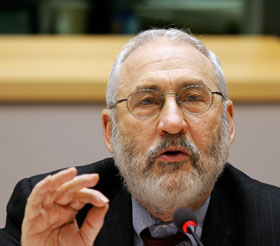
Feb. 1 (Bloomberg) — Nobel laureate Joseph Stiglitz said any decision by President Barack Obama to establish a so-called bad bank to rid financial companies of toxic assets risks swelling the national debt.

Obama’s administration is moving closer to buying the illiquid assets currently clogging bank’s balance sheets and preventing them from boosting lending, people familiar with the matter said this week.

That amounts to swapping taxpayers’ “cash for trash,” Stiglitz said yesterday in a panel discussion at the World Economic Forum in Davos, Switzerland. “You shouldn’t chase good money after bad. We’re talking about a national debt that’s very hard to manage.”

Stiglitz, a professor at Columbia University in New York and a former adviser to President Bill Clinton, says the plan would leave taxpayers paying for years of excess lending by banks. It would also deprive the government of money that would have been better spent shoring up Social Security, he said.

Whether a bad bank would accelerate an end to the financial crisis split delegates attending the Davos talks. JPMorgan Chase & Co. Chief Executive Officer Jamie Dimon said such an operation would help if “executed well.” Billionaire investor George Soros said in an interview that “it’s not the measure that would turn the situation around and enable banks to lend.”

Obama Plan

Obama said yesterday he’s readying a plan to unlock credit markets and lower mortgage rates. Under the initiative, the government would buy some tainted securities and insure the banks against losses on the rest.

“Soon my Treasury secretary, Timothy Geithner, will announce a new strategy for reviving our financial system that gets credit flowing to businesses and families,” Obama said in his weekly radio address.

Stiglitz drew criticism from panel participant Angel Gurria, head of the Organization for Economic Cooperation and Development, who says a bad bank is necessary for lending to resume.

“I agree about the moral, ethical fallout, but you’ve got to face the music and someone has to take the loss,” said Gurria, Mexico’s former finance minister. “It’s the only way to jumpstart the economy.”

Bank losses worldwide from toxic U.S.-originated assets may double to $2.2 trillion, the International Monetary Fund said in a report released Jan. 28.

John Monks, general secretary of the European Trade Union Confederation, told the same audience that governments are getting “close to straining the patience of the public and voters” by repeatedly extending lifelines to banks.

Philippines President Gloria Arroyo urged Obama to make a quick decision on his plan.

“We want Americans to do something,” she said at the session, which was called “Rebooting the Global Economy.” “We can discuss what to do but the worst thing is to do nothing.”