Senator, Target of Anthrax Letter, Challenges F.B.I. Finding

Stories

NEW YORK TIMES

WASHINGTON — Senator Patrick J. Leahy,
chairman of the Senate Judiciary Committee and a target of the anthrax
letters of 2001, said Wednesday that he did not believe the F.B.I.’s contention that an Army scientist conducted the attacks alone.

At a hearing of his committee, Mr. Leahy told the F.B.I. director, Robert S. Mueller III, that even if the bureau was right about the involvement of the scientist, Bruce E. Ivins, who killed himself in July before ever being charged, he thought there were accomplices.

“If he is the one who sent the letter, I do not believe in any
way, shape or manner that he is the only person involved in this attack
on Congress and the American people,” said Mr. Leahy, Democrat of
Vermont.

“I believe there are others involved, either as accessories
before or accessories after the fact,” he added. “I believe
there are others who can be charged with murder.”

Mr. Leahy, who has received special briefings on the investigation
because one of the anthrax-laced letters was addressed to him, later
declined to elaborate. “Sorry,” said an aide, David Carle,
“but he said his piece and does not intend to comment further
today.”

Mr. Leahy was one of several senators at the hearing who raised
questions about the bureau’s case. But Mr. Mueller said he stood
by the conclusion that Dr. Ivins, who worked at the Army biodefense
laboratory at Fort Detrick, Md., was solely responsible for the attacks.

Even after the anthrax case is formally closed, a step that
officials say is likely in three to six months, “if we receive
additional evidence indicating the participation of any additional
person, we certainly would pursue that,” Mr. Mueller said.

On Tuesday, Mr. Mueller said he had asked the National Academy of Sciences to convene an expert panel to review the bureau’s scientific work on the case.

But Senator Charles E. Grassley,
Republican of Iowa, said Wednesday that he did not think that was
adequate. Mr. Grassley said the academy “would only be reviewing
the science and not the detective work,” and added, “I
believe we need an independent review of both.”

The hearing underscored the challenge the bureau faces in persuading
Congress and the public that the case is resolved. In the audience was Steven J. Hatfill,
another former Army biodefense scientist, whom the F.B.I. pursued as a
suspect for several years before the Justice Department cleared him
this summer and paid $4.6 million to settle a lawsuit he had filed
against the government.

Dr. Hatfill did not speak. But Senator Grassley asked Mr. Mueller:
“Should not the F.B.I. apologize to Dr. Hatfill? Please explain
how chasing an innocent man for four years was not a mistake.”

Mr. Mueller replied that investigators had done nothing
“inappropriate.” The settlement, he said, was not for
scrutinizing Dr. Hatfill but for leaking information about him to the
news media. “I abhor those leaks,” he said.

Mr. Leahy pressed Mr. Mueller to say what laboratories in the United
States were capable of producing dry powder anthrax like that used in
the attacks, specifically asking about the Dugway Proving Ground, an
Army center in Utah, and the Battelle Memorial Institute, a government
contractor in Ohio, both of which have made such powder in small
quantities in the past.

But Mr. Mueller said he could answer the question only in a closed
session because the matter involved classified information. The secrecy
appeared likely to fuel rumors, circulating on the Internet and denied
by the F.B.I., that the attacks had some link to a secret government
bioweapons program.

Mr. Mueller, F.B.I. director since just before the terrorist attacks
of Sept. 11, 2001, was criticized at the hearing by Mr. Leahy and
others for what they described as his record of failing to answer in a
timely manner the committee’s questions on a broad range of
subjects.

But he was praised for what senators characterized as his courage
in resisting some Bush administration counterterrorism tactics,
including harsh interrogation methods and elements of the National Security Agency’s domestic surveillance program.

“Against intense and hostile pressure from the highest offices
in the land,” said Senator Sheldon Whitehouse, Democrat of Rhode
Island, “you stood for the principle that all public offices have
public duties and responsibilities.”

The World Banks Get Together and Pump $180 Billion Into Financial System

Stories

Central banks pump up the dollars

As banks hoard cash and lending dries up, Fed plus 5 to pump $180 billion into system.

By Chris Isidore, CNNMoney.com senior writer

NEW YORK (CNNMoney.com) — The Federal Reserve and five other central banks around the globe announced joint efforts early Thursday to try to pump an additional $180 billion into the battered global financial system.

The Fed joined with the European Central Bank, the Swiss National Bank, the Bank of Japan, Bank of England and Bank of Canada in the coordinated effort.

“These measures, together with other actions taken in the last few days by individual central banks, are designed to improve the liquidity conditions in global financial markets,” said the Fed’s statement. “The central banks continue to work together closely and will take appropriate steps to address the ongoing pressures.”

The bankruptcy of Lehman Brothers and the Fed rescue of insurance giant American International Group (AIG, Fortune 500) this week has led to a tightening of credit in global markets.

Major banks have become even more reluctant to lend to each other on an overnight basis because of worries about unknown financial problems with other institutions and a desire to hoard cash to protect themselves.

Even money market managers are reluctant to loan money to banks, preferring to buy short-term Treasurys instead. That demand has driven up the price of Treasurys and driven down the yield, or interest rate, that those government instruments pay.

The yield on the 3-month Treasury bill fell briefly into negative territory for the first time since 1940 and closed Wednesday at 0.04%.

“Liquidity has never been in shorter supply in the credit markets during this painful episode,” said Kevin Giddis, managing director and head of fixed income for investment bank Morgan Keegan.

Bond prices slipped narrowly, lifting yields only slightly. The three-month had a yield of 0.105% in early trading. Giddis said the markets are looking for a more permanent solution than the one announced by the central banks Thursday.

“Based on nearly every metric that’s used in our business, a clear message has emerged over the last couple of days’ of trading activity: those with capital are reluctant to lend until the near term visibility becomes a little more certain,” he added.

The New York Federal Reserve Bank Thursday also pumped $55 billion into the nation’s financial system. That comes on top of $70 billion that it pumped into the system Tuesday.

The announcement of coordinated action Thursday helps provide dollars to foreign banks that needed the U.S. currency to transact business, but had been unable to access the Fed directly the way U.S. banks can. While the Bank of England and European Central had pumped money into their own financial systems earlier this week, that had been in the own currency, not dollars.

The ECB will get a $55 billion increase in the dollars it can loan out, doubling what it had already received under an earlier swap program, while the Swiss National Bank will receive an additional $15 billion on top of an earlier $12 billion program.

The Bank of Japan, Bank of England and Bank of Canada set up new swap programs with the Fed, with Japan getting $60 billion, England getting $50 billion and Canada getting $10 billion.

The swap program provides essentially no risk for the Fed since the U.S. central bank is receiving the same amount of cash back from its foreign counterparts.  To top of page

Morgan Stanley and Goldman Sachs Stocks Plummet

Stories

Financial crisis mounts as stocks fall

People walk past the world headquarters for Morgan Stanley & Co.
REUTERS
Zoom

By Jack Reerink and Douwe Miedema

NEW YORK/LONDON (Reuters) – Shares of Wall Street firms Morgan Stanley and Goldman Sachs plummeted on Wednesday and Britain’s biggest mortgage lender neared a sale in the latest signs of extreme distress in the financial industry.

Tuesday’s surprise $85 billion (47 billion pound) rescue of insurer American International Group by the U.S. Federal Reserve did little to calm investors’ nerves, and U.S. stocks dropped as much as 4.1 percent.

The White House said it was “concerned about other companies” while the U.S. presidential candidates struck populist tones, with Sen. John McCain blasting Wall Street’s “casino culture” and Sen. Barack Obama stressing protection for mom-and-pop investors.

The Fed move capped a week of bailouts, a bankruptcy on Wall Street, and central banks around the world flooding the financial system with money to prevent it from seizing up.

The result: a seismic shift in the financial industry, with some of Wall Street’s biggest names disappearing overnight.

“The fear is who is next,” said John O’Brien, senior vice president at MKM Partners in Cleveland. “It almost feels like people scour the books and say who is the next likely target that we can put a short on. And that spreads continuous fear.”

Shares of Morgan Stanley and larger rival Goldman fell as much as 43 percent and 27 percent, respectively, even after both reported better-than-expected quarterly earnings on Tuesday.

“I’m assuming that Goldman Sachs and Morgan Stanley are lining up dancing partners. They don’t want to be … this week’s victim,” said William Larkin, fixed income manager at Cabot Money Management in Salem, Massachusetts.

The drama kept traders glued to their screens: In the capital of the hedge fund industry, Greenwich, Connecticut, an industry conference for 500 people had 200 empty seats.

“A lot of people who are seeing massive red ink and are suffering the most are not here,” said Jean de Bolle, the chief investment officer at Byron Advisors.

The cost of protecting Morgan Stanley’s and Goldman’s debt spiked, reflecting investor fears that their debt issues are no safer than junk bonds.

“The credit crunch and credit contraction is intensifying,” said Peter Boockvar, equity strategist at Miller Tabak & Co in New York. “The action in Morgan Stanley in light of what was better-than-expected numbers last night is disconcerting.”

Goldman spokesman Lucas van Praag said: “We think the markets will positively differentiate those financial institutions that have global, diversified business models and that outperformed through this crisis.”

Morgan Stanley spokeswoman Jeanmarie McFadden declined to comment.

PROPPING UP THE SYSTEM

In the latest sign of regulatory anxiety, the U.S. Securities and Exchange Commission curbed short-selling, or investor bets on declining share prices.

“Seems like the SEC is a day late on the rule … Morgan Stanley is clearly in the short-sellers’ sights,” said Andrew Brenner, senior vice president at MF Global in New York.

Other distress signals had popped up earlier: The cost of borrowing overnight dollars spiked above 10 percent, indicating a deep lack of trust spooking the interbank lending market in Europe.

And Bank of Ireland became the latest bank to cut its dividend, causing a sell-off in Irish banking shares.

Lloyds TSB was in advanced talks to buy domestic rival HBOS Plc to create a 28 billion pound mortgage giant.

The talks underscore how quickly authorities around the world are ditching long-held beliefs about free markets and competition as they seek to counter the credit crunch.

Lloyds, for example, was previously blocked from buying a smaller mortgage bank.

Then there was the shocking British government decision in February to take over troubled bank Northern Rock — the first major nationalization in Britain since the 1970s.

U.S. authorities also have moved to prop up the financial system.

The AIG rescue comes just over a week after the bailout of mortgage finance companies Fannie Mae and Freddie Mac, and six months after the Fed brokered the sale of failed investment bank Bear Stearns to JPMorgan Chase.

AIG’s bailout brings to about $900 billion the total of U.S. rescue efforts to stabilize the financial system and housing market. Authorities may get much of that money back — if asset prices do not slide further.

The week has already seen two legendary firms bite the dust: Lehman Brothers Holdings Inc filed for bankruptcy, and Merrill Lynch & Co threw itself into the arms of Bank of America.

Barclays gave Wall Street a small boost on Tuesday by agreeing to buy Lehman’s Manhattan headquarters and investment bank for $1.75 billion and taking aboard 10,000 staff.

YARD SALE AT AIG

AIG’s newly appointed chief, former Allstate CEO Edward Liddy, was poised to hold a big yard sale to pay off the Fed loan. There are plenty of interested bidders, AIG’s main regulator told business television channel CNBC.

AIG, which has businesses ranging from life insurance to airplane leasing in 130 countries, has a big incentive to raise cash: It is currently paying more than 11.4 percent interest on the $85 billion loan.

Japan’s cash-rich insurers and Australia’s top player, QBE Insurance, are seen as potential buyers. And then there is billionaire investor Warren Buffett.

“It wouldn’t surprise me to see him in the fray, though he might not want all the businesses,” said Michael Nix, a portfolio manager at Greenwood Capital Associates in Greenwood, South Carolina.

AIG faced a cash crunch after $18 billion of losses over three quarters, largely because of complex securities that are tied to mortgages, and which plunged in value as the U.S. housing crisis deepened. The rescue kept AIG from surpassing Lehman as the largest corporate failure ever.

If it was meant to prevent a deepening of the credit crisis or sooth investors, it did not work.

“The system will remain unstable and fragile,” the chief executive of top bond fund Pimco, Mohamed El-Erian, told Reuters. “Further action will be required that targets both, and I stress both, institutions and the system as a whole. Otherwise, and as has been repeatedly the case in this crisis, seemingly bold policy actions will turn out to be too little, too late.”

(Additional reporting by Svea Herbst-Bayliss, Jon Stempel, Jennifer Ablan, Joseph Giannone, Jeffrey Hodgson and Kevin Plumberg; Editing by John Wallace and Maureen Bavdek)

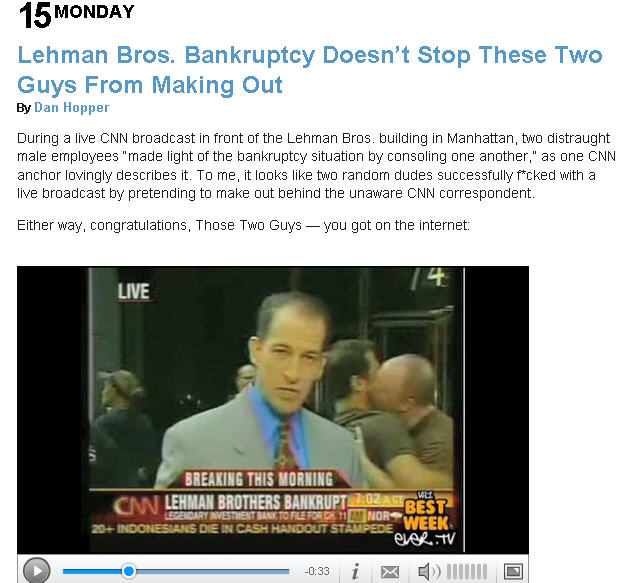
VH1's "Best Week Ever" Gang Clueless About Howard Stern Show

Stories

Do You Know the Way to the San Jose Electric Car Plant?

Stories
San Jose wins electric car plant

By Maggie Shiels
Technology reporter, BBC News, Silicon Valley

San Jose is aiming to be the capital of clean technology following a $250m (£139m) deal with electric car maker Tesla to base its new factory there.

The city beat other contenders to secure a project that will bring more than 1,000 jobs to the area.

“This is a big step toward being the centre of world cleantech innovation,” said San Jose Mayor Chuck Reed.

Tesla boss Ze’ev Drori said that “this is proof the time has come for the electric car.”

The company plans to produce an all-electric luxury sedan, called the Model S, at the plant with a retail price of around $60,000 (£33,000.)

It already manufactures a two seater zero emission Roadster which sells for $109,000 (£61,000) and is built by Lotus in England.

Mr Drori told BBC News Tesla hopes to deliver its first cars by 2010. They will have a range of about 240 miles (390 km) per battery charge. The production run is set for around 15,000 vehicles initially, with half of the line being sold in Europe.

“This car signals an end to dependency on foreign oil. The summer of high gas prices has accelerated demand for such a vehicle.”

San Jose’s mayor Mr Reed agrees. “This is the next step in transportation.

“Shifting from petroleum to electric vehicles will make a huge change to how the world moves and we are excited to be part of that happening.”

Analysts however believe Tesla will face a tough challenge with its five-seater sedan, especially from GM’s Volt, which was unveiled this week.

“Tesla’s electric sedan will be a tough sell alongside the Volt which will cost around $35,000 (£19,500),” said Michael Kanellos of Greentech Media.

“Price will play a big role in this battle.”

‘Vote of confidence’

San Jose along with the State of California devised an incentive programme estimated at around $150m (£84m) to persuade Tesla to site its new plant in the city.

While California came up with a hefty $100m (£56m) financing package, San Jose put land into the deal.

The first 10 years of the 40 year lease on the 90-acre plot will be rent-free. After that a yearly lease payment of $1.5m (£835,000) will be paid over the next ten years with a 2% increase year on year for the last 20.

Mayor Reed told BBC News he believed this part of the package was worth around $50m (£28m) but stressed the land was not being used anyway.

“A lot of investment decisions are based on faith in the future and confidence in the future and this 250 million dollar project is a real stamp for us and a vote of confidence in San Jose.

“Hopefully it will help other companies to make investment decisions and locate their businesses here.”

He said that San Jose, which is said to have America’s highest per-capita concentration of hybrid cars, is aggressively encouraging cleantech companies to the area.

The Mayor claimed the city is the leader in attracting these types of companies with more than 40 already calling San Jose home and providing more than 2,500 jobs.

“San Jose is the capital of Silicon Valley, which offers the best opportunities because it is right here where the innovation is happening.

“It is important for Tesla to be close to that innovation and this is a big boost for us.”

Tesla’s Mr Drori said his business represents the beginning of a burgeoning growth sector.

“Cleantech is a completely new paradigm and what we are doing represents a major seismic shift. That’s the reason we chose San Jose and we will lead this charge.”

Greentech Media’s Mr Kanellos said cleantech is “going through a really exciting time.”

“It’s cool the fact the government of California sees a bit future in this and certainly companies are saying they are getting swamped with applications for people to work in the sector,” he said.

“There is a whole generation of kids who want to work in this area not just for the money but because it’s cool.”

Story from BBC NEWS:
http://news.bbc.co.uk/go/pr/fr/-/1/hi/technology/7617972.stm

Published: 2008/09/17 08:14:46 GMT

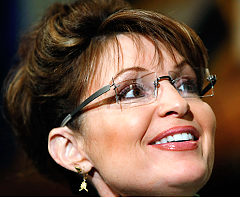
Hillary Clinton and Sarah Palin Hold Joint Press Conference

Amy Poehler, Hillary, Palin, SNL, Tina Fey

Vodpod videos no longer available.

Washington Redskins Decide to Start Playing Football in Exciting Win Over Saints

NFL, Washington Redskins


SF GATE DOT COM

In his attempt to redesign the Washington Redskins’ offense, rookie coach Jim Zorn has constantly peppered Jason Campbell with all sorts of phrases. One of them: “Avoid, reset and throw.”

After a miserable first game, Campbell last week responded with a phrase of his own: “Coach, just trust me.”

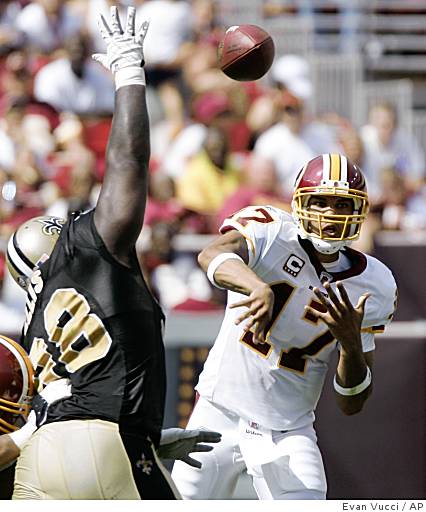
On Sunday, both got the point. Campbell went from uncomfortable to prolific with a 321-yard passing day, and he mastered the “avoid, reset and throw” move with aplomb on a 67-yard touchdown to Santana Moss as the Redskins came from behind to beat visiting New Orleans 29-24.

“We talked a lot during the week,” Campbell said. “I said ‘Coach, just trust me.’ And he said, ‘I’ve got to trust you more.’ We do it together.”

Campbell appeared out of sorts with Zorn’s West Coast attack in a 16-7 loss to the Giants, but he went 24-for-36 with no interceptions against the Saints. He completed his last eight passes as the Redskins (1-1) overcame a nine-point deficit with two touchdowns in the final 6 1/2 minutes.

“I don’t really know how to act, but I am very excited,” Zorn said of his first NFL win. “I wish I could enjoy it as much as I had to endure last week for four or five days, but I won’t be able to.”

The big play came with 3:29 left and the Redskins trailing 24-22. Campbell avoided the rush, stepped forward and hit Moss in stride, the receiver one step ahead of rookie cornerback Tracy Porter.

Reggie Bush returned a punt 55 yards for a touchdown that gave the Saints (1-1) a 24-15 lead at the end of the third quarter. New Orleans remained in the game principally because all five of the Redskins’ first-half drives ended in field-goal attempts.

The Saints committed three turnovers, and all landed in the hands of seventh-round draft pick Chris Horton.

Apple to Podcaster: No App Store for you

Apple, I Phone

Apple’s App Store policies are really starting to frustrate application developers.

Over the weekend, a good old-fashioned Internet-style kerfuffle arose over Apple’s decision to reject Podcaster–an iPhone application that lets people download podcasts directly to their devices without going through iTunes–from the App Store. The developer of the application said that Apple told him the application “duplicates the functionality of the Podcast section of iTunes,” apparently making it unfit for the App Store.

This has been a persistent question hanging over Apple’s decision to vet every single iPhone and iPod Touch application sold through the App Store, the only official source of iPhone and iPod Touch applications. How will Apple choose to wield this power? The rejection of Pull My Finger and I Am Richexecution of NetShare, but the exact parameters remain a mystery. didn’t cause as many waves as the

Back in March, the company said it would prohibit applications that took up a lot of bandwidth, or delivered porn, but they have never explicitly stated what is permissible and what isn’t. And without any guidelines, developers have no way of knowing whether their application will be included in the only official market for iPhone applications until after they’ve done all the work on it.

I can’t help but be reminded of the Soup Nazi, brought to life by Bill Gates’ new best friend Jerry Seinfeld. Watch the clip if you don’t remember, or were in grade school when that came out, but if you didn’t order soup from the Soup Nazi in the exact right way, without asking any questions or voicing concerns–procedures that you were somehow just expected to know–no soup for you.

On Friday, Fraser Spiers, creator of Exposure, lashed out at Apple’s lack of explicit policies regarding iPhone application development. “Apple’s current practice of rejecting certain applications at the final hurdle – submission to the App Store – is disastrous for investor confidence. Developers are investing time and resources in the App Store marketplace and, if developers aren’t confident, they won’t invest in it. If developers – and serious developers at that – don’t invest, what’s the point?”

It’s understandable that Apple might want to control the development of iPhone applications with an iron fist, given that the company attempts to control absolutely every last detail of its activities with an iron fist. And there are benign reasons for wanting to control application development so tightly, such as ensuring quality and security.

But in another example of what we’ve seen so far this summer, Apple’s recent mistakes involve communication, or the lack thereof. If the company would just come out and explain to developers what type of applications will be rejected, and why, developers could make a conscious decision about whether to invest their time and money in developing their application.

Instead, Apple is giving developers a choice: they can take the risk of guessing whether their application will pass muster, or they can steer clear of developing any application that might infringe on Apple’s current or future plans; without knowing what those might be, of course. As Harry McCracken put it (via Daring Fireball), “Way back when, if software distribution for the Mac had been handled via a Mac App Store with a don’t-duplicate-Apple-products policy, Photoshop might have been refused distribution on the grounds that it was too similar to MacPaint.”

The end result is that Apple’s attempt to control third-party development might be re-encouraging the growth of the jailbreaking market once again: iPhone OS 2.1 is already open to jailbroken applications.

Technorati Tags: , , , , ,

Sulu Gets Married as Uhura and Chekov Look On

Stories

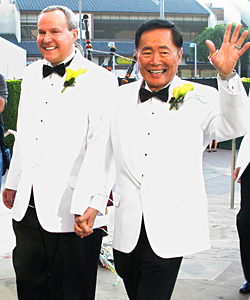
Toast the groom (and the other groom) with a tall mug of Romulan ale! George Takei of “Star Trek” fame tied the knot in Los Angeles on Sunday and People magazine was all over it like Captain Kirk on that green alien lady.

George Takei and his longtime partner, Brad Altman, were wed Sunday evening in a Buddhist ceremony in downtown Los Angeles.

“All I can remember is what the priest said,” Takei told People after the ceremony. “That this moment will never happen again. It’s something to savor.”

Nearly 200 of the couple’s friends attended the event, which began as a kimono-clad koto player plucked out tunes on the ancient Japanese stringed instrument. Afterward, the couple sipped sake from red lacquer cups, then said their vows to one another while standing within a circle of yellow rose petals.

A Scottish bagpiper led Takei, 71, and Altman, 54, to the reception on the grounds of the Japanese American National Museum. On the way, the couple, along with their maid of honor and best man (Takei’s former “Star Trek” costars Nichelle Nichols and Walter Koenig) flashed the “live long and prosper” hand sign to photographers and friends.

“I was fighting back the tears,” said Nichols, who played Uhura on the “Star Trek” series. “But they came oozing out anyway. I’m so happy that they’re both able to legally proclaim their commitment to one another after spending the past 21 years together.”

In May, Takei announced his plans to wed after California’s Supreme Court allowed gay marriage under the state’s Constitution.

Wait, does this mean Mr. Sulu is gay? Set red-state phasers on stunned!

But seriously, best wishes for Takei and Altman, and we hope didn’t get too many of these as wedding gifts.

— Geoff Boucher

LOS ANGELES TIMES BLOG

Oki Dog Alert! Bill Maher's Realtime Brings Back Garofalo to Ponder the Palin

9/11, Barack Obama, Bin Laden, Election 2008, Hillary Clinton, Obama, Politics, Sarah Palin, Tullycast

PART ONE

PART TWO

PART THREE

PARTFOUR

PART FIVE

PART SIX

PART SEVEN