CIA
Waterboarding Used 266 Times on 2 Suspects
CIA, Rendition, TortureTHE NEW YORK TIMES
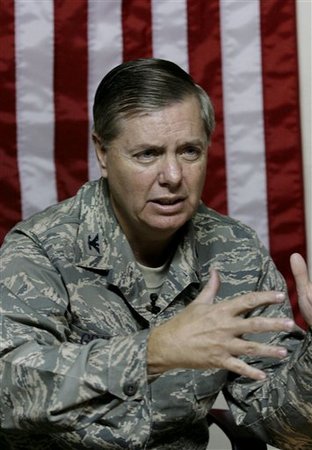 C.I.A. interrogators used waterboarding, the near-drowning technique that top Obama administration officials have described as illegal torture, 266 times on two key prisoners from Al Qaeda, far more than had been previously reported.
The C.I.A. officers used waterboarding at least 83 times in August 2002 against Abu Zubaydah, according to a 2005 Justice Department legal memorandum. Abu Zubaydah has been described as a Qaeda operative.
A former C.I.A. officer, John Kiriakou, told ABC News and other news media organizations in 2007 that Abu Zubaydah had undergone waterboarding for only 35 seconds before agreeing to tell everything he knew.
The 2005 memo also says that the C.I.A. used waterboarding 183 times in March 2003 against Khalid Shaikh Mohammed, the self-described planner of the Sept. 11, 2001, terrorist attacks.
The New York Times reported in 2007 that Mr. Mohammed had been barraged more than 100 times with harsh interrogation methods, causing C.I.A. officers to worry that they might have crossed legal limits and to halt his questioning. But the precise number and the exact nature of the interrogation method was not previously known.
The release of the numbers is likely to become part of the debate about the morality and efficacy of interrogation methods that the Justice Department under the Bush administration declared legal even though the United States had historically treated them as torture.
President Obama plans to visit C.I.A. headquarters Monday and make public remarks to employees, as well as meet privately with officials, an agency spokesman said Sunday night. It will be his first visit to the agency, whose use of harsh interrogation methods he often condemned during the presidential campaign and whose secret prisons he ordered closed on the second full day of his presidency.
C.I.A. officials had opposed the release of the interrogation memo, dated May 30, 2005, which was one of four secret legal memos on interrogation that Mr. Obama ordered to be released last Thursday.
Mr. Obama said C.I.A. officers who had used waterboarding and other harsh interrogation methods with the approval of the Justice Department would not be prosecuted. He has repeatedly suggested that he opposes Congressional proposals for a “truth commission” to examine Bush administration counterterrorism programs, including interrogation and warrantless eavesdropping.
The Senate Intelligence Committee has begun a yearlong, closed-door investigation of the C.I.A. interrogation program, in part to assess claims of Bush administration officials that brutal treatment, including slamming prisoners into walls, shackling them in standing positions for days and confining them in small boxes, was necessary to get information.
The fact that waterboarding was repeated so many times may raise questions about its effectiveness, as well as about assertions by Bush administration officials that their methods were used under strict guidelines.
A footnote to another 2005 Justice Department memo released Thursday said waterboarding was used both more frequently and with a greater volume of water than the C.I.A. rules permitted.
The new information on the number of waterboarding episodes came out over the weekend when a number of bloggers, including Marcy Wheeler of the blog emptywheel, discovered it in the May 30, 2005, memo.
The sentences in the memo containing that information appear to have been redacted from some copies but are visible in others. Initial news reports about the memos in The New York Times and other publications did not include the numbers.
Michael V. Hayden, director of the C.I.A. for the last two years of the Bush administration, would not comment when asked on the program “Fox News Sunday” if Mr. Mohammed had been waterboarded 183 times. He said he believed that that information was still classified.
A C.I.A. spokesman, reached Sunday night, also would not comment on the new information.
Mr. Hayden said he had opposed the release of the memos, even though President Obama has said the techniques will never be used again, because they would tell Al Qaeda “the outer limits that any American would ever go in terms of interrogating an Al Qaeda terrorist.”
He also disputed an article in The New York Times on Saturday that said Abu Zubaydah had revealed nothing new after being waterboarded, saying that he believed that after unspecified “techniques” were used, Abu Zubaydah revealed information that led to the capture of another terrorist suspect, Ramzi Binalshibh.
The Times article, based on information from former intelligence officers who spoke on condition of anonymity, said Abu Zubaydah had revealed a great deal of information before harsh methods were used and after his captors stripped him of clothes, kept him in a cold cell and kept him awake at night. The article said interrogators at the secret prison in Thailand believed he had given up all the information he had, but officials at headquarters ordered them to use waterboarding.
He revealed no new information after being waterboarded, the article said, a conclusion that appears to be supported by a footnote to a 2005 Justice Department memo saying the use of the harshest methods appeared to have been “unnecessary” in his case.
Jane Hamsher Calls Bullshit On Rahm Emmanuel's 'This Week' Appearance
Jay Bybee, John Yoo, Rahm Emanuel, Steven Bradbury, Torture, WaterboardingJANE HAMSHER Gets it done; as usual…
Because someone has to
Rahm on This Week:
STEPHANOPOLOUS: The President has ruled out prosecutions of CIA officials who believed they were following the law. Does he believe the officials who devised the policies should be immune from prosecution?
RAHM: Yeah, what he believes is, look, as you saw in that statement he wrote. And I think, just take a step back. That he came up with this, and he worked on this for four weeks. Wrote that statement Wednesday night, after he made his decision, and dictated what he wanted to see and then Thursday morning I saw him in the office, he was still editing it. He believes that people in good faith were operating with the guidance they were provided. They shouldn’t be prosecuted.
STEPHANOPOLOUS: But what bout those who devised the policies?
RAHM: But those who devised the policies –he believes that they were — should not be prosecuted either. And it’s not the place that we go — as he said in that letter, and I really recommend that people look at that full statement. Not the letter, the statement. In that second paragraph: This is not a time for retribution. It’s a time for reflection. It is not a time to use our energy and our time in looking back, and in a sense of anger and retribution. We have a lot to do to protect America. What people need to know, this practice and technique, we don’t useany more. He banned it.
Is that truly what the administration thinks? That people who want to see those who illegally led the country down the road of torture held to account are simply “looking back” in “anger” and “retribution”? Fifty percent of the country favor such investigations, including 69% of Democrats and a majority of independents. Is Rahm saying that President Obama believes they’re nothing more than an angry, vindictive mob, and that nobody could possibly have a rational basis for believing that our laws should be enforced?
Manfred Nowak, the United Nations top torture investigator, says that treaties entered into by the United States require criminal investigations:
The United States, like all other states that are part of the U.N. convention against torture, is committed to conducting criminal investigations of torture and to bringing all persons against whom there is sound evidence to court.
How does Rahm rationalize the President’s stated goal to “restore our moral standing” in the world with thumbing our noses at the international agreements we’ve entered into? Is there an “except when we don’t feel like it” clause?
The United States has 5% of the world’s population, but nearly 25% of its prisoners. There is something terribly inconsistent about a Senior Administration official like Rahm Emanuel insisting that an elite few should not be subject to our laws, and that people who take issue with this have no higher motive than counterproductive rage.
Sign the petition telling Attorney General Eric Holder to appoint a special prosecutor to investigate torture here.
Red Cross Torture Report | Mark Danner
Stories"We've Got a Terrible Situation With This Great Patriot, He's Out of Control and We Must Save Him From Himself"
CIA, George Patton, Wild Bill Donovan, World War Two
George S. Patton, America’s greatest combat general of the Second World War, was assassinated after the conflict with the connivance of US leaders, according to a new book.
“We’ve got a terrible situation with this great patriot, he’s out of control and we must save him from himself'”
-WILD BILL DONOVAN
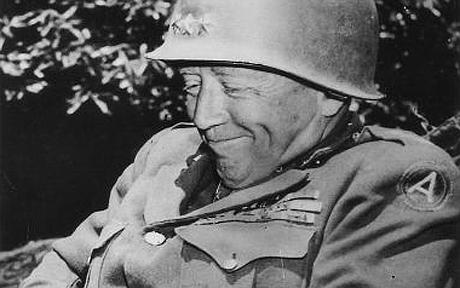
The newly unearthed diaries of a colourful assassin for the wartime Office of Strategic Services (OSS), the forerunner of the CIA, reveal that American spy chiefs wanted Patton dead because he was threatening to expose allied collusion with the Russians that cost American lives.
The death of General Patton in December 1945, is one of the enduring mysteries of the war era. Although he had suffered serious injuries in a car crash in Manheim, he was thought to be recovering and was on the verge of flying home.
But after a decade-long investigation, military historian Robert Wilcox claims that OSS head General “Wild Bill” Donovan ordered a highly decorated marksman called Douglas Bazata to silence Patton, who gloried in the nickname “Old Blood and Guts”.
His book, “Target Patton”, contains interviews with Mr Bazata, who died in 1999, and extracts from his diaries, detailing how he staged the car crash by getting a troop truck to plough into Patton’s Cadillac and then shot the general with a low-velocity projectile, which broke his neck while his fellow passengers escaped without a scratch.
Mr Bazata also suggested that when Patton began to recover from his injuries, US officials turned a blind eye as agents of the NKVD, the forerunner of the KGB, poisoned the general.
Mr Wilcox told The Sunday Telegraph that when he spoke to Mr Bazata: “He was struggling with himself, all these killings he had done. He confessed to me that he had caused the accident, that he was ordered to do so by Wild Bill Donovan.
“Donovan told him: ‘We’ve got a terrible situation with this great patriot, he’s out of control and we must save him from himself and from ruining everything the allies have done.’ I believe Douglas Bazata. He’s a sterling guy.”
Mr Bazata led an extraordinary life. He was a member of the Jedburghs, the elite unit who parachuted into France to help organise the Resistance in the run up to D-Day in 1944. He earned four purple hearts, a Distinguished Service Cross and the French Croix de Guerre three times over for his efforts.
After the war he became a celebrated artist who enjoyed the patronage of Princess Grace of Monaco and the Duke and Duchess of Windsor.
He was friends with Salvador Dali, who painted a portrait of Bazata as Don Quixote.
He ended his career as an aide to President Ronald Reagan’s Navy Secretary John Lehman, a member of the 9/11 Commission and adviser to John McCain’s presidential campaign.
Mr Wilcox also tracked down and interviewed Stephen Skubik, an officer in the Counter-Intelligence Corps of the US Army, who said he learnt that Patton was on Stalin’s death list. Skubik repeatedly alerted Donovan, who simply had him sent back to the US.
“You have two strong witnesses here,” Mr Wilcox said. “The evidence is that the Russians finished the job.”
The scenario sounds far fetched but Mr Wilcox has assembled a compelling case that US officials had something to hide. At least five documents relating to the car accident have been removed from US archives.
The driver of the truck was whisked away to London before he could be questioned and no autopsy was performed on Patton’s body.
With the help of a Cadillac expert from Detroit, Mr Wilcox has proved that the car on display in the Patton museum at Fort Knox is not the one Patton was driving.
“That is a cover-up,” Mr Wilcox said.
George Patton, a dynamic controversialist who wore ivory-handled revolvers on each hip and was the subject of an Oscar winning film starring George C. Scott, commanded the US 3rd Army, which cut a swathe through France after D-Day.
But his ambition to get to Berlin before Soviet forces was thwarted by supreme allied commander Dwight D. Eisenhower, who gave Patton’s petrol supplies to the more cautious British General Bernard Montgomery.
Patton, who distrusted the Russians, believed Eisenhower wrongly prevented him closing the so-called Falaise Gap in the autumn of 1944, allowing hundreds of thousands of German troops to escape to fight again,. This led to the deaths of thousands of Americans during their winter counter-offensive that became known as the Battle of the Bulge.
In order to placate Stalin, the 3rd Army was also ordered to a halt as it reached the German border and was prevented from seizing either Berlin or Prague, moves that could have prevented Soviet domination of Eastern Europe after the war.
Mr Wilcox told The Sunday Telegraph: “Patton was going to resign from the Army. He wanted to go to war with the Russians. The administration thought he was nuts.
“He also knew secrets of the war which would have ruined careers.
I don’t think Dwight Eisenhower would ever have been elected president if Patton had lived to say the things he wanted to say.” Mr Wilcox added: “I think there’s enough evidence here that if I were to go to a grand jury I could probably get an indictment, but perhaps not a conviction.”
Charles Province, President of the George S. Patton Historical Society, said he hopes the book will lead to definitive proof of the plot being uncovered. He said: “There were a lot of people who were pretty damn glad that Patton died. He was going to really open the door on a lot of things that they screwed up over there.”
Karl Rove Discusses His Second Subpoena From House Judiciary Committee
CIA, David Iglesias, Don Siegelman, Guantanamo, Iraq, Joe Wilson, Justice Department, Karl Rove, Torture, U.S. Attorney Firings, Valerie Plame, Wiretapping, WMDTerror Suspect's Case Drags on 5 years After Arrest in Minneapolis
Civil Liberties, Guantanamo, War on Terror“Some harm to civil liberties seems to be endemic to war situations and you know, at the end of the day, if we win this war against terrorism, we and the whole world will be more free and our rights will be more secure, but along the way, there may be some situations and some individuals who will have the opposite,” said Joshua Muravchik, a resident scholar at American Enterprise Institute, a Washington think tank.

On a cold December morning five years ago, FBI agents knocked on the door of a basement apartment in northeast Minneapolis, and Mohamed Abdullah Warsame answered.
He let the agents in to talk, and later they took him to another location to talk more. He hasn’t been home since.
For five years, Warsame, now 35, has been awaiting trial on charges that he provided material support to Al-Qaida. A Canadian citizen of Somali descent, he has done most of the waiting alone in a jail cell, under special restrictions that limit his contact with the outside world.
His pretrial detention is one of the longest for a terrorism- related case since Sept. 11, with the delays stemming from a variety of sources.
Authorities have needed extra time for security clearances. Attorneys have argued over Warsame’s detention conditions and debated access to facts and witnesses. Some information is classified by the federal government, and defense attorneys have no legal access to it. An appeals court is also considering whether some of Warsame’s statements to authorities, thrown out by the district judge, should be allowed to be used against him.
Warsame was one of 46 still awaiting trial as of mid-2007, among the 108 charged since Sept. 11 with providing material support to a terrorist organization, according to one analyst who tracks such cases.
The length of Warsame’s case raises questions about how the courts handle terrorism cases.
The federal courts are “being used the same way that the prosecutions in Guantanamo are being used … based on the accusation of terrorism, the normal rules don’t seem to apply,” said Peter Erlinder, a professor at the William Mitchell College of Law in St. Paul and who has been involved in Warsame’s defense and at least one other terrorism-related case. Some Guantanamo detainees are being released in less time than Warsame has been held, Erlinder said.
Others point out that Warsame and other defendants in terrorism cases present unusual circumstances.
“Some harm to civil liberties seems to be endemic to war situations and you know, at the end of the day, if we win this war against terrorism, we and the whole world will be more free and our rights will be more secure, but along the way, there may be some situations and some individuals who will have the opposite,” said Joshua Muravchik, a resident scholar at American Enterprise Institute, a Washington think tank. “And it’s a shame, but nonetheless, if there’s a strong reason to believe that this man was involved with terrorists, I wouldn’t want him out on the streets.”
Warsame’s case may be cited as the debate rages about what to do with detainees if Guantanamo closes, said Robert Chesney, a Wake Forest University professor who compiled the data on 108 defendants. Warsame’s is the longest pretrial detention of the post-9/11 terrorism prosecutions that Chesney has found.
Some question whether federal courts are equipped to handle such cases or special courts should be set up.
Those against setting up special courts argue that defendants would be deprived of due process and a fair trial.
John Radsan, a former CIA attorney who is now a professor at William Mitchell, said the public will see more drawn-out court procedures if terrorism cases continue in federal courts. Rules have long been in place to handle classified information in federal court, he said, but few cases needed them.
Though Radsan said he favors prosecuting high-level terrorism cases in a separate arena, Warsame doesn’t necessarily fall into that category, he said.
Nevertheless, Warsame’s case highlights the difficulty of using regular courts. “If we’re having this much trouble on Warsame, imagine what’s in store if we try to handle higher-level terrorists in the regular courts,” he said.
A dragged-out case
Warsame, who was a student at Minneapolis Community and Technical College at the time of his arrest, is charged with lying to federal agents about traveling to Afghanistan in 2000 and later sending $2,000 to an associate he met at a training camp there. Authorities contend Warsame once dined next to Osama bin Laden and fought on the front lines with the Taliban.
The U.S. attorney’s office, which is prosecuting the case, declined to comment.
A defense attorney said early in the case that Warsame was searching for a Muslim utopia and went to training camps because he was out of money and needed shelter. The attorney said someone had lent Warsame money to get back to North America and the money he sent was repayment.
The latest delay in the case comes as the 8th Circuit U.S. Court of Appeals considers a district judge’s ruling that statements Warsame made to authorities on his second day of interviews with FBI agents in 2003 cannot be used against him. U.S. District Judge John Tunheim found that Warsame was in custody that day when agents spoke to him without a Miranda warning at Camp Ripley, a National Guard base near Little Falls.
Prosecutors appealed that decision to the higher court.
Defense attorney David Thomas said he’s been frustrated by the lack of access to information. “Most of the evidence is classified, so I can’t see that,” Thomas said. “I sit there and I watch. The government will make a submission to Judge Tunheim and then Tunheim will lob something back to the government and, you know, I don’t see any of it. It’s like sitting at a tennis match, watching the ball go back and forth.”
‘Give Warsame a chance’
Thomas said his client is “full of vim and vigor” and wants to keep fighting the charges.
Warsame’s family in the Twin Cities declined to comment.
Talk of the case has been fading in the local Somali community recently, said Sharmarke Jama, a member of the United Somali Movement. Nevertheless, the length of the case helped feed skepticism, fear and mistrust of the justice system, he added.
The Somali Justice Advocacy Center’s Omar Jamal said he plans to write a letter and “plead to the court to give [Warsame] a chance for his day in court and get over with this. He’s been there suffering, not knowing his fate.”
Pam Louwagie • 612-673-7102
© 2009 Star Tribune. All rights reserved.
Sneaky George W. Bush Pushing Through Dozens of Last-Minute Legislative Scams
Coal, D.C. Lobbyists, EPA, George W. Bush, National ParksPAUL HARRIS
DEC 14 2008
After spending eight years at the helm of one of the most ideologically driven administrations in American history, George W. Bush is ending his presidency in characteristically aggressive fashion, with a swath of controversial measures designed to reward supporters and enrage opponents.
By the time he vacates the White House, he will have issued a record number of so-called ‘midnight regulations’ – so called because of the stealthy way they appear on the rule books – to undermine the administration of Barack Obama, many of which could take years to undo.
Dozens of new rules have already been introduced which critics say will diminish worker safety, pollute the environment, promote gun use and curtail abortion rights. Many rules promote the interests of large industries, such as coal mining or energy, which have energetically supported Bush during his two terms as president. More are expected this week.
America’s attention is focused on the fate of the beleaguered car industry, still seeking backing in Washington for a multi-billion-dollar bail-out. But behind the scenes, the ‘midnight’ rules are being rushed through with little fanfare and minimal media attention. None of them would be likely to appeal to the incoming Obama team.
The regulations cover a vast policy area, ranging from healthcare to car safety to civil liberties. Many are focused on the environment and seek to ease regulations that limit pollution or restrict harmful industrial practices, such as dumping strip-mining waste.
The Bush moves have outraged many watchdog groups. ‘The regulations we have seen so far have been pretty bad,’ said Matt Madia, a regulatory policy analyst at OMB Watch. ‘The effects of all this are going to be severe.’
Bush can pass the rules because of a loophole in US law allowing him to put last-minute regulations into the Code of Federal Regulations, rules that have the same force as law. He can carry out many of his political aims without needing to force new laws through Congress. Outgoing presidents often use the loophole in their last weeks in office, but Bush has done this far more than Bill Clinton or his father, George Bush sr. He is on track to issue more ‘midnight regulations’ than any other previous president.
Many of these are radical and appear to pay off big business allies of the Republican party. One rule will make it easier for coal companies to dump debris from strip mining into valleys and streams. The process is part of an environmentally damaging technique known as ‘mountain-top removal mining’. It involves literally removing the top of a mountain to excavate a coal seam and pouring the debris into a valley, which is then filled up with rock. The new rule will make that dumping easier.
Another midnight regulation will allow power companies to build coal-fired power stations nearer to national parks. Yet another regulation will allow coal-fired stations to increase their emissions without installing new anti-pollution equipment.
The Environmental Defence Fund has called the moves a ‘fire sale of epic size for coal’. Other environmental groups agree. ‘The only motivation for some of these rules is to benefit the business interests that the Bush administration has served,’ said Ed Hopkins, a director of environmental quality at the Sierra Club. A case in point would seem to be a rule that opens up millions of acres of land to oil shale extraction, which environmental groups say is highly pollutant.
There is a long list of other new regulations that have gone onto the books. One lengthens the number of hours that truck drivers can drive without rest. Another surrenders government control of rerouting the rail transport of hazardous materials around densely populated areas and gives it to the rail companies.
One more chips away at the protection of endangered species. Gun control is also weakened by allowing loaded and concealed guns to be carried in national parks. Abortion rights are hit by allowing healthcare workers to cite religious or moral grounds for opting out of carrying out certain medical procedures.
A common theme is shifting regulation of industry from government to the industries themselves, essentially promoting self-regulation. One rule transfers assessment of the impact of ocean-fishing away from federal inspectors to advisory groups linked to the fishing industry. Another allows factory farms to self-regulate disposal of pollutant run-off.
The White House denies it is sabotaging the new administration. It says many of the moves have been openly flagged for months. The spate of rules is going to be hard for Obama to quickly overcome. By issuing them early in the ‘lame duck’ period of office, the Bush administration has mostly dodged 30- or 60-day time limits that would have made undoing them relatively straightforward.
Obama’s team will have to go through a more lengthy process of reversing them, as it is forced to open them to a period of public consulting. That means that undoing the damage could take months or even years, especially if corporations go to the courts to prevent changes.
At the same time, the Obama team will have a huge agenda on its plate as it inherits the economic crisis. Nevertheless, anti-midnight regulation groups are lobbying Obama’s transition team to make sure Bush’s new rules are changed as soon as possible. ‘They are aware of this. The transition team has a list of things they want to undo,’ said Madia.
General Barry McCaffrey Exposed For The Ultimate Spineless Shill That He Is
401k, ABC, ABC News, Abrams, Addington, AEI, Al Qaeda, Ari Fleisher, Ashcroft, bailout, Baker Botts, Banks, Bechtel, Beltway Groupthink, Beltway Journalism, Bin Laden, Blackwater, Bozell, Bremer, Britain, Broadcatching, Brown and Root, Buffett, Bush, Bush Apologists, Byron York, California, Campbell Brown, Carlyle Group, Charlie Gibson, Chevy Chase Club, Children, CIA, Coalition Provisional Authority, Cokie Roberts, Colin Powell, Condi Rice, Consensus Journalism, Conservatism, Constitution, Corn, Credit, Credit Default Swaps, Dan Rather, Dan Senor, Dana Perino, David Brooks, David Iglesias, Debates, Democrats, Dick Cheney, District Of Corruption, Dow Jones, Duke Zeiberts, Equity Market, Evolution, FBI, Feith, Finance, FISA, Fournier, Framing, Freepers, George Stephanopoulos, George Tenet, George W. Bush, George Will, Global Warming, Gonzales, Gonzalez, Gootube, Grey, Grover Nordquist, Guantanamo, Guns, Habeas Corpus, Halliburton, Hannity, Healthcare, Hedge Funds, Hillary, Hume, Immigration, Iran, Iraq, Jeff Gannon, Jeff Guckert, Joe Biden, Joe Klein, John Yoo, Joseph Wilson, Judith Miller, Justice Department, K Street, Karen Hughes, Karl Rove, Katrina, Kellog, Kerry, Kristol, Lee Atwater, Lehman. AIG, Libby, Limbaugh, Lobbyists, Luntz, Malkin, Maria Bartiromo, Mary Mapes, Matalin, Matt Cooper, Matt Drudge, Media Landscape, Medved, Meet The Press, Money Market, Moonbats, New York, New York Herald Sun, New York Times, NSA, O'Reilly, Obama, Olbermann, Patriot Act, Perle, PNAC, Politico, Politics, Politics Rundown, Poverty, Prager, Republic_Party, Retail Investors, Rich Lowry, Rick Sanchez, Right-Wing Conspiracy, Robert Luskin, Robert Novak, Roger Ailes, Rosie, Rumsfeld, Rupert Murdoch, Saddam, Sarah Palin, Scott McClellan, Shiite, Smerconish, Soldiers, Stock Market, Sunni, Surge, Taxes, terrorism, The Palm, The Plank, Tim Russert, Tony snow, Torture, Tullycast, Valerie Plame, Vandenheuvel, veterans, Viveca Novak, Wall Street, War Criminals, Washington D.C., Watergate, web 2.0, William Kristol, Wingnuttia, Wolfowitz, YoutubeOne Man’s Military-Industrial-Media Complex
In the spring of 2007 a tiny military contractor with a slender track record went shopping for a precious Beltway commodity.
The company, Defense Solutions, sought the services of a retired general with national stature, someone who could open doors at the highest levels of government and help it win a huge prize: the right to supply Iraq with thousands of armored vehicles.
Access like this does not come cheap, but it was an opportunity potentially worth billions in sales, and Defense Solutions soon found its man. The company signed Barry R. McCaffrey, a retired four-star Army general and military analyst for NBC News, to a consulting contract starting June 15, 2007.
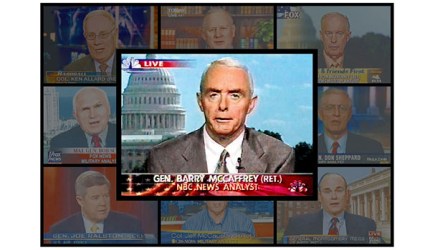

Four days later the general swung into action. He sent a personal note and 15-page briefing packet to David H. Petraeus, the commanding general in Iraq, strongly recommending Defense Solutions and its offer to supply Iraq with 5,000 armored vehicles from Eastern Europe. “No other proposal is quicker, less costly, or more certain to succeed,” he said.
Thus, within days of hiring General McCaffrey, the Defense Solutions sales pitch was in the hands of the American commander with the greatest influence over Iraq’s expanding military.
“That’s what I pay him for,” Timothy D. Ringgold, chief executive of Defense Solutions, said in an interview.
President-Elect Barack Obama's Press Conference | Dec 1 2008
401k, ABC, ABC News, Abrams, Addington, AEI, Al Qaeda, Ari Fleisher, Ashcroft, bailout, Baker Botts, Banks, Bechtel, Beltway Groupthink, Beltway Journalism, Bin Laden, Blackwater, Bozell, Bremer, Britain, Broadcatching, Brown and Root, Buffett, Bush, Bush Apologists, Byron York, California, Campbell Brown, Carlyle Group, Charlie Gibson, Chevy Chase Club, Children, CIA, Coalition Provisional Authority, Cokie Roberts, Colin Powell, Condi Rice, Consensus Journalism, Conservatism, Constitution, Corn, Credit, Credit Default Swaps, Dan Rather, Dan Senor, Dana Perino, David Brooks, David Iglesias, Debates, Democrats, Dick Cheney, District Of Corruption, Dow Jones, Duke Zeiberts, Equity Market, Evolution, FBI, Feith, Finance, FISA, Fournier, Framing, Freepers, George Stephanopoulos, George Tenet, George W. Bush, George Will, Global Warming, Gonzales, Gonzalez, Gootube, Grey, Grover Nordquist, Guantanamo, Guns, Habeas Corpus, Halliburton, Hannity, Healthcare, Hedge Funds, Hillary, Hume, Immigration, Iran, Iraq, Jeff Gannon, Jeff Guckert, Joe Biden, Joe Klein, John Yoo, Joseph Wilson, Judith Miller, Justice Department, K Street, Karen Hughes, Karl Rove, Katrina, Kellog, Kerry, Kristol, Lee Atwater, Lehman. AIG, Libby, Limbaugh, Lobbyists, Luntz, Malkin, Maria Bartiromo, Mary Mapes, Matalin, Matt Cooper, Matt DrudgePart Two
 The New York Herald Sun