Hillary

Studs Terkel, Dead at 96
Studs TerkelStuds Terkel, writer and radio personality, dies at 96
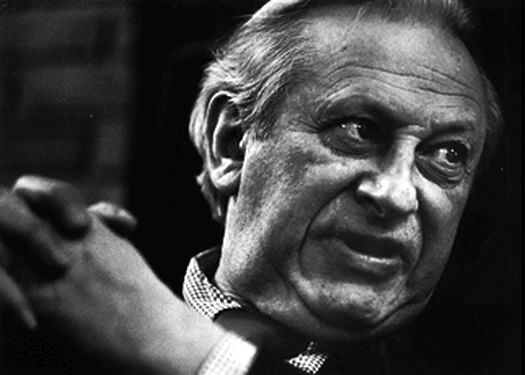
The Chicago fixture used his knack for conversation to capture oral histories on World War II, the Great Depression and more.
By Stephanie Simon
2:54 PM PDT, October 31, 2008
Studs Terkel, who made his name listening to ordinary folks talk about their ordinary lives — and who turned that knack for conversation into a much-honored literary career — died today. He was 96.
Terkel died at his home in Chicago, his son said.
“He lived a long, eventful, satisfying, though sometimes tempestuous, life,” Dan Terkel said. “I think that pretty well sums it up.”
The author of blockbuster oral histories on World War II, the Great Depression, and contemporary attitudes toward work, Terkel roamed the country engaging an astounding cross-section of Americans in tape-recorded chats — about their dreams, their fears, their chewing gum, about racism, courage, dirty floors, the Beatles.
With his loud laugh and raspy voice, plus his inept fumbles with his tape recorder, he set his subjects at ease and tugged from them memories, predictions and simple truths about their everyday existence. Terkel transcribed and edited the interviews, then compiled them into books at once intimate and sweeping, among them “Division Street,” “Hard Times,” “Working,” and “The Good War,” which won the Pulitzer Prize in 1984.
Terkel was also a legendary radio personality, hosting a daily music and interview show on Chicago’s WFMT for 45 years.
He never prepared his questions in advance. He interrupted his guests often. Yet Terkel was known as a master interviewer, able to establish an easy rapport with just about anyone. His secret, he once said, was simple: “It’s listening.”
And listen he did: to sultry jazz singers and insecure housewives; to a repentant Ku Klux Klan leader; to Bob Dylan, the Rev. Martin Luther King Jr., Marlene Dietrich, Bertrand Russell; to a parking lot attendant and a lesbian grandmother; to a piano tuner; to a barber.
As the late CBS newsman Charles Kuralt once said: “When Studs Terkel listens, everybody talks.”
Reviewers called Terkel’s oral histories accessible, powerful and deeply moving. “Readers will experience emotions they didn’t know they had,” the Cleveland Plain Dealer wrote of his World War II book. Though they were lengthy — some more than 600 pages — most of Terkel’s books shot straight to the best-seller list and much of his work was translated for publication abroad.
“I think he was the most extraordinary social observer this country has produced,” said Dr. Robert Coles, a Harvard professor of psychiatry who considered Terkel a friend and inspiration.
Though Terkel did interview the rich and famous, “he recognized the need to pay attention to the poor, the vulnerable, the ordinary people,” Coles said. “I pray for the day when American universities will understand that Studs Terkel is worth many departments of sociology. He’s an institution in himself.”
Louis “Studs” Terkel was born May 16, 1912, in New York City. His family moved to Chicago when he was a boy, and he quickly grew to love the city.
“It’s not that Chicago is that great,” he once said. “In fact, it’s horrible. But living here is like being married to a woman with a broken nose. There may be lovelier lovelies, but never a lovely so real.”
Real was what Terkel always wanted to get at: real people, real lives, real emotions.
He did not claim to be a social scientist. He did not seek to conduct a statistically valid poll. He simply talked to people he found interesting. He didn’t hide his liberal politics, and at times his cross-sections seemed tilted heavily to the left. In general, though, Terkel sought to reach across lines of politics, race, class, education and geography to coax America’s history from its varied voices.
” ‘Statistics’ become persons, each one unique,” he once wrote. “I am constantly astonished.”
Terkel developed his taste for gabbing as a child hanging out with the blue-collar workers who lived in his family’s Chicago rooming house. The men would get drunk on a Saturday night and talk to young Terkel for hours.
His father, a tailor, died when Terkel was 19. His mother, Anna, was able to put him through the University of Chicago for both an undergraduate and a law-school education. Yet Terkel graduated disillusioned with the law. So he worked for a time as a federal statistician. He acted in radio soap operas (usually playing a gangster, with lines of “stunning banality,” he later recalled).
Finally, in the 1940s, he moved into radio full time, first as a newscaster, then as a disc jockey and variety-show host on Chicago’s WFMT. By this time, he had thrown off his given name in favor of Studs — a tribute to the fictional Studs Lonigan, a rough-and-ready character created by novelist James T. Farrell.
Well on his way to becoming a Chicago institution, Terkel expanded into television in 1949 with “Studs’ Place.” An informal mix of banter and jazz, the show was set in a restaurant. “It was kind of like a ‘Cheers.’ But better,” Terkel said years later.
The breezy-but-smart informality of his programs won Terkel a devoted audience on both radio and TV.
“Studs’ Place” ran for four years, from 1949 to 1953 — and was only canceled, Terkel later maintained, because he was blacklisted by Sen. Joseph McCarthy for his liberal leanings. (He supported causes like rent control, desegregation and the abolition of the poll tax. “In those days, it was all quite radical,” he recalled.)
Throughout the 1950s and 60s, Terkel continued to broadcast his radio interviews while writing newspaper columns, acting in Chicago theaters and even penning plays of his own.
He hit upon oral history as an outlet for his insatiable curiosity in 1967, when at the age of 55 he published “Division Street: America” — a series of conversations about race with Chicago residents. The New York Times praised the book as “a modern morality play, a drama with as many conflicts as life itself.”
Terkel had a new career.
Blending journalism, history, sociology and literature, Terkel traipsed across the country, tape recorder at the ready, for the next three and half decades.
“I tape, therefore I am,” Terkel used to say. “Only one other man has used the tape recorder with as much fervor as I — Richard Nixon.”
Terkel’s techniques came in for some criticism, especially after “The Good War” won a Pulitzer Prize. Some called his work overly sentimental. Others accused him of letting his liberal politics taint both his selection of interview subjects and his editing of conversations. Still others wondered aloud how Terkel could be considered a master author when he did little more than transcribe other people’s memories.
In response, Terkel said he had but one goal for each of his books: to open new worlds for his readers. He wanted them to feel what it was like to be a laid-off factory hand during the Depression. Or a soldier facing his first enemy fire. Or a black businessman, or a poor Latino. Or a Miss USA.
“If I can get that in a book,” Terkel said, “that’s what it’s all about.”
Thus, in “Hard Times,” he probed the guilt many senior citizens felt for having survived the Great Depression. In “Working,” he let Americans vent about their jobs — and found a depressing majority saw themselves as automatons. In “The Good War,” he got his subjects to discuss racism, officers shot in the back by their own troops, and other topics that mainstream historians had shied away from.
“No one has done more to expand the American library of voices,” President Clinton said upon awarding Terkel a National Arts Medal in 1997.
“People would say the truth to him even when they had lied to themselves for their [whole] lives,” Terkel’s longtime editor, Andre Schiffrin, added. “The key thing was his respect for them. He wasn’t there to use them. He wasn’t there to make a point. He really wanted to hear what they had to say, and he respected them.”
Terkel, his editor added, was “a true democrat.”
Editing his interviews into book-ready segments took great discipline; often, Terkel had room for less than 10% of his material. Exchanging draft after draft with Schiffrin — who published all his books at New Press — Terkel would struggle to distill an evening’s conversation into an essential, honest portrait of just five or six pages.
In his later years, Terkel returned to his original tapes to mine material for new books — and to catalog reel after dusty reel in the Chicago Historical Society archive. (The society has put excerpts from those interviews online at www.studsterkel.org.) The exercise was his way of combating what he described as “national Alzheimer’s disease” — the rush-rush, live-for-the-minute pace he deplored as both irreverent and dangerous.
“We don’t remember anything. There’s no yesterday in this country,” he often complained. “I want to recreate those yesterdays.”
Despite his passion for the past, Terkel didn’t live in it; he kept a hectic schedule of travel, interviews and writing even after signing off from his daily radio show on Jan. 1, 1988. That same year he appeared in “Eight Men Out,” a film about the Black Sox scandal of 1919, in the role of a savvy newspaperman.
In 1996, Terkel had quintuple bypass surgery — and emerged hale as ever, still dedicated to his daily routine of two martinis, two cigars, and too many hours at the electric typewriter. His book of interviews about death and dying, “Hope Dies Last,” was released in 2004, when he was 92.
In 2005, at the age of 93, Terkel had another round of open-heart surgery, which doctors described as terribly risky for a man his age. He was back at work within weeks, promoting his 16th book, “And They All Sang,” an eclectic collection of interviews from his half-century on the radio.
When officials from Rutgers University knocked on Terkel’s door in May 2007 to present him with the Stephen E. Ambrose Oral History Award, they could hear furious typing inside. At the age of 95, he was polishing his memoir.
Though he was nearly deaf by then, Terkel’s memory for names, dates and bawdy anecdotes was impeccable.
Dressed in his trademark red-and-white-checked shirt and red socks, Terkel would entertain visitors at his Chicago home with long rants against President George W. Bush. His monologues were sprinkled with a dizzying array of allusions: He’d quote Shakespeare and Henry Kissinger and “Ode on a Grecian Urn” — and then, moments later, delve into the details of the 1920s Teapot Dome scandal.
Though rarely given to introspection, Terkel did tell one interviewer that he felt he had shortchanged his family by being so absorbed in his work. His wife of 60 years, Ida, died in 1999. He is survived by their son.
Terkel planned his funeral years in advance. He wanted readings from Mark Twain and George Bernard Shaw; music from Schubert and Mississippi bluesman Big Bill Broonzy. He wanted his ashes — and Ida’s — to be scattered in the Chicago square where, as a young man, he’d stand atop a soapbox and shout out his leftist views.
And Studs Terkel wanted this as his epitaph: “Curiosity did not kill this cat.”
Simon is a former Times staff writer.
Wassup? 2008 | Old and New
401k, ABC, ABC News, Abrams, Addington, AEI, Al Qaeda, Ari Fleisher, Ashcroft, bailout, Baker Botts, Banks, Bechtel, Beltway Groupthink, Beltway Journalism, Bin Laden, Blackwater, Bozell, Bremer, Britain, Broadcatching, Brown and Root, Buffett, Bush, Bush Apologists, Byron York, California, Campbell Brown, Carlyle Group, Charlie Gibson, Chevy Chase Club, Children, CIA, Cokie Roberts, Colin Powell, Condi Rice, Consensus Journalism, Conservatism, Constitution, Corn, Credit, Credit Default Swaps, Dan Rather, Dan Senor, Dana Perino, David Brooks, David Iglesias, Debates, Democrats, Dick Cheney, District Of Corruption, Dow Jones, Duke Zeiberts, Equity Market, Evolution, FBI, Feith, Finance, FISA, Fournier, Framing, Freepers, George Stephanopoulos, George Tenet, George W. Bush, George Will, Global Warming, Gonzales, Gonzalez, Gootube, Grey, Grover Nordquist, Guantanamo, Guns, Habeas Corpus, Halliburton, Hannity, Healthcare, Hedge Funds, Hillary, Hume, Immigration, Iran, Iraq, Jeff Gannon, Jeff Guckert, Joe Biden, Joe Klein, John Yoo, Joseph Wilson, Judith Miller, Justice Department, K Street, Karen Hughes, Karl Rove, Katrina, Kellog, Kerry, Kristol, Lee Atwater, Lehman. AIG, Libby, Limbaugh, Lobbyists, Luntz, Malkin, Maria Bartiromo, Mary Mapes, Matalin, Matt Cooper, Matt Drudge, Media Landscape, Medved, Meet The Press, Money Market, Moonbats, New York, New York Herald Sun, New York Times, NSA, O'Reilly, Obama, Olbermann, Patriot Act, Perle, PNAC, Politico, Politics, Politics Rundown, Poverty, Prager, Republic_Party, Retail Investors, Rich Lowry, Rick Sanchez, Right-Wing Conspiracy, Robert Luskin, Robert Novak, Roger Ailes, Rosie, Rumsfeld, Rupert Murdoch, Saddam, Sarah Palin, Scott McClellan, Shiite, Smerconish, Soldiers, Stock Market, Sunni, Surge, Taxes, terrorism, The Palm, The Plank, Tim Russert, Tony snow, Torture, Tullycast, Valerie Plame, Vandenheuvel, veterans, Viveca Novak, Wall Street, War Criminals, Washington D.C., Watergate, web 2.0, William Kristol, Wingnuttia, Wolfowitz, Youtube

Brand New Channel | Tullycast 3
401k, ABC, ABC News, Abrams, Addington, AEI, Al Qaeda, Ari Fleisher, Ashcroft, bailout, Baker Botts, Banks, Bechtel, Beltway Groupthink, Beltway Journalism, Bin Laden, Blackwater, Bozell, Bremer, Britain, Broadcatching, Brown and Root, Buffett, Bush, Bush Apologists, Byron York, California, Campbell Brown, Carlyle Group, Charlie Gibson, Chevy Chase Club, Children, CIA, Cokie Roberts, Colin Powell, Condi Rice, Consensus Journalism, Conservatism, Constitution, Corn, Credit, Credit Default Swaps, Dan Rather, Dan Senor, Dana Perino, David Brooks, David Iglesias, Debates, Democrats, Dick Cheney, District Of Corruption, Dow Jones, Duke Zeiberts, Equity Market, Evolution, FBI, Feith, Finance, FISA, Fournier, Framing, Freepers, George Stephanopoulos, George Tenet, George W. Bush, George Will, Global Warming, Gonzales, Gonzalez, Gootube, Grey, Grover Nordquist, Guantanamo, Guns, Habeas Corpus, Halliburton, Hannity, Healthcare, Hedge Funds, Hillary, Hume, Immigration, Iran, Iraq, Jeff Gannon, Jeff Guckert, Joe Biden, Joe Klein, John Yoo, Joseph Wilson, Judith Miller, Justice Department, K Street, Karen Hughes, Karl Rove, Katrina, Kellog, Kerry, Kristol, Lee Atwater, Lehman. AIG, Libby, Limbaugh, Lobbyists, Luntz, Malkin, Maria Bartiromo, Mary Mapes, Matalin, Matt Cooper, Matt Drudge, Media Landscape, Medved, Meet The Press, Money Market, Moonbats, New York, New York Herald Sun, New York Times, NSA, O'Reilly, Obama, Olbermann, Patriot Act, Perle, PNAC, Politico, Politics, Politics Rundown, Poverty, Prager, Republic_Party, Retail Investors, Rich Lowry, Rick Sanchez, Right-Wing Conspiracy, Robert Luskin, Robert Novak, Roger Ailes, Rosie, Rumsfeld, Rupert Murdoch, Saddam, Sarah Palin, Scott McClellan, Shiite, Smerconish, Soldiers, Stock Market, Sunni, Surge, Taxes, terrorism, The Palm, The Plank, Tim Russert, Tony snow, Torture, Tullycast, Valerie Plame, Vandenheuvel, veterans, Viveca Novak, Wall Street, War Criminals, Washington D.C., Watergate, web 2.0, William Kristol, Wingnuttia, Wolfowitz, Youtube
Hackoff Anyone?
401k, ABC, ABC News, Abrams, Addington, AEI, Al Qaeda, Ari Fleisher, Ashcroft, bailout, Baker Botts, Banks, Bechtel, Beltway Groupthink, Beltway Journalism, Bin Laden, Blackwater, Bozell, Bremer, Britain, Broadcatching, Brown and Root, Buffett, Bush, Bush Apologists, Byron York, California, Campbell Brown, Carlyle Group, Charlie Gibson, Chevy Chase Club, Children, CIA, Cokie Roberts, Colin Powell, Condi Rice, Consensus Journalism, Conservatism, Constitution, Corn, Credit, Credit Default Swaps, Dan Rather, Dan Senor, Dana Perino, David Brooks, David Iglesias, Debates, Democrats, Dick Cheney, District Of Corruption, Dow Jones, Duke Zeiberts, Equity Market, Evolution, FBI, Feith, Finance, FISA, Fournier, Framing, Freepers, George Stephanopoulos, George Tenet, George W. Bush, George Will, Global Warming, Gonzales, Gonzalez, Gootube, Grey, Grover Nordquist, Guantanamo, Guns, Habeas Corpus, Halliburton, Hannity, Healthcare, Hedge Funds, Hillary, Hume, Immigration, Iran, Iraq, Jeff Gannon, Jeff Guckert, Joe Biden, Joe Klein, John Yoo, Joseph Wilson, Judith Miller, Justice Department, K Street, Karen Hughes, Karl Rove, Katrina, Kellog, Kerry, Kristol, Lee Atwater, Lehman. AIG, Libby, Limbaugh, Lobbyists, Luntz, Malkin, Maria Bartiromo, Mary Mapes, Matalin, Matt Cooper, Matt Drudge, Media Landscape, Medved, Meet The Press, Money Market, Moonbats, New York, New York Herald Sun, New York Times, NSA, O'Reilly, Obama, Olbermann, Patriot Act, Perle, PNAC, Politico, Politics, Politics Rundown, Poverty, Prager, Republic_Party, Retail Investors, Rich Lowry, Rick Sanchez, Right-Wing Conspiracy, Robert Luskin, Robert Novak, Roger Ailes, Rosie, Rumsfeld, Rupert Murdoch, Saddam, Sarah Palin, Scott McClellan, Shiite, Smerconish, Soldiers, Stock Market, Sunni, Surge, Taxes, terrorism, The Palm, The Plank, Tim Russert, Tony snow, Torture, Tullycast, Valerie Plame, Vandenheuvel, veterans, Viveca Novak, Wall Street, War Criminals, Washington D.C., Watergate, web 2.0, William Kristol, Wingnuttia, Wolfowitz, Youtube

Hillary Clinton Seals the Deal for Obama’s Nomination; Richard Cohen Wets his Pants
StoriesThe Venerable DETROIT FEEE PRESS
Here’s Cohen’s Dreck about Hillary’s speech last night
DENVER – His former rival moving for his nomination by acclimation as her friends and supporters chanted her name, Barack Obama became the Democrats’ official nominee this evening, with nary a suggestion of disunity in the house.
The traditional roll call of states proceeded, with each in its turn announcing the votes of its delegates, with California and then Illinois – Obama’s home state – passing. Then, as it got to New Mexico, with Obama well ahead of Hillary Clinton in the call, that state passed to Illinois, which then passed to New York.

Clinton – New York’s junior senator – was led into the hall, and, smiling, she called for Obama – who she fought a sometimes bitter primary battle against – to be nominated for the presidency by acclimation.
“Let’s declare together in once voiced, right here, right now, that Barack Obama is our candidate and he will be our president,” she said, as applause boomed through the Pepsi Center.
House Speaker Nancy Pelosi – overseeing the proceedings – asked for yeas and nays. The former thundered through the hall, and, knowing something about calling voice votes, Pelosi seemed to gloss quickly past any scattering nay votes which may have resonated in the venue.
It didn’t matter. Obama was going to be the nominee, having secured it by beating Clinton during the primary season and winning the support of superdelegates to the convention even though it was she who was once considered the overwhelming front runner in the race for the Democratic nod to the White House.
Dennis Kucinich Rocks The House; Pleads With Americans to "Wake Up"
StoriesFrom John Amato’s Singular Crooks and Liars
Download | Play
Download | Play
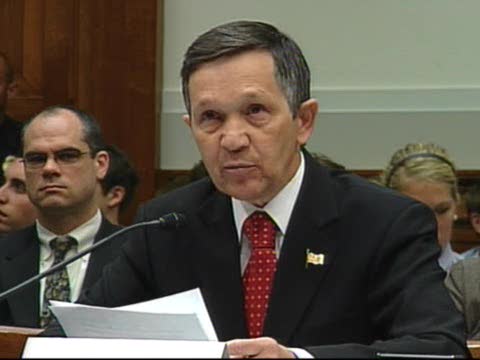
Ohio Congressman Dennis Kucinich spoke at the Democratic National Convention today and there is little doubt his was the most enthusiastic and hard hitting speech thus far. Dennis always comes armed with truth and facts, and today was no exception.
From illegal wiretapping, Iraq and high gas prices to playing the fear card, he blazed through the laundry list of Bush hackery and crimes and pounded the message home — Americans to wake up and vote for Barack Obama.
“…Wake up America! The insurance companies took over health care. Wake up America! The pharmaceutical companies took over drug pricing. Wake up America! The speculators took over Wall Street. Wake up America, they want your Social Security. Wake up America, multi-national corporations took over our trade policies, factories are closing, good paying jobs are being lost, wake up America!”
Now that’s the spirit! We need to hear more of this during the convention. The American electorate needs a good dose of reality. If this speech doesn’t get you fired up, nothing will.
All of Cable News Geeks Out About Obama's VP Pick on a Friday in August
Barack Obama, CNN, Evan Bayh, Fox, Hillary Clinton, Joe Biden, MSNBC, Nagourney, Politics, Punditry, Television, Wingnuts, Wolf Blitzer
It was ….horrible
Kos Jumps a Shark
Stories[Ed. note: I’ve liked Markos since I used to read his baby blog and before he basically
invented the Netroots. With that said, this may not just be his “Jump the Shark” moment but it may also be some of the worst writing in the history of the game]

Daily Kos: State of the Nation
Rewarding good behavior
by kos
Tue Jul 01, 2008 at 11:05:46 AM PDTSo many of you are upset that I pulled back my credit card last night, making a last minute decision to hold back on a $2,300 contribution to Obama. Let me explain further:
First of all, obviously Obama is a great candidate who is running a great 50-state race. That much cannot be denied. But he’s had a rough couple of weeks.
First, he reversed course and capitulated on FISA, not just turning back on the Constitution, but on the whole concept of “leadership”. Personally, I like to see presidents who 1) lead, and 2) uphold their promises to protect the Constitution.
Then, he took his not-so-veiled swipe at MoveOn in his “patriotism” speech.
Finally, he reinforced right-wing and media talking points that Wes Clark had somehow impugned McCain’s military service when, in reality, Clark had done no such thing.
All of a sudden, there was a lot of cowering when, just days ago, we got to read this:
When Mr. Wenner asked how Mr. Obama might respond to harsh attacks from Republicans, suggesting that Democrats have “cowered” in the past, Mr. Obama replied, “Yeah, I don’t do cowering.”
Could’ve fooled me, and maybe he is. Maybe what looks like cowering to me is really part of that “moving to the center” stuff everyone keeps talking about. But there is a line between “moving to the center” and stabbing your allies in the back out of fear of being criticized. And, of late, he’s been doing a lot of unecessary stabbing, betraying his claims of being a new kind of politician. Not that I ever bought it, but Obama is now clearly not looking much different than every other Democratic politician who has ever turned his or her back on the base in order to prove centrist bona fides. That’s not an indictment, just an observation.
Now I know there’s a contingent around here that things Obama can do no wrong, and he must never be criticized, and if you do, well fuck you! I respect the sentiment, but will respectfully disagree. We’re allowed to do that here. But fair notice — I will never pull a Rush Limbaugh and carry water for anyone. Not for the Democratic Congress, and not for our future Democratic president. When anyone does something I don’t care for, I will say so. I’ve never pulled my punches before, so why start now?
Obama will be fine without my contribution, and he may even still get it before this thing is said and done, but it would be at a time when he has done something positive. That’s called rewarding good behavior. And if that opportunity fails to arise because Obama goes on a Sister Souljah’ing rampage, then no worries. Chances are good that the DNC would get the money instead. But at this time, I simply have no desire to reward bad behavior. Some of you don’t care about his behavior, or don’t think it’s bad behavior, or whatever. I didn’t ask any of you to follow suit, and don’t care whether you do or not. I didn’t pull him from the Orange to Blue list. I’m not going to start praising Nader or Barr. I’ll still vote for him. Yadda, yadda, yadda. At the end of the day, I’m pretty irrelevant in the whole affair. Obama is going to raise a ton of dough and win this thing whether I send him money or not.
Ultimately, he’s currently saying that he doesn’t need people like me to win this thing, and he’s right. He doesn’t. If they’ve got polling or whatnot that says that this is his best path to victory, so much the better. I want him to win big. But when the Obama campaign makes those calculations, they have to realize that they’re going to necessarily lose some intensity of support. It’s not all upside. And for me, that is reflected in a lack of interest in making that contribution.
That’s it. No need to freak out. It is what it is. Others will happily pick up the slack. We’re headed toward a massive Democratic wave, and what I decide to do with my money means next to nothing, no matter how much hyperventilating may happen on this site’s comments and diaries about it all.
And if for some crazy hard-to-see reason my money actually is important to the Obama campaign, then they can adjust their behavior to get it.

 The New York Herald Sun