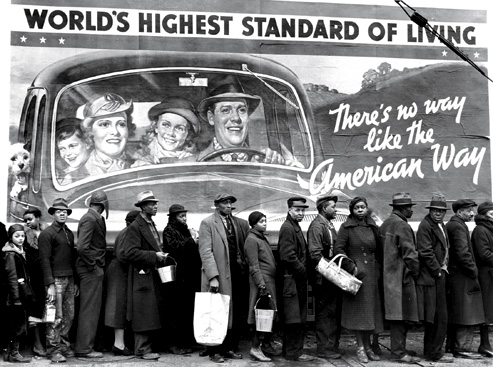
California State Unemployment Rate Highest Since 1941

California, Unemployment

San Francisco Chronicle

Saturday, April 18, 2009

BY TOM ABATE Chronicle Staff Writer

simpsons_torch_mobThe state unemployment rate soared to 11.2 percent in March, the highest since before World War II, leaving a record 2.1 million Californians out of work, according to a report issued Friday.

Employment Development Department spokeswoman Patti Roberts said the March figure surpasses the 11 percent rate that occurred during the 1980s recession and brings California close to the jobless level of January 1941, when unemployment stood at about 11.7 percent.

Roberts said unemployment is estimated to have been as high as 25 percent during the Great Depression. The highest reliable figure in state archives is the 14.7 percent rate in October 1940.

The U.S. unemployment rate for March stood at 8.5 percent.

“California’s higher rate of job loss is primarily the result of greater exposure to the housing downturn,” said Stephen Levy, with the Center for the Continuing Study of the California Economy in Palo Alto.

The Bay Area job market remained slightly better than the state average in March. But local rates continued to rise even in the San Francisco metropolitan area, which has been among the state’s most resilient job markets.

Unemployment in the three-county metropolitan zone made up of San Francisco, San Mateo and Marin counties rose to 8.5 percent in March.

In the Oakland metropolitan area, composed of Alameda and Contra Costa counties, the March rate was 10.2 percent.

The unemployment rate in metropolitan San Jose was 11 percent, as Santa Clara County and San Benito County suffered accelerating losses.

State figures show that employers cut 62,100 jobs last month. Since March 2008 the state has lost 637,400 jobs.

Over the past 12 months, another 913,000 have joined the ranks of the unemployed. That includes workers who were laid off, young people looking for their first jobs, and older adults who rejoined the labor force, perhaps because a family member got laid off.

“These are stark numbers and this is certainly not an easy time, but on the other hand things are not really as bad as you might think,” said Chris Thornberg with Beacon Economics, a firm that forecasts California conditions.

Thornberg said these job losses reflect the slump in consumer spending that occurred at the end of 2008 and in the beginning of 2009. He said spending is starting to stabilize rather than fall.

“If the stability in consumer spending continues over the next few months, as I expect, the job market will stabilize,” Thornberg said.

But even if the national and state economies start to bottom out later this year, that would only slow the rate of job losses, said Jerry Nickelsburg, an economist with the UCLA Anderson Forecast.

“Unemployment will likely creep up through the end of the year because employers will want to see that the increase in demand is strong before they hire,” he said.

Nickelsburg predicts that the state jobless rate will hit 12 percent before it starts to decline in 2010.

Meanwhile, record numbers of Californians struggle to find work in the toughest job market of their lives.

“This is the first time I’ve been out of work for seven months,” said Phillip House, a 46-year-old San Francisco native who can’t find openings or land interviews in his chosen field of accounting.

“I’m at the point where I’ll do any job that’s legal, moral and ethical,” he said.

State unemployment in March

Labor force*

18,604,000

Total employment

16,524,000

Total unemployment

2,080,000

State unemployment rate

11.2 percent

*People with jobs or looking to work

Source: Employment Development Department

E-mail Tom Abate at tabate@sfchronicle.com.

http://sfgate.com/cgi-bin/article.cgi?f=/c/a/2009/04/18/MNPQ174BVL.DTL

This article appeared on page A – 1 of the San Francisco Chronicle

98% of Cities in America Report Unemployment Rise

City, Labor Department, Metropolitan, U.S.A., Unemployment
skylook1
CNNMoney.com staff writer

NEW YORK (CNNMoney.com) — In a sign that job losses are felt in every corner of the nation, unemployment rates rose in 98% of metropolitan areas across the country in December, according to a recent government report.

The Labor Department reported that the unemployment rates in 363 of 369 metropolitan areas rose in December 2008, compared with the same month in the prior year. In November, 364 of 369 areas reported higher unemployment rates.

According to the report, 168 areas reported jobless rates of at least 7%, compared with just 33 a year ago, and 40 areas reported rates that were higher than 10%. Just 22 metropolitan regions had unemployment rates that were under 4%, down from 112 last year.

A total of 95 regions registered unemployment rates that were at least 3 percentage points higher than a year ago. Not one region had a jobless rate decrease of more than 0.2 percentage point during that period.

Though the rise in unemployment rates depicts the rampant job losses facing the country, the Labor Department does not adjust the rates in its metropolitan unemployment report for typical seasonal changes in employment.

Furthermore, smaller cities are usually dependent on a fewer number of employers, so layoffs can exacerbate those areas’ unemployment rates.

El Centro, Calif. continued to hold the highest rate of unemployment at 22.6%. The town on the border of Mexico is highly reliant on agricultural employment, according to economists. The unemployment rate has a tendency to rise and fall in the area depending on the farming season.

Morgantown, W.Va., had a rate of just 2.7%, the lowest in the country. Morgantown houses West Virginia University, which is the town’s largest employer. The University has a large hospital and pharmaceutical manufacturing component – areas of the economy that are actually adding jobs.

Of the 49 metropolitan areas with a population of at least 1 million, Detroit had the largest unemployment rate, at 10.6%, followed by San Bernadino, Calif., with 10.1%. Detroit’s labor force has been slammed by dreadful auto sales, and the sinking California housing market has dragged down construction jobs in that area.

Oklahoma City had the lowest unemployment rate of large metropolitan regions, at 4.6%, followed by Washington at 4.7%. Oklahoma City is benefiting from the still-booming energy industry, especially through the several large natural gas companies in the city. Washington’s employment is largely based on federal government jobs in the district.

The report comes on the same day as two independent reports showed job cut announcements and payroll reductions continued to rise in January.

The Labor Department is expected to report Friday that the economy lost another 500,000 jobs, according to a consensus estimate of economists surveyed by Briefing.com. The national unemployment rate is expected to rise to 7.5% from its current level of 7.2%, its highest rate since January 1993

There's a New Sheriff in Town and He's Not Wearing a Cowboy Hat

Barack Obama, Bonuses, Federal Reserve, Jobs, Michelle Obama, Treasury, Unemployment, Wall Street

lilly

You know you can whine all day about the idea that no matter what President Obama does in the next couple of years- we’re all in for some rough times- and you’d be right.

But there’s just no accounting for the feeling an American citizen gets after a day like today- miserable, pissed off and yet hopeful that at last, someone is Finally in charge.

The very first bill that President Barack Obama signed into law protects American workers on a day that unemployment benefits climbed to a record number of claims. Lilly Ledbetter worked alongside her male Goodyear plant supervisors for twenty years making less money because she was a female. She stood behind the President as he signed the legislation.

Mrs. Obama, who made her first public comments since becoming First Lady said: “She knew unfairness when she saw it, and was willing to do something about it because it was the right thing to do — plain and simple,”

The President explained that he wanted his daughters to be treated equally and valued for their talents in the workplace.

Later in the day he met with Vice President Biden amd Treasury Secretary Geithner and then addressed the press about the report that Wall Street bonuses are the same as 2004.

Barack Obama leaned forward in his gold and blue striped antique chair and ripped in to Wall Street:

“Shameless”

“There will be times for them to make profits and there will be time for them to get bonuses — now is not that time,” Obama said. “The American people understand that we’ve got a big hole that we’ve got to dig ourselves out of, but they don’t like the idea that people are digging a bigger hole even as they’re asked to fill it up.”

It’s nice to have a living, working brain back in the Oval Office.

JT

Stiglitz on The Great American Economy [must read]

Stories

VANITY FAIR

Reversal of Fortune

Describing how ideology, special-interest pressure, populist politics, and sheer incompetence have left the U.S. economy on life support, the author puts forth a clear, commonsense plan to reverse the Bush-era follies and regain America’s economic sanity.

by Joseph E. Stiglitz November 2008

When the American economy enters a downturn, you often hear the experts debating whether it is likely to be V-shaped (short and sharp) or U-shaped (longer but milder). Today, the American economy may be entering a downturn that is best described as L-shaped. It is in a very low place indeed, and likely to remain there for some time to come.

Virtually all the indicators look grim. Inflation is running at an annual rate of nearly 6 percent, its highest level in 17 years. Unemployment stands at 6 percent; there has been no net job growth in the private sector for almost a year. Housing prices have fallen faster than at any time in memory—in Florida and California, by 30 percent or more. Banks are reporting record losses, only months after their executives walked off with record bonuses as their reward. President Bush inherited a $128 billion budget surplus from Bill Clinton; this year the federal government announced the second-largest budget deficit ever reported. During the eight years of the Bush administration, the national debt has increased by more than 65 percent, to nearly $10 trillion (to which the debts of Freddie Mac and Fannie Mae should now be added, according to the Congressional Budget Office). Meanwhile, we are saddled with the cost of two wars. The price tag for the one in Iraq alone will, by my estimate, ultimately exceed $3 trillion.