Banks Keeping Mum on TARP Bailout Funds; Only Morgan Stanley Coming Clean

ABC, AIG, Banking, Finance, Goldman Sachs, Morgan Stanley, TARP, Treasury, Verizon, Wall Street

inaug3

Morgan Stanley Is One Bank That Cites a Loan From TARP Money

Other Financial Banks Including Goldman Sachs and CitiGroup Keep Mum on How They Are Using TARP Cash

By CHARLES HERMAN, DAN ARNALL, LAUREN PEARLE and ZUNAIRA ZAKI

ABC NEWS

Dec. 17, 2008—

Banks that were rescued with billions of dollars in public funds have, in most cases, refused to provide specifics about how they have used or intend to use the money.

ABC News asked 16 of the banks that have received money from the Treasury Department’s $700 billion Trouble Asset Relief Program the same two questions: How has your financial institution used the money, and how much has your financial institution allocated to bonuses and incentives this year?

To read the banks’ responses, click here.

Goldman Sachs reported Tuesday that it paid $10.93 billion in compensation for the year, which includes salaries and bonuses, payroll taxes and benefits. That is down 46 percent from a year ago. Goldman Sachs received $10 billion from the Treasury.

“Bonuses across Goldman Sachs will be down significantly this year,” a bank representative told ABC News. The spokesman refused to disclose the size of the bonus pool or how much of the compensation fund of $10.93 billion was planned for bonuses.

“We do not break down the components of compensation; however, most of that number was not bonuses,” he said. Goldman Sachs added, “TARP money is not being paid to employee compensation. It’s been and will continue to be used to facilitate client activity in the capital markets.”

Goldman Sachs has pointed out that seven of its senior executives were forgoing bonuses this year. The company also reported Tuesday that it lost $2.1 billion in the last quarter.

“It looks like Goldman Sachs is treating this as business as usual,” said compensation expert James Reda. “They are taking our taxpayer money. They should be able to account for that money.

“What’s missing from this report is the exact amount of bonuses that were paid,” said Reda. He later added, “They’re hiding the ball.”

Fred Cannon, chief equity strategist with Keefe Bruyette and & Woods, an investment bank that specializes exclusively in financial services, said, “It is difficult to say what the TARP funds are directly used for. In terms of compensation, while TARP funds may not directly pay for compensation, the funds do provide additional overall cash to the companies.”

When pressed for what the TARP money was being used for, Goldman Sachs replied that it is spent to “facilitate client activity in the capital markets.”

Only One Bank Cited a Loan It Made

Of the 16 banks that were contacted by ABC News and asked how they were spending the hundreds of billions of taxpayer dollars, only one bank pointed to a specific loan that it made with the cash. That was a $17 billion loan that Morgan Stanley made to Verizon Wireless.

Morgan Stanley, which received $10 billion from TARP, released its quarterly finances today. The bank announced a dramatic and larger-than-predicted $2.37 billion quarterly loss but an overall year-end profit of $1.59 billion. That was down 49 percent from last year. The bank’s stock price dropped 72 percent this year.

In response to an ABC News email request, Morgan Stanley public information officer Mark Lake confirmed that bonuses are down “approximately 50 percent.”

Besides the Verizon loan cited by Morgan Stanley, the banks declined to detail how they were using the federal funds.

“Tarp money doesn’t go into bonuses,” Lake said, in an email to ABC News.

Wells Fargo said that of the $25 billion it received, it “cannot provide any foward-looking guidance on lending for this quarter [and] Intend[s] to use the Capital Purchase Program funds to make more loans to credit-worthy customers.”

More typical was the generic response by the Bank of New York Mellon, which said of the fortune it had banked in public moneys: “Using the $3 billion to provide liquidity to the credit markets.”

Congress and fiscal watchdogs have been frustrated and upset that the banks do not have to account for the way they are spending these publicly financed bonanzas.

The U.S. Treasury has spent or committed $335 billion of the $700 billion in the TARP fund in an attempt to get banks back in the lending business and to unfreeze the nation’s credit markets.

Last week Congress was angered to learn that giant insurance company American Insurance Group, which received $150 billion in TARP cash to stay afloat, was paying more than $100 million in “retention bonuses” to 168 employees.

That revelation prompted Rep. Elijah Cummings, D-Md., to complain, “It’s absolutely and incredibly wrong that we don’t have more transparency.”

All the Banks That Got TARP Cash Indicate They Are Paying Bonuses

While several banks said that its top executives would skip bonuses this year or its compensation pool was smaller this year than in past years, all indicated that some end-of-year compensation was in the works.

When asked how much the banks were paying out in bonuses and whether TARP funds would be used to finance them, most of the banks did not make such a declaration.

“Incentive compensation not yet allocated,” was as far as JP Morgan Chase, which received $25 billion from TARP, would go.

Bank of America, which got $15 billion from TARP, said only, “Have reduced the incentive targets by more than half. Final awards have not been determined.”

State Street Bank ruled out using TARP to reward its top officers.

“Will not use any of the proceeds from the TARP Capital Purchase Program to fund our bonus pool or executive compensation,” the bank insisted.

Cannon said the banks are being very conservative with their money.

After reviewing the statements the banks provided to ABC News he said, “The banks are expressing good intention in line with the good intention of the program. However, the answers from the bank belie the current challenge; the economy is deteriorating rapidly and making good loans, with strong underwriting into an economy that is falling apart is very difficult.”

ABC News’ MaryKate Burke contributed to this report.

–>

Billions in Drug and Organized Crime 'Dirty Money' Funneled Into Bernie Madoff's Operation

Barack Obama, Wall Street
WASHINGTON, Feb. 4, 2009


(CBS) By CBS News chief investigative correspondent Armen Keteyian and Investigative Producer Laura Stricker.


main
On Capitol Hill Wednesday, the financial analyst who first blew the whistle on Bernie Madoff back in 2000 went public for the first time, stunning lawmakers with the full scope of the $50 billion fraud.
CBS News correspondent Armen Keteyian reports.

In two hours of riveting, no-holds barred testimony, Harry Markopolos revealed the depth – and danger – of his nine-year fight to expose the Madoff scandal.

Markopolos said at one point he feared for his life.

“He would have known my name and, he knew he had a team tracking him. I didn’t think I was long for this world,” he said.

One reason: Bernie Madoff was among the “most powerful men” on Wall Street.

Another: In 2002 Markopolos said he discovered billions of dollars in “dirty money” was being funneled into Madoff Securities through a series of off-shore accounts.

“When you’re that big and that secretive, you’re going to attract a lot of organized crime money, and which we … now know came from the Russian mob and the Latin-American drug cartel,” Markopolos said.


A 162-page document filed with the U.S. Bankruptcy Court in Manhattan late Wednesday lists several thousand of the people and entities that handed money over to Madoff to “invest”. Among the victims are some very well-known personalities – and Madoff’s own defense lawyer. Click here to read more.


Markopolos said he began his crusade back in late 1999, when he was asked by his employer to see if he could match an investment strategy that produced unusually steady returns – like Madoff’s.

“It took me about five minutes to figure out that he was a fraud,” Markopolos said.

Despite “gift wrapping” evidence of the largest Ponzi scheme in history, Markopolos ran into a stone wall at the SEC. It was an agency, he charged, was unwilling and incapable of following his leads.

“I gave them a road map and a flashlight to find the fraud, and they didn’t go where I told them to go,” Markopolos said.

And he wasn’t the only one warning the feds.

This anonymous letter sent in April 2006 to the head of the SEC was obtained exclusively by CBS News.

In it, SEC Chairman Christopher Cox is told that Madoff keeps two “sets of records. The most interesting of which is on his computer which is always on his person.”

The letter was sent to Cox once on Dec. 6, 2006, and then again on April 26, 2006. The second letter has a note at the top saying, “Dear Sir, this is sent in the event you did not receive the original.”

The letter is also stamped, “Received: 2006 March 31, Chairman’s Correspondence Unit.” The anonymous writer says Madoff is perpetrating a “scandal of major proportion …”

But again, nothing happened.

Hardly surprising to former SEC Commissioner Paul Atkins, who told CBS News “higher ups” pushed investigators into cases that made headlines and careers.

“They were actively discouraged from going after Ponzi schemes, pump-and-dump schemes, and things that were considered small cases,” Paul Atkins, former SEC commissioner, said. “Actively discouraged by their superiors.”

As to the question of whether Bernie Madoff pulled off $50 billion worth of fraud all by himself?

Markopolos had a very simple answer: “No.”

© MMIX, CBS Interactive Inc. All Rights Reserved.

Stiglitz Calls Bad Bank Idea "Cash For Trash"

Bad Bank, Barack Obama, Columbia University, Davos, George Soros, Good Bank, Jamie Dimon, Joseph Stiglitz, JPMorgan Chase & Co, National Debt, Stimulus Package, Tim Geithner

BLOOMBERG

stiglitz_73457812

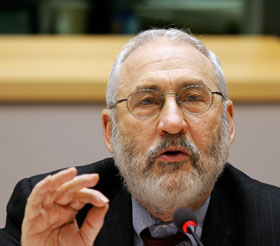
Feb. 1 (Bloomberg) — Nobel laureate Joseph Stiglitz said any decision by President Barack Obama to establish a so-called bad bank to rid financial companies of toxic assets risks swelling the national debt.

Obama’s administration is moving closer to buying the illiquid assets currently clogging bank’s balance sheets and preventing them from boosting lending, people familiar with the matter said this week.

That amounts to swapping taxpayers’ “cash for trash,” Stiglitz said yesterday in a panel discussion at the World Economic Forum in Davos, Switzerland. “You shouldn’t chase good money after bad. We’re talking about a national debt that’s very hard to manage.”

Stiglitz, a professor at Columbia University in New York and a former adviser to President Bill Clinton, says the plan would leave taxpayers paying for years of excess lending by banks. It would also deprive the government of money that would have been better spent shoring up Social Security, he said.

Whether a bad bank would accelerate an end to the financial crisis split delegates attending the Davos talks. JPMorgan Chase & Co. Chief Executive Officer Jamie Dimon said such an operation would help if “executed well.” Billionaire investor George Soros said in an interview that “it’s not the measure that would turn the situation around and enable banks to lend.”

Obama Plan

Obama said yesterday he’s readying a plan to unlock credit markets and lower mortgage rates. Under the initiative, the government would buy some tainted securities and insure the banks against losses on the rest.

“Soon my Treasury secretary, Timothy Geithner, will announce a new strategy for reviving our financial system that gets credit flowing to businesses and families,” Obama said in his weekly radio address.

Stiglitz drew criticism from panel participant Angel Gurria, head of the Organization for Economic Cooperation and Development, who says a bad bank is necessary for lending to resume.

“I agree about the moral, ethical fallout, but you’ve got to face the music and someone has to take the loss,” said Gurria, Mexico’s former finance minister. “It’s the only way to jumpstart the economy.”

Bank losses worldwide from toxic U.S.-originated assets may double to $2.2 trillion, the International Monetary Fund said in a report released Jan. 28.

John Monks, general secretary of the European Trade Union Confederation, told the same audience that governments are getting “close to straining the patience of the public and voters” by repeatedly extending lifelines to banks.

Philippines President Gloria Arroyo urged Obama to make a quick decision on his plan.

“We want Americans to do something,” she said at the session, which was called “Rebooting the Global Economy.” “We can discuss what to do but the worst thing is to do nothing.”

Bank of America Throws Ten Million Dollar Super Bowl Party

AIG, Bank of america, Banking, Bear Stearns, CDS, Citibank, Derivatives, Finance, Hedge Funds, Merrill, Sports Business

T H I N K  P R O G R E S S

news

Just weeks ago, the federal government extended $20 billion to Bank of America to keep it afloat, bringing its total in federal bailout dollars received to $45 billion. ABC News reports, however, that the bank managed to scrounge up millions of dollars to be an NFL sponsor and for “a five day carnival-like” Super Bowl party just outside the stadium:

The event — known as the NFL Experience — was 850,000 square feet of sports games and interactive entertainment attractions for football fans and was blanketed in Bank of America logos and marketing calls to sign up for football-themed banking products. […]

The bank refused to tell ABC News how much it is spending as an NFL corporate sponsor, but insiders have put the figure at close to $10 million. The NFL Experience was on top of that and was inked last summer, according to the bank.

The NFL said it was a “multi-million dollar” event and that it was also spending money to put on the event. A Super Bowl insider said the tents alone cost over $800,000.

The Huffington Post notes that this is the latest in a series of bailed-out banks that continue to spend lavishly on sports sponsorships.

SEC Under Scrutiny in Madoff Case

Bernie Madoff, Fraud, Grassley, Madoff Securities, Palm Beach, SEC, Wall Street, Wiesel. Spielberg, Zuckerman

Senator: The SEC “Letting Down the American People”

mad-money

ABC NEWS

By BRIAN ROSS and RICHARD ESPOSITO

Dec. 15, 2008—

As the list of victims continues to grow and investigators examine how Bernard Madoff allegedly ran his massive scam, some are questioning how Madoff avoided detection for so long. As a registered investment advisor since 2006, he was subject to scrutiny by the Securities and Exchange Commission, yet he managed to maintain a clean record even after complaints from whistleblowers started nine years ago.

“The Securities and Exchange Commission is letting down the American people,” Sen. Charles Grassley (R-Iowa) said of the SEC. “They failed. This person was registered as a broker dealer, they should have known what he was doing all the time, and particularly if you have whistleblowers.”

The head of enforcement at the SEC attempted to duck questions about the failure of the agency to detect what may be the biggest investment fraud in history.

“It is hard to directly respond given the fact that so much of what we have done historically is non-public and needs to remain non-public until someone decides otherwise,” said Linda Thomsen.

Meanwhile, the list of Madoff’s victims keeps growing. European banks have lost billions, as have charities run by Elie Wiesel, director Steven Spielberg, and New York billionaire Mort Zuckerman, whose charitable trust lost $30 million.

Authorities say Madoff didn’t hesitate to scam even close friends and fellow members of the Palm Beach Country Club.

“They’re going to have to sell their 20, 30 million dollar mansions,” said Larry Leamer, author of “Madness Under the Royal Palms”. “It’s all over. Some of these people crazily put all their money with him so they’re finished.”

Some Were Sent a Warning Sign on Madoff

While many trusted Madoff with their life savings, others were sending out a warning signal. The research firm Aksia, which also provides advice to pensions, endowments, foundations and insurance companies, says it has long been steering clients away from Madoff’s hedge fund based on a “host of red flags.”

According to a letter to its clients, Aksia “published extensive reports on several of the ‘feeder funds’ which allocated their capital to Madoff Securities … Our judgment was swift, given the extensive list of red flags.”

Aksia said in its letter that when the firm checked the auditor of Madoff’s fund they found the operation was quite small, given the amount of money being handled.

The accounting firm, says Aksia, had just three employees, “of which one was 78 years old and living in Florida, one was a secretary, and one was an active 47-year-old accountant (and the office in Rockland County, N.Y., was only 13 ft x 18 ft large).”

New Yorkers Popping Pills Like Skittles

Anxiety, Banking, Big Pharma, Financial Meltdown, New York, Prescription Drugs, Wall Street

Anxious New Yorkers popping more pills

CRAINS NEW YORK BUSINESS

By Daniel Massey

Published: December 12, 2008

skylook

Prescriptions filled for anti-anxiety drugs, anti-depressants and sleep aids have surged in the city as New Yorkers struggle to cope with uncertainties brought on by the financial crisis.

The spike was particularly evident in September, when an economic tsunami bankrupted Lehman Brothers Holdings Inc., forced Washington to bail out insurer American Insurance Group Inc., prompted Bank of America Corp. to rescue Merrill Lynch & Co., and led Goldman Sachs Group Inc. and Morgan Stanley to reorganize as bank holding companies.

“If we looked to diagnose the city, I would say it has an anxiety disorder,” said Mel Schwartz, a psychotherapist with practices in the city and in Westport, Conn.

In September and October, prescriptions filled for sleep aids rose more than 7% to 366,870 compared to the same two-month period last year, according to data provided to Crain’s by Wolters Kluwer Health, a global provider of medical information. Prescriptions for anti-anxiety drugs rose 5% to 317,268, and anti-depressants were also up 5% to 926,654 in the two months in the city.

Taken alone, the September rise was sharper. As the financial world collapsed that month, New Yorkers filled 11% more sleep aid prescriptions and 9% more prescriptions for anti-anxiety and anti-depressant drugs than they had in the same period in 2007.

The increases come at a time when spending on all classes of prescription drugs has fallen across the country, as patients deal with tighter budgets. In the city, prescriptions for anti-anxiety drugs, anti-depressants and sleep aids had all dropped in August on a year-over-year basis before shooting up in September, according to the Wolters Kluwer Health data.

There’s no way to say with certainty that the increases are directly tied to the financial crisis. But anecdotal evidence from psychiatrists, psychologists and sleep doctors suggests that patient volume is up and that rarely does a session go by without discussion of anxiety over the faltering economy.

“It’s unusual for somebody to come in at this point and for the economic environment not to be on the list of things affecting them,” said Dr. Neil Kavey, director of the Sleep Disorder Center at New York Presbyterian Hospital Columbia University Medical Center. “It’s on everybody’s mind.”

Experts say it’s too soon to tell whether the trend will continue, but with news of layoffs and consumer spending worsening by the day, the psyche of the city remains fragile.

“There’s a sense of foreboding that what’s been going on in recent months is just the beginning,” said Dr. Charles Goodstein, clinical professor of psychiatry at New York University Langone Medical Center.

There's a New Sheriff in Town and He's Not Wearing a Cowboy Hat

Barack Obama, Bonuses, Federal Reserve, Jobs, Michelle Obama, Treasury, Unemployment, Wall Street

lilly

You know you can whine all day about the idea that no matter what President Obama does in the next couple of years- we’re all in for some rough times- and you’d be right.

But there’s just no accounting for the feeling an American citizen gets after a day like today- miserable, pissed off and yet hopeful that at last, someone is Finally in charge.

The very first bill that President Barack Obama signed into law protects American workers on a day that unemployment benefits climbed to a record number of claims. Lilly Ledbetter worked alongside her male Goodyear plant supervisors for twenty years making less money because she was a female. She stood behind the President as he signed the legislation.

Mrs. Obama, who made her first public comments since becoming First Lady said: “She knew unfairness when she saw it, and was willing to do something about it because it was the right thing to do — plain and simple,”

The President explained that he wanted his daughters to be treated equally and valued for their talents in the workplace.

Later in the day he met with Vice President Biden amd Treasury Secretary Geithner and then addressed the press about the report that Wall Street bonuses are the same as 2004.

Barack Obama leaned forward in his gold and blue striped antique chair and ripped in to Wall Street:

“Shameless”

“There will be times for them to make profits and there will be time for them to get bonuses — now is not that time,” Obama said. “The American people understand that we’ve got a big hole that we’ve got to dig ourselves out of, but they don’t like the idea that people are digging a bigger hole even as they’re asked to fill it up.”

It’s nice to have a living, working brain back in the Oval Office.

JT

Wall Street Bonuses Are Same As 2004

AIG, Banking, Bear Stearns, CDS, Citi, Executive Pay, Finance, Merrill, Wall Street, Wall Street bailout
January 29, 2009

What Red Ink? Wall Street Paid Hefty Bonuses

Wall Street ArrestBy almost any measure, 2008 was a complete disaster for Wall Street — except, that is, when the bonuses arrived.

Despite crippling losses, multibillion-dollar bailouts and the passing of some of the most prominent names in the business, employees at financial companies in New York, the now-diminished world capital of capital, collected an estimated $18.4 billion in bonuses for the year.

That was the sixth-largest haul on record, according to a report released Wednesday by the New York State comptroller.

While the payouts paled next to the riches of recent years, Wall Street workers still took home about as much as they did in 2004, when the Dow Jones industrial average was flying above 10,000, on its way to a record high.

Some bankers took home millions last year even as their employers lost billions.

The comptroller’s estimate, a closely watched guidepost of the annual December-January bonus season, is based largely on personal income tax collections. It excludes stock option awards that could push the figures even higher.

The state comptroller, Thomas P. DiNapoli, said it was unclear if banks had used taxpayer money for the bonuses, a possibility that strikes corporate governance experts, and indeed many ordinary Americans, as outrageous. He urged the Obama administration to examine the issue closely.

“The issue of transparency is a significant one, and there needs to be an accounting about whether there was any taxpayer money used to pay bonuses or to pay for corporate jets or dividends or anything else,” Mr. DiNapoli said in an interview.

Granted, New York’s bankers and brokers are far poorer than they were in 2006, when record deals, and the record profits they generated, ushered in an era of Wall Street hyperwealth. All told, bonuses fell 44 percent last year, from $32.9 billion in 2007, the largest decline in dollar terms on record.

But the size of that downturn partly reflected the lofty heights to which bonuses had soared during the bull market. At many banks, those payouts were based on profits that turned out to be ephemeral. Throughout the financial industry, years of earnings have vanished in the flames of the credit crisis.

According to Mr. DiNapoli, the brokerage units of New York financial companies lost more than $35 billion in 2008, triple their losses in 2007. The pain is unlikely to end there, and Wall Street is betting that the Obama administration will move swiftly to buy some of banks’ troubled assets to encourage reluctant banks to make loans.

Many corporate governance experts, investors and lawmakers question why financial companies that have accepted taxpayer money paid any bonuses at all. Financial industry executives argue that they need to pay their best workers well in order to keep them, but with many banks cutting jobs, job options are dwindling, even for stars.

Lucian A. Bebchuk, a professor at Harvard Law School and expert on executive compensation, called the 2008 bonus figure “disconcerting.” Bonuses, he said, are meant to reward good performance and retain employees. But Wall Street disbursed billions despite staggering losses and a shrinking job market.

“This was neither the sixth-best year in terms of aggregate profits, nor was it the sixth-most-difficult year in terms of retaining employees,” Professor Bebchuk said.

Echoing Mr. DiNapoli, Professor Bebchuk said he was concerned that banks might be using taxpayer money to subsidize bonuses or dividends to stockholders. “What the government has been trying to do is shore up capital, and any diversion of capital out of banks, whether in the form of dividends or large payments to employees, really undermines what we are trying to do,” he said.

Jesse M. Brill, a lawyer and expert on executive compensation, said government bailout programs like the Troubled Asset Relief Program, or TARP, should be made more transparent.

“We are all flying in the dark,” Mr. Brill said. “Companies can simply say they are trying to do their best to comply with compensation limits without providing any of the details that the public is entitled to.”

Bonuses paid by one troubled Wall Street firm, Merrill Lynch, have come under particular scrutiny during the last week.

Andrew M. Cuomo, the New York attorney general, has issued subpoenas to John A. Thain, Merrill’s former chief executive, and to an executive at Bank of America, which recently acquired Merrill, asking for information about Merrill’s decision to pay $4 billion to $5 billion in bonuses despite new, gaping losses that forced Bank of America to seek a second financial lifeline from Washington.

A Treasury Department official said that in the coming weeks, the department would take action to further ensure taxpayer money is not used to pay bonuses.

Even though Wall Street spent billions on bonuses, New York firms squeezed rank-and-file executives harder than many companies in other fields. Outside the financial industry, many corporate executives received fatter bonuses in 2008, even as the economy lost 2.6 million jobs. According to data from Equilar, a compensation research firm, the average performance-based bonuses for top executives, other than the chief executive, at 132 companies with revenues of more than $1 billion increased by 14 percent, to $265,594, in the 2008 fiscal year.

For New York State and New York City, however, the leaner times on Wall Street will hurt, Mr. DiNapoli said.

Mr. DiNapoli said the average Wall Street bonus declined 36.7 percent, to $112,000. That is smaller than the overall 44 percent decline because the money was spread among a smaller pool following thousands of job losses.

The comptroller said the reduction in bonuses would cost New York State nearly $1 billion in income tax revenue and cost New York City $275 million.

On Wall Street, where money is the ultimate measure, some employees apparently feel slighted by their diminished bonuses. A poll of 900 financial industry employees released on Wednesday by eFinancialCareers.com, a job search Web site, found that while nearly eight out of 10 got bonuses, 46 percent thought they deserved more.

Paul J. Sullivan contributed reporting.

Thousands Line Up For Free Food In San Francisco

George W. Bush, Homelessness, San Francisco, The Economy

Wednesday, December 17, 2008

sf-food

(12-16) 13:47 PST SAN FRANCISCO — Never have so many people waited so long in San Francisco for a chicken.

Not only a chicken, but cans of pears, corn, carrots and tomatoes, plus a sack of pinto beans.

The line Tuesday for the annual grocery giveaway at Glide Memorial United Methodist Church was longer than anyone could remember. It stretched beyond the liquor store on the corner, past a half dozen residence hotels, up and down the aisles of a parking lot and along the far side of the massage parlor. It coiled back on itself like a cobra.

“We may run out of food,” said the Rev. Cecil Williams, who this year appeared to mean it. “The line is all the way around the block, twice over. We’re trying to rush things along so the line doesn’t come back on itself three times.”

Six thousand sacks of groceries were handed out. The first thousand came with a turkey. The rest came with a chicken. A lot of people were willing to show up before dawn in rainy 40-degree weather, to make sure they got the turkey instead of the less weighty, if not lesser, bird.

Four hundred volunteers in red T-shirts began passing out the food at 7 a.m., about a half hour earlier than scheduled. By 8 a.m., the turkeys were gone and it was chickens only.

Williams stood on the sidewalk in front of his fabled Tenderloin church, directing traffic. In the race for the turkeys, a woman in a motorized wheelchair nearly plowed over a woman in a walker, along with Williams.

“Just a minute here,” said Williams. “Take it easy. Please.”

Inside the church, volunteers were loading up the sacks in an assembly line that would do credit to whatever’s left of the ones in Detroit. Sarah Anderson, who was perched on two cases of canned corn while she loaded cans from a third case into the sacks, marveled at the versatility of canned corn.

“You can sit on it and then you can eat it,” she said.

Aaron Harris, who was lifting 48 cans of tomato sauce at a time, said it’s important to do something good when times are bad.

“People are hurting right now,” he said. “It’s good to give back.”

Outside, the line was so long that dozens of volunteers were required to make sure it stayed orderly. There was also a line for the three outhouses that had been set up in the middle of Ellis Street.

At the end of the food line, John Sorensen and a pal, Danny Holliday, were waiting for their sacks.

“Times are tougher than ever,” said Sorensen, an unemployed construction worker. “I used to be able to find some kind of work. Not now.”

Holliday, an out-of-work waiter, said standing in line for free groceries “is kind of a new thing to me.”

“I’m broke all the time right now,” he said. “So this really helps.”

Across Ellis Street in front of Boeddeker Park, recipients conducted the usual swapping. Homeless people without access to kitchens were less than excited about a sack of uncooked pinto beans and more than willing to trade for a can of cooked vegetables. Deals went down by the dozens.

“OK, gimme the beans and the rice,” said one man in a denim coat to another man in a knit cap. “You get the peas, corn and carrots.”

E-mail Steve Rubenstein at srubenstein@sfchronicle.com.

Not Just Super Rich Getting Destroyed By "The Madoff"

Banking, Berrie Madoff, Charities, Investment Firms, Money Manager, NASDAQ, The Madoff, Wall Street

ASSOCIATED PRESS

Dec 14, 6:16 PM (ET)

By JOE BEL BRUNOWall Street Arrest

NEW YORK (AP) – From a Jewish youth charity in Boston to major banks as far afield as Zurich, the list of investors who say they were duped in one of Wall Street’s biggest Ponzi schemes are streaming forward.

Around the world, investors who sunk cash into veteran Wall Street money manager Bernard Madoff’s investment pool spent the weekend calculating how much exposure they might have. The 70-year-old Madoff, well respected in the investment community after serving as chairman of the Nasdaq Stock Market, was arrested Thursday in what prosecutors say was a $50 billion scheme to defraud investors.

One thing was clear in the fallout from his arrest: The alleged victims span from the super rich, to pensioners and powerful financial institutions, to local charities. Some investors claim they’ve been wiped out, while others are still likely to come forward.

“There were a lot of very sophisticated people who were duped, and that happens a great deal when you’ve had somebody decide to be unscrupulous,” said Harvey Pitt, a former chairman of the Securities and Exchange Commission, a regulator in charge of monitoring investment funds like the one Madoff operated.

(AP) The apartment building where Bernard L. Madoff’s lives on New York’s Upper East Side is seen…
Full Image

“It isn’t just the big investors,” he said. “There’s a lot of charitable and foundation money involved in this, which is the real tragedy.”

Charities across the country are expected to be directly affected by the collapse of Madoff’s investment fund. The assets of Bernard L. Madoff Investment Securities LLC were frozen Friday in a deal with federal regulators and a receiver was appointed to manage the firm’s financial affairs.

One of the largest financial scams to hit Wall Street has investors wondering if they’ll ever get their money back.

In Boston, the Robert I. Lappin Charitable Foundation, a charity that financed trips for Jewish youth to Israel, said on its Web site Sunday that the money for its operations was invested with Madoff.

“The money needed to fund the programs of the Lappin Foundation is gone,” it said. “The foundation staff has been terminated today.”

(AP) The Manhattan apartment building where Bernard L. Madoff lives on New York City’s Upper East Side…
Full Image

New Jersey Sen. Frank Lautenberg, one of the wealthiest members of the Senate, entrusted his family’s charitable foundation to Madoff. Lautenberg’s attorney, Michael Griffinger, said they weren’t yet sure the extent of the foundation’s losses, but that the bulk of its investments had been handled by Madoff.

Lautenberg’s foundation handed out more than $765,000 to at least 100 recipients in 2006, according to the most recent listing on Guidestar, which tracks charitable organization filings.

The foundation helps support a variety of religious, educational, civic and arts organizations in New Jersey and elsewhere, and its contributions range from a gift of than $300,000 to the United Jewish Communities of MetroWest New Jersey to a $2,000 donation to a children’s program at the Hackensack Medical Center.

Reports from Florida to Minnesota included profiles of ordinary investors who gave Madoff their money. Some had been friends with him for decades, others were able to invest because they were a friend of a friend. They told stories of losing everything from $40,000 to an entire nest egg worth well over $1 million.

They join a list of more powerful investors that have come forward, all worried about the extent of their losses. The roster of names include Philadelphia Eagles owner Norman Braman, New York Mets owner Fred Wilpon and J. Ezra Merkin, the chairman of GMAC Financial Services, among others.

Beyond U.S. hedge funds, more corporate names disclosed exposure to Madoff. Late Sunday, some of Europe’s biggest banks acknowledged they, too, were exposed to Madoff’s investment fund.

Switzerland’s Reichmuth & Co. said the private bank has $327 million at risk. It told investors that they “sincerely regret” being affected.

Other banks such as Spain’s Grupo Santander SA, Europe’s second-largest banking consortium, and France’s BNP Paribas are also left with billions of dollars in exposure, according to media reports. Both banks could not immediately be reached for comment.

__

Associated Press Writer Samantha Henry in Trenton, N.J. contributed to this report.