

Web 2.0 afficionados and general internet geeks accross the planet staged a history-making rush of blog posts heralding the new Google browser, Chrome and the cavalcade of programs being written to use it on Apple’s I-Phone.

Today on Twitter, one mashup nerd excitedly wondered what custom API’s were in the works and a Spore programmer claimed on Tumblr that they would run a version of the new game through Mountain View’s Google servers utilizing Chrome’s mobile capabilities.
Rock bottom for Palm and Hawkins?
Suddenly, it seems even more fitting that a company called Elevation Partners recently took a stake in Palm.
This might be rock bottom for the storied mobile-computing company. The decision to cancel the Foleo even before letting people get their hands on it is an embarrassing admission that Palm’s vision of the computing world is way off base from the rest of the world, and it’s a black mark on the otherwise stellar career of Palm founder Jeff Hawkins.
It’s hard to dump too much on Hawkins. The man invented the Palm Pilot and the Treo. I once invented a novel method of stacking beer cans in a fridge (the key is not to buy any food). But after Hawkins unveiled the Foleo at the D: All Things Digital conference–arguably the most prestigious gathering of the computing elite–with proclamations like “it’s the best idea I’ve ever had” and “the most exciting product I have ever worked on”–Palm’s decision to cancel it without even a product launch must be mortifying for Hawkins.
Now, Hawkins has his own company, Numenta, which is trying to develop a computer that works like the human brain. If he pulls that off, we’ll forget all about the Foleo.
But what is Palm going to do? Speaking of mortifying, Ed Colligan must be wondering why he gave Hawkins $10 million to go down into the basement and come up with Palm’s Next Big Thing, only to emerge with the Foleo. Almost universally panned by analysts and bloggers, the Foleo was a lightweight Linux “mobile companion” that was designed to read e-mail, but didn’t work with corporate e-mail software from RIM or Motorola, among a multitude of other sins.
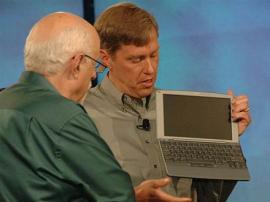
Palm founder Jeff Hawkins (right) shows The Wall Street Journal’s Walt Mossberg the Foleo, canceled Tuesday by Palm.
(Credit: CNET Networks)
Palm has squandered its position in the mobile-computing world by failing to improve its operating system since 2004, come up with a noticeably different Treo since the Treo 600, or clearly articulate any vision of where the company thinks smart phone development is headed. The company wisely hooked up with Microsoft to ship Windows Mobile Treos, otherwise this post might have been written a year ago. But it has watched companies like Motorola, RIM, LG, Nokia and even Apple pass it by while it tried to make its biggest splash of the year with a product canceled just three months later. Imagine the reaction if Apple had canceled the iPhone in April.
Jack Gold of market research firm J. Gold Associates thinks Elevation Partners is starting to throw its weight around a little. “Hopefully they are coming in and cracking the whip and making them do the right thing,” he wrote in a research note distributed Tuesday. After all, Palm clearly still hasn’t found what it’s looking for.
Palm also announced Tuesday that Bruce Dunlevie of Benchmark Partners is resigning from Palm’s board, while Scott Mercer will stay. Mercer was going to resign from the board to make way for Fred Anderson and Roger McNamee of Elevation Partners, but now Dunlevie (who’s also on the board at Numenta) is out. Anderson and McNamee haven’t formally assumed their positions yet as the deal hasn’t formally closed, but perhaps their impact is already starting to be felt.
While it’s embarrassing, Colligan made the right decision. You’ve got to know when to fold them, and the Foleo wasn’t going to beat anything better than a pair of sixes.
You’re supposed to have an intervention after the downtrodden hits rock bottom, but Colligan’s moment of clarity could still allow Palm to recapture some of its past glory.
However, Palm better think long and hard before the next time it tells people it’s about to change the world of mobile computing. The company is in danger of watching a category it helped create leave it in the dust.


Good Stuff StoogeWatcher!
You managed to get all the Dollar Store talking points in -Soros, Homosexuality, Manliness, Fear of a woman with a viewpoint, (“Gosh -I don’t know what it is about my lizard frat-boy brain that there’s just SOMETHING that bothers me, no, more like gnaws at me, about Hillary Clinton. She’s a no-good forgiver of her murdering husband Jeff Gerth told me. John Edwards makes airplanes stop on the runway and makes the stewardesses give him $1000 haircuts[John Tully]
I’m going to remain calm.
But I get physically ill at the thought of this weasel;
cute language columns vs. 625,000 Iraqis dead…
I know I know,,,but we have to start calling the Joe “turning a corner!”Liebermans and William (uh) Safires and Thomas (next 6 months!) Friedmans and David “Mealy Mouthed” Brooks’ on their complete and utter full-of-shitness/wrongness/assness… They were wrong about everything and are still wrong….wrong!
But they’ve just numbed us out with all their antics and just last week the President used the Iraq-Al-Qaeda connection yet AGAIN!
I mean WTF!?
1441!!!!!!!!!!!
P.S.
PLAME WAS UNDERCOVER YOU FUCKING MOTHERFUCKERS!
thanks
JT

The disc of terror : LETTERS TO THE EDITOR
Friday, February 13, 2004
I must take issue with William Safire’s contention that an intercepted document, allegedly written by Abu Musab al-Zarqawi, establishes a clear link between Saddam Hussein and Al Qaeda. (“Saddam’s links to terror, on disc,” Views, Feb. 12) This highly suspect message refers to ongoing and future operations to maintain a destabilized Iraq. It suggests, if anything, that the U.S. invasion and occupation has encouraged terrorist networks to team with Iraqi nationalists in order to focus on a common enemy.
To claim that because Al Qaeda may now be operating in Iraq confirms that the terror network was there under Saddam’s regime is yet another poor attempt to justify President George W. Bush’s pre-emptive war.
Buck Rutledge, Knoxville, Tennessee
Follow our plans : LETTERS TO THE EDITOR
Thursday, January 22, 2004
Thomas Friedman tells the Europeans to let Turkey join the European Union, or else (“Turkey, the EU and history,” Views, Jan. 12). William Safire solves the Kurdish question by telling the Kurds this and the Turks that. (“How to answer the Kurdish question,” Views, Jan. 15).
.There seems to be agreement between the two columnists: The world needs to be told what to do, or else.
Fons van Mourik, Tannay, Switzerland
William Safire, minister of disinformation
The New York Times runs corrections when reporters get a middle initial wrong. So why does its conservative columnist get away with glaring errors that shape world affairs?
By Barry Lando
Pages 1 2
February 21, 2004 | With daily revelations of how the White House made use of faulty intelligence to bolster its political agenda, the media is also beginning to examine its own role in the affair. There’s plenty to examine: Take, for instance, William Safire and the New York Times, frequently cited as a conduit for official disinformation.
A recent example was his trumpeting of the sensational charges published last November in the Weekly Standard, a conservative magazine. The article proved, according to Safire, “that Saddam Hussein’s spy agency and top al-Qaida operatives certainly were in frequent contact for a decade, and that there is renewed reason to suspect an Iraqi spymaster in Prague may have helped finance the 9/11 attacks.” Those charges were based on the leak of a secret memorandum from Douglas Feith, a senior Pentagon official, to the U.S. Senate Intelligence Committee.
Safire had been pounding on the Prague connection since November 2001, two months after the 9/11 terror attacks. Fired anew by the Weekly Standard’s story, he fired off two imperious columns of his own, demanding action from FBI Director Robert Mueller and the Senate Intelligence Committee. “I’d also assign new agents to follow up leads in Prague,” he advised.
“Intrepid journalists,” Safire assured his readers, “will ultimately bring the full story of the Saddam-bin Laden connection to light. In the meantime, the F.B.I. should stop treating 9/11 as a cold case.”
Sounds pretty sensational indeed, except for the fact that the Pentagon immediately issued an unusual statement declaring that reports claiming that the new information proved there had been contacts between al-Qaida and Iraq “are inaccurate.”
Further, the Pentagon continued, the leak “was deplorable and may be illegal.”
The memo consists mainly of 50 excerpts drawn from raw intelligence reports from four U.S. agencies from 1990 to 2003. They are vague, mostly unsourced and far from conclusive. Indeed, according to several retired intelligence officers, the memo represents the same kind of ideological cherry-picking of intelligence that led to the U.S. invasion of Iraq in the first place.
In short, the original headline-making conclusions are now seen by most to be threadbare. But not to Safire, who has made no mention of the Pentagon denials and remains incredulous that anyone might doubt the charges.
That, of course, is vintage Safire. Which might be fine if he were writing for a small town paper in Northern Maine. But the fact is that, whether Times editors like it or not, for most readers, Safire’s charges also carry the weighty validation of the planet’s most important newspaper of record. It’s a problem the Times has yet to face.
I speak from the experience of looking into three Safire columns attacking France.
Countries cannot sue for libel. Otherwise, France would have quite a case against Safire and the Times. Safire’s wild charges in a three-column barrage last year helped to deepen the war-related alienation between the U.S. and France. And though erroneous, they have entered the realm of historical verity — and remain there to this day, thanks to the Times.
What is particularly outrageous is that Safire and his sources were allowed to continue their campaign using the Times and the International Herald Tribune as their podium — even though the editors of both papers had been advised that the charges didn’t hold water.
Further, according to Times policy, neither Safire nor his editors are under any obligation whatsoever to correct those errors.
Safire’s main accusation was that French companies, with the knowledge of French intelligence services, helped supply vital rocket fuel components to Saddam.
As a former producer for 30 years with CBS’ “60 Minutes,” I looked into Safire’s claim. I concluded that his story was based more on Francophobia than fact, built on flimsy evidence and biased reporting.
Safire’s case has two parts. The first is that a French trader, CIS Paris, was the key intermediary enabling a Chinese company, Qilo Chemicals, to ship a product known as HTPB to Iraq. HTPB is used as a “binder” for solid rocket propellants. His charge is based on quotes from an exchange of e-mails, leaked to Safire from “an Arab source.” The most damning message was sent Sept. 4, 2002. In that e-mail, James Crown of Qilo Chemicals wrote, “Thank you for your order to our HTPB-III! We just have sent a 40′ container to Tartous (Syria) last month.”
According to Safire, the chemical was received there by a trading company that was an intermediary for the Iraqi missile industry, the end user. The HTPB was then trucked across Syria to Iraq. According to Safire, it was the French connection — CIS Paris — that made the whole deal possible.
CIS Paris president Jean-Pierre Pertriaux makes no secret of his long-term relationship with Iraq, including brokering materials destined for military ends, like HTPB. He also admits having contacted the Chinese company, Qilo Chemicals. Like many such brokers, he skirts the law. By acting only as a go-between, strictly speaking, he would not be breaking any French or European export regulations, if the HTPB were not exported from France.
But the key point is that, according to Pertriaux, he was never able to consummate the deal for HTPB. When contacted by phone, James Crown of Qilo also claimed he’d never completed the sale.
What about the e-mails cited by Safire?
Read in their entirety, they make no sense, one sentence contradicting the next. Indeed, carefully analyzed, the whole convoluted exchange of e-mails quoted by Safire doesn’t hold together, which may be why Safire quotes sparingly from them.
Safire also noted that Pertriaux claimed the deal with Qilo Chemicals was never consummated, but there was no way that denial would blunt his attack.
His target wasn’t a single French trader but the government of France. CIS Paris, he charged, would never have been able to pursue its trade without the knowledge of French intelligence. “French intelligence has long been aware of it,” he wrote.
Safire was right on that point, but totally wrong on his conclusions. In July 2002, both the U.S. State Department and the Defense Intelligence Agency warned France of CIS Paris’ attempts to purchase various products for Iraq’s arms industry. The French immediately investigated CIS’s activities but found nothing illegal. They requested more information from the United States — information that might permit France to intercept any eventual delivery.
The U.S. authorities never replied.
“We’re still waiting,” says a French source close to the investigation.
TWO
So why did the deal between Qilo Chemical and CIS Paris never go through? Because, despite the lack of response from the U.S., the French continued to monitor CIS Paris’ activities and, in August 2002, when it looked as if CIS Paris was about to make a firm order, the authorities warned CIS Paris to back off. “There are many different ways to exert pressure,” says the French source.
It wasn’t just one private French broker involved with Saddam’s rocket program, Safire continued, but firms controlled by the French government itself.
“I’m also told,” he wrote, again with no attribution, “that a contract was signed last April in Paris for five tons of 99 percent unsymmetric dimethylhydrazine, another advanced missile fuel, which is produced by France’s Societe Nationale des Poudre [sic] et Explosifs (SNPE). In addition, Iraqi attempts to buy an oxidizer for solid propellant missiles, ammonium perchlorate, were successful, at least on paper.”
The Times’ columnist concluded his vitriolic attack: “Perhaps a few intrepid members of the Chirac Adoration Society, formerly known as the French media, will ask France’s lax export-control authorities about these shipments.”
The French government immediately investigated Safire’s charge. The conclusion: SNPE exported neither product to Iraq, nor to any Middle Eastern country — other than the state of Israel.
I submitted an Op-Ed piece to the Times ticking off the many serious flaws in Safire’s column. Within hours, editor David Shipley replied that under Times policy, the Op-Ed page did not run pieces that quarrelled with its own columnists. He didn’t question the points I made in my article. He suggested I write a brief letter to the editor.
Fine, I thought, can’t argue with New York Times policy, but at least they’d been advised of the errors in Safire’s report. I also e-mailed Safire saying I’d found problems with his column and would like to talk with him. There was no reply.
Just a few hours later, though, the Times published another vitriolic Safire salvo, “French Connection II,” continuing the same erroneous blather about the French and Saddam’s rocket fuel, this time targeting President Chirac.
Now the Times, like most newspapers, maintains that pieces on its Op-Ed page represent the personal views of their columnists. Their relationship is with the publisher, Op-Ed editor David Shipley told me, not with the editors. They are not subject to the same meticulous checking as more mortal Times reporters.
That lack of editorial oversight may make for provocative columns, but most readers don’t recognize such fine distinctions, which is understandable. Particularly when, as in the case of those Safire columns, we were not presented with opinion but opinion disguised as investigative reporting — in reality a pretense, a caricature of investigative reporting. One would expect such explosive charges to be subject to the Times’ famous editorial checks and balances.
But one would be wrong.
With the imprimatur of his august paper, Safire’s charges were picked up by newspapers and Internet sites around the globe, and consecrated as fact “reported in the New York Times.” They fueled the firestorm against the French — and they continue to do so.
I wrote a rebuttal that was published in Le Monde and by Tompaine.com. The Times bureau in Paris immediately asked for a translation of the Le Monde article and I thought that ended the matter. I had demonstrated that Safire’s charges were seriously flawed, if not completely false. At the very least, I had given the Times editors the specific facts behind my charge that they were giving Safire’s wild fiction a totally undeserved platform. No one from the Times contacted me or questioned my article.
Incredibly — at least as I saw it — a few days later, the Times published yet another column by Safire, continuing his same fabricated charge; this time, he challenged the CIA to reveal what it knew about France’s role in shipping rocket fuel to Iraq. (Why won’t the CIA tell all? Aha, another government coverup!)
The next day, Safire’s column ran in the International Herald Tribune, as had the first two Safire attacks against France. The editors there also knew Safire’s charges had gaping holes, but they had no choice in the matter. Since the paper is owned by the Times, its editors are required to republish the Times’ star columnists without question.
As Walter Wells, the managing editor of the IHT wrote me: “It’s apparent that Safire — like Krugman or Friedman — has free rein in his columns, even when he’s dead wrong.”
This is not the first time William Safire has been accused of mistaking fiction for fact, floating charges based on information leaked by unnamed high-level sources. After the World Trade Center attack, it was Safire who claimed as “undisputed fact” that, just five months prior to 9/11, Mohamed Atta had met secretly in Prague with a top-ranking Iraqi intelligence officer. In the supercharged months following 9/11, that accusation was the journalistic equivalent of tossing a lighted match into a powder keg, bolstering the case of those pushing for the U.S. to topple Saddam.
Over the following months, however, other more serious reporters found that Safire’s reporting was, once again, flimsy at best. It was based on erroneous information from Czech intelligence, and was finally denied by Czech President Vaclav Havel himself. But the best evidence of Safire’s ongoing error was that Colin Powell, desperate to demonstrate even the shakiest link between al-Qaida and Saddam, made no mention of that supposed Prague meeting to build the U.S. case before the United Nations
Safire, typically, has never backed down, inventing one conspiracy after another to explain away the Czech denials. The truth about Atta, Safire promised — and the French rocket fuel companies — would be uncovered once U.S. forces had taken Baghdad and had access to all those secret files and Iraqi officials. Well, the U.S. forces have been there now for months, and we’re still waiting. Now, he announces, he’s found proof of the Atta-Iraq connection in the memo leaked to the Weekly Standard. The memo, you’ll recall, that the Pentagon called inaccurate.
And this is the New York Times, mind you, a paper that regularly runs a “Corrections Box” to fess up to the most picayune of inaccuracies, from an incorrect middle initial to the misspelling of a company name — but not to innuendo and error on its Op-Ed page.
Recently, editor David Shipley wrote a piece attempting to explain the makeup of the Times Op-Ed page. I thought that was an ideal opening to submit another article. Using the Safire anti-French diatribes as case in point, I suggested it was a bit too much to expect the average reader to comprehend that while the Times stands behind the facts on its news pages, it can set a much lower standard for the “facts” presented by its columnists.
Shipley suggested I send the piece instead to Times ombudsman, Dan Okrent. Okrent, in reply, said I raised some interesting points which, one day, he might deal with.
On Feb. 15, in an astonishing admission, Okrent wrote that one issue that has attracted his attention is “whether columnists should be free, as they are now, to decide whether and when to publish corrections of their own mistakes.”
Is all of this old history? Not really. Just Google “Safire” and “France.” You’ll find scores of sites around the world that still carry Safire’s venomous opinions as indisputable fact, backed by the credibility of the New York Times.



 The New York Herald Sun