Dick Cheney is a man of principles. Disastrous principles

Alan Greenspan, Ben Bernanke, Bin Laden, Cheney Energy Task Force, Condoleezza Rice, Dick Cheney, Donald Rumsfeld, George W. Bush, Gerald Ford, Iraq, John Snow, Karl Rove, Larry Lindsey, Molly Tully, National Economic Council, Office of Homeland Security, Paul O'Neill, Saddam Hussein, Scooter Libby, Torture, U.N., Wyoming

VICE GRIP

THE WASHINGTON MONTHLY :: FEB/MARCH 2003

JOSHUA MICAH MARSHALL

inaug31

Early last December, Vice President Dick Cheney was dispatched to inform his old friend, Treasury Secretary Paul O’Neill, that he was being let go. O’Neill, the president’s advisers felt, had made too many missteps, given too much bad advice, uttered too many gaffes. He had become a liability to the administration. As Cheney himself once said in a different context, it was time for him to go. It couldn’t have been a fun conversation–especially since it was Cheney who had picked O’Neill two years earlier.
O’Neill stormed off to Pittsburgh and within days the White House had announced his replacement. Yet the new treasury secretary nominee turned out not to be much of an improvement. Like O’Neill, John Snow was a veteran of the Ford administration who ran an old-economy titan (the railroad firm CSX) and seemed to lack the global market financial experience demanded of modern day treasury secretaries. Like other Bush appointees, Snow came from a business that traded heavily on the Washington influence game. And–again typical of the president and his men–the size of Snow’s compensation package seemed inversely proportional to the returns he made for his shareholders. Of the three new members of the president’s economic team nominated in early December, Snow was the only one to get almost universally poor reviews. He was also Dick Cheney’s pick.
Week after week, one need only read the front page of The Washington Post to find similar Cheney lapses. Indeed, just a few days after Cheney hand-picked Snow, Newsweek magazine featured a glowing profile of National Security Adviser Condoleezza Rice that began with an anecdote detailing her deft efforts to clean up another Cheney mess. In a July speech, the vice president had argued that weapons inspections in Iraq were useless and shouldn’t even be tried. That speech nearly upended the administration’s careful late-summer repositioning in favor of a new United Nations-backed inspections program. As the article explained, Rice–the relatively junior member of the president’s inner circle of foreign policy advisers–had to take the vice president aside and walk him through how to repair the damage he’d done, with a new statement implicitly retracting his earlier gaffe. Such mistakes–on energy policy, homeland security, corporate reform–abound. Indeed, on almost any issue, it’s usually a sure bet that if Cheney has lined up on one side, the opposite course will turn out to be the wiser.

Yet somehow, in Washington’s collective mind, Cheney’s numerous stumbles and missteps have not displaced the reputation he enjoys as a sober, reliable, skilled inside player. Even the Newsweek article, so eager to convey Rice’s competence, seemed never to explicitly note the obvious subtext: Cheney’s evident incompetence. If there were any justice or logic in this administration as to who should or shouldn’t keep their job, there’d be another high-ranking official in line for one of those awkward conversations: Dick Cheney.

Overruling Dick

Consider the evidence. Last year, Cheney’s White House energy task force produced an all-drilling-and-no-conservation plan that failed not just on policy grounds but as a political matter as well, saddling the administration with a year-long public relations headache after Cheney insisted on running his outfit with a near-Nixonian level of secrecy. (To this day, Cheney and his aides have refused to provide the names of most of those industry executives who “advised” him on the task force’s recommendations, though a federal judge has now rejected the Government Accounting Office’s effort to make them do so.) During the spring of 2001, rather than back congressional efforts to implement the findings of the Hart-Rudman commission that called for forceful action to combat terrorism (including the creation of a department of homeland security), Cheney opted to spearhead his own group–not because he disagreed with the commission’s proposals, but to put the administration’s stamp on whatever anti-terrorism reforms did get adopted. Cheney’s security task force did nothing for four months, lurching into action only after terrorists actually attacked America on September 11. In the months that followed, Cheney was one of several key advisers arguing that the White House should keep Tom Ridge’s Office of Homeland Security within the White House rather than upgrade it to a cabinet department and thus open it to congressional scrutiny. Cheney’s obstinacy ensured that the administration’s efforts were stuck in neutral for nearly eight months.

Cheney has not fared much better in the diplomatic arena. Last March, he went on a tour of Middle Eastern capitals to line up America’s allies for our war against Saddam. He returned a week later with the Arabs lining up behind Saddam and against us–a major embarrassment for the White House. Much of the success of the administration’s Iraq policy came only after it abandoned the strategy of unilateral action against Saddam, the strategy Cheney championed, to one of supporting a U.N. inspections regime–a necessary and successful course correction that Cheney resisted and almost halted. Indeed, broadly speaking, the evolution of White House Iraq policy might be described fairly as a slow process of overruling Dick Cheney.

And there’s more. Remember those corporate scandals that came close to crippling Bush? Last summer, White House advisers were pondering whether to back the sort of tough corporate accountability measures that Democrats and the press were demanding. The president was scheduled to deliver a big speech on Wall Street in early July. His advisers were divided. Some argued that strong reforms were at the least a political necessity. But Cheney, along with National Economic Council chair Larry Lindsey, opposed the idea, arguing that new restrictions on corporations would further weaken the economy. The president took Cheney’s advice, and gave a speech on Wall Street that recommended only mild and unspecific reforms. “He mentioned a lot of things in the speech that the Securities and Exchange Commission already does,” one non-plussed Wall Streeter told The Washington Post with a yawn. The day after the president’s speech, the Dow shed 282 points, the biggest single-day drop since the post-terrorist tailspin of Sept. 20. Within days the president was backpedaling and supporting what Cheney had said he shouldn’t. Lindsey got the boot later in the year. Cheney is still in the West Wing shaping economic policy.

Cartel Capitalists

Much of the reason Cheney so often calls things wrong–even on those business issues that would seem his area of expertise–can be traced to the culture in which he’s spent most of his professional life. Despite his CEO credentials and government experience, Dick Cheney has been surprisingly insulated from the political and financial marketplace. He began his career as a Nixon-administration functionary under Donald Rumsfeld. Later, he joined the Ford administration as a deputy assistant to the president before becoming White House chief of staff. From there he moved into elective office, but to the ultra-safe House seat from Wyoming, a post only slightly less shielded from the tides of American politics than were his posts in the Ford administration.

Cheney resigned his House seat in 1989 and moved back to the executive branch where he belonged, serving–with distinction–as defense secretary under the first President Bush. From there he moved to the corporate suite at Halliburton, where he eventually earned tens of millions of dollars. But Halliburton is a peculiar kind of enterprise. It doesn’t market shoes or design software. Rather, its business–providing various products and services to the oil industry and the military–is based on securing lucrative contracts and concessions from a handful of big customers, primarily energy companies and the U.S. and foreign governments. Success in that business comes not by understanding and meeting the demands of millions of finicky customers, but by cementing relationships with and winning the support of a handful of powerful decision-makers.

Indeed, that’s why Halliburton came to Cheney in the first place. His ties with the Bush family, his post-Gulf War friendships with Arab emirs, and the Rolodex he’d compiled from a quarter century in Washington made him a perfect rainmaker. And though he did rather poorly on the management side–he shepherded Halliburton’s disastrous merger with Dresser Industries, which saddled the new company with massive asbestos liabilities–he handled the schmoozing part of the enterprise well.

Cheney is conservative, of course, but beneath his conservatism is something more important: a mindset rooted in his peculiar corporate-Washington-insider class. It is a world of men–very few women–who have been at the apex of both business and government, and who feel that they are unique in their mastery of both. Consequently, they have an extreme assurance in their own judgment about what is best for the country and how to achieve it. They see themselves as men of action. But their style of action is shaped by the government bureaucracies and cartel-like industries in which they have operated. In these institutions, a handful of top officials make the plans, and then the plans are carried out. Ba-da-bing. Ba-da-boom.

In such a framework all information is controlled tightly by the principals, who have “maximum flexibility” to carry out the plan. Because success is measured by securing the deal rather than by, say, pleasing millions of customers, there’s no need to open up the decision-making process. To do so, in fact, is seen as governing by committee. If there are other groups (shareholders, voters, congressional committees) who agree with you, fine, you use them. But anyone who doesn’t agree gets ignored or, if need be, crushed. Muscle it through and when the results are in, people will realize we were right is the underlying attitude.

The danger of this mindset is obvious. No single group of people has a monopoly on the truth. Whether it be plumbers, homemakers, or lobbyist bureaucrats, any group will inevitably see the world through its own narrow, mostly self-interested, prism. But few groups are so accustomed to self-dealing and self-aggrandizement as the cartel-capitalist class. And few are more used to equating their own self-interest with the interests of the country as a whole.

Not since the Whiz Kids of the Kennedy-Johnson years has Washington been led by men of such insular self-assurance. Their hierarchical, old economy style of management couldn’t be more different from the loose, non-hierarchical style of, say, high-tech corpor-ations or the Clinton White House, with all their open debate, concern with the interests of “stake-holders,” manic focus on pleasing customers (or voters), and constant reassessment of plans and principles. The latter style, while often sloppy and seemingly juvenile, tends to produce pretty smart policy. The former style, while appearing so adult and competent, often produces stupid policy.

Over time, people in the White House have certainly had to deal with enough examples of Cheney’s poor judgment. It’s fallen to the White House’s political arm, led by the poll-conscious Karl Rove, to rein in or overrule him. Yet the vice president has apparently lost little stature within the White House. That may be because his get-it-done-and-ignore-the-nay-sayers attitude is one that others in the administration share. Cheney stands up for the cartel-capitalist principles they admire. He is right, in a sense, even when he’s wrong.

Why, though, has the press failed to grasp Cheney’s ineptitude? The answer seems to lie in the power of political assumptions. The historian of science Thomas Kuhn famously observed that scientific theories or “paradigms”–Newtonian physics, for instance–could accommodate vast amounts of contradictory evidence while still maintaining a grip on intelligent people’s minds. Such theories tend to give way not incrementally, as new and conflicting data slowly accumulates, but in sudden crashes, when a better theory comes along that explains the anomalous facts. Washington conventional wisdom works in a similar way. It doesn’t take long for a given politician to get pegged with his or her own brief story line. And those facts and stories that get attention tend to be those that conform to the established narrative. In much the same way, Cheney’s reputation as the steady hand at the helm of the Bush administration–the CEO to Bush’s chairman–is so potent as to blind Beltway commentators to the examples of vice presidential incompetence accumulating, literally, under their noses. Though far less egregious, Cheney’s bad judgment is akin to Trent Lott’s ugly history on race: Everyone sort of knew it was there, only no one ever really took notice until it was pointed out in a way that was difficult to ignore. Cheney is lucky; as vice president, he can’t be fired. But his terrible judgment will, at some point, become impossible even for the Beltway crowd not to see.

Joshua Micah Marshall, author of the Talking Points Memo, is a Washington Monthly contributing writer.


Karl Rove Had an IT Guy and He Just Died in a Plane Crash

Don Siegelman, GOP, Karl Rove, Michael Connell

UPDATE AT THIS LINK: GOP consultant killed in plane crash was warned of sabotage

RAW STORYmconnellmccain

A top level Republican IT consultant who was set to testify in a case alleging GOP election tampering in Ohio died in a plane crash late Friday night.

Michael Connell — founder of Ohio-based New Media Communications, which created campaign Web sites for George W. Bush and John McCain — died instantly after his single-prop, private aircraft smashed into a vacant home in suburban Lake Township, Ohio.

“The plane was attempting to land around 6 p.m. Friday at Akron-Canton Airport when it crashed about three miles short of the runway,” reports the Akron Beacon Journal.

Connell’s exploits as a top GOP IT ‘guru’ have been well documented by RAW STORY’s investigative team.

The interest in Mike Connell stems from his association with a firm called GovTech, which he had spun off from his own New Media Communications under his wife Heather Connell’s name. GovTech was hired by Ohio Secretary of State Kenneth Blackwell to set up an official election website at election.sos.state.oh.us to presented the 2004 presidential returns as they came in.

Connell is a long-time GOP operative, whose New Media Communications provided web services for the Bush-Cheney ’04 campaign, the US Chamber of Commerce, the Republican National Committee and many Republican candidates. This in itself might have raised questions about his involvement in creating Ohio’s official state election website.

However, the alternative media group ePlubibus Media further discovered in November 2006 that election.sos.state.oh.us was hosted on the servers of a company in Chattanooga, TN called SmarTech, which also provided hosting for a long list of Republican Internet domains.

“Since early this decade, top Internet ‘gurus’ in Ohio have been coordinating web services with their GOP counterparts in Chattanooga, wiring up a major hub that in 2004, first served as a conduit for Ohio’s live election night results,” researchers at ePluribus Media wrote.

A few months after this revelation, when a scandal erupted surrounding the firing of US Attorneys for reasons of White House policy, other researchers found that the gwb43 domain used by members of the White House staff to evade freedom of information laws by sending emails outside of official White House channels was hosted on those same SmarTech servers.

Given that the Bush White House used SmarTech servers to send and receive email, the use of one of those servers in tabulating Ohio’s election returns has raised eyebrows. Ohio gave Bush the decisive margin in the Electoral College to secure his reelection in 2004.

IT expert Stephen Spoonamore says the SmartTech server could have functioned as a routing point for malicious activity and remains a weakness in electronic voting tabulation.

“…I have reason to believe that the alternate accounts were used to communicate with US Attorneys involved in political prosecutions, like that of Don Siegelman,” said RAW STORY’s Investigative News Editor, Larisa Alexandrovna, on her personal blog Saturday morning. “This is what I have been working on to prove for over a year. In fact, it was through following the Siegelman-Rove trail that I found evidence leading to Connell. That is how I became aware of him. Mike was getting ready to talk. He was frightened.

“He has flown his private plane for years without incident. I know he was going to DC last night, but I don’t know why. He apparently ran out of gas, something I find hard to believe. I am not saying that this was a hit nor am I resigned to this being simply an accident either. I am no expert on aviation and cannot provide an opinion on the matter. What I am saying, however, is that given the context, this event needs to be examined carefully.”

“Mr. Connell has confided that he was being threatened, something that his attorneys also told the judge in the Ohio election fraud case,” concluded Alexandrovna.

An FAA investigation into the causes of Connell’s plane crash is underway, but no results are expected for several weeks.

UPDATE AT THIS LINK: GOP consultant killed in plane crash was warned of sabotage

Thomas Ricks Plays Propaganda Point-Man on Pentagon Plan for Permanent U.S. Bases in Iraq

Admiral Fallon, AEI, Bechtel. Halliburton, Blackwater, Carlyle Group, Colin Powell, Condi Rice, Dick Cheney, Don Rumsfeld, Douglas Feith, Erik Prince, General Keane, General Odierno, General Patraeus, George W. Bush, Iraq, KBR, Military Industrial Complex, Neocons, Oil, Paul Wolfowitz, PNAC, Propaganda, Raytheon, Richard Perle, Steven Hadley, Think-Tanks

The Official Failures of Rebuilding Iraq

Bechtel, Blackwater, CACI, Commission on Wartime Contracting, Congress, Dick Cheney, DOD, Erik Prince, George W. Bush, Halliburton, Irag, Iraqi Infrastructure, KBR, Lobbyists, Pentagon, Senate, Stuart Bowen Jr., Water
Official history details failures of rebuilding Iraq
Sunday, December 14, 2008
14iraq550

BAGHDAD: An unpublished, 513-page federal history of the U.S.-led reconstruction of Iraq depicts an effort crippled before the invasion by Pentagon planners who were hostile to the idea of rebuilding a foreign country, and then molded into a $100 billion failure by bureaucratic turf wars, spiraling violence and ignorance of the basic elements of Iraqi society and infrastructure.

“Hard Lessons: The Iraq Reconstruction Experience,” the first official account of its kind, is circulating in draft form here and in Washington among a tight circle of technical reviewers, policy experts and senior officials. It also concludes that when the reconstruction began to lag – particularly in the critical area of rebuilding the Iraqi police and army – the Pentagon simply put out inflated measures of progress to cover up the failures.

In one passage, for example, former Secretary of State Colin Powell is quoted as saying that in the months after the 2003 invasion, the Defense Department “kept inventing numbers of Iraqi security forces – the number would jump 20,000 a week! ‘We now have 80,000, we now have 100,000, we now have 120,000.”‘

Powell’s assertion that the Pentagon inflated the number of competent Iraqi security forces is backed up by Lieutenant General Ricardo Sanchez, the former commander of ground troops in Iraq, and L. Paul Bremer 3rd, the top civilian administrator until an Iraqi government took over in June 2004.

Among the overarching conclusions of the history is that five years after embarking on its largest foreign reconstruction project since the Marshall Plan in Europe after World War II, the U.S. government has in place neither the policies and technical capacity nor the organizational structure that would be needed to undertake such a program on anything approaching this scale.

The bitterest message of all for the reconstruction program may be the way the history ends. The hard figures on basic services and industrial production compiled for the report reveal that for all the money spent and promises made, the rebuilding effort never did much more than restore what was destroyed during the invasion and the convulsive looting that followed.

By mid-2008, the history says, $117 billion had been spent on the reconstruction of Iraq, including some $50 billion in U.S. taxpayer money.

The history contains a catalog of new revelations that show the chaotic and often poisonous atmosphere prevailing in the reconstruction effort.

When the Office of Management and Budget balked at the U.S. occupation authority’s abrupt request for about $20 billion in new reconstruction money in August 2003, a veteran Republican lobbyist working for the authority made a bluntly partisan appeal to Joshua Bolten, then the Office of Management and Budget director and now the White House chief of staff. “To delay getting our funds would be a political disaster for the President,” wrote the lobbyist, Tom Korologos. “His election will hang for a large part on show of progress in Iraq and without the funding this year, progress will grind to a halt.” With administration backing, Congress allocated the money later that year.

In an illustration of the hasty and haphazard planning, a civilian official at the U.S. Agency for International Development was at one point given four hours to determine how many miles of Iraqi roads would need to be reopened and repaired. The official searched through the agency’s reference library, and his estimate went directly into a master plan. Whatever the quality of the agency’s plan, it eventually began running what amounted to a parallel reconstruction effort in the provinces that had little relation with the rest of the U.S. effort.

Money for many of the local construction projects still under way is divided up by a spoils system controlled by neighborhood politicians and tribal chiefs. “Our district council chairman has become the Tony Soprano of Rasheed, in terms of controlling resources,” said a U.S. Embassy official working in a dangerous Baghdad neighborhood, referring to the popular TV mob boss. “‘You will use my contractor or the work will not get done.”‘

The United States could soon have reason to consult this cautionary tale of deception, waste and poor planning, as both troop levels and reconstruction efforts in Afghanistan are likely to be stepped up under the new administration.

The incoming Obama administration’s rebuilding experts are expected to focus on smaller-scale projects and emphasize political and economic reform. Still, such programs do not address one of the history’s main contentions: that the reconstruction effort has failed because no single agency in the U.S. government has responsibility for the job.

Five years after the invasion of Iraq, the history concludes, “the government as a whole has never developed a legislatively sanctioned doctrine or framework for planning, preparing and executing contingency operations in which diplomacy, development and military action all figure.”

“Hard Lessons” was compiled by the Office of the Special Inspector General for Iraq Reconstruction, led by Stuart Bowen Jr., a Republican lawyer who regularly travels to Iraq and has a staff of engineers and auditors based here. Copies of several drafts of the history were provided to reporters at The New York Times and ProPublica by two people outside the inspector general’s office who have read the draft but are not authorized to comment publicly.

Bowen’s deputy, Ginger Cruz, declined to comment for publication on the substance of the history. But she said it would be presented Feb. 2 at the first hearing of the Commission on Wartime Contracting, which was created this year as a result of legislation sponsored by Senators Jim Webb of Virginia and Claire McCaskill of Missouri, both Democrats.

The manuscript is based on about 500 new interviews, as well as more than 600 audits, inspections and investigations on which Bowen’s office has reported individually over the years. Laid out for the first time in a connected history, the material forms the basis for broad judgments on the entire rebuilding program.

In the preface, Bowen gives a searing critique of what he calls the “blinkered and disjointed prewar planning for Iraq’s reconstruction” and the botched expansion of the program from a modest initiative to improve Iraqi services to a multibillion-dollar enterprise.

Bowen also swipes at the endless revisions and reversals of the program, which at various times gyrated from a focus on giant construction projects led by large Western contractors to modest community-based initiatives carried out by local Iraqis. While Bowen concedes that deteriorating security had a hand in spoiling the program’s hopes, he suggests, as he has in the past, that the program did not need much outside help to do itself in.

Despite years of studying the program, Bowen writes that he still has not found a good answer to the question of why the program was even pursued as soaring violence made it untenable. “Others will have to provide that answer,” Bowen writes.

“But beyond the security issue stands another compelling and unavoidable answer: The U.S. government was not adequately prepared to carry out the reconstruction mission it took on in mid-2003,” he concludes.

The history cites some projects as successes. The review praises community outreach efforts by the Agency for International Development, the Treasury Department’s plan to stabilize the Iraqi dinar after the invasion and a joint effort by the Departments of State and Defense to create local rebuilding teams.

But the portrait that emerges overall is one of a program’s officials operating by the seat of their pants in the middle of a critical enterprise abroad, where the reconstruction was supposed to convince the Iraqi citizenry of U.S. good will and support the new democracy with lights that turned on and taps that flowed with clean water. Mostly, it is a portrait of a program that seemed to grow exponentially as even those involved from the inception of the effort watched in surprise.

On the eve of the invasion, as it began to dawn on a few U.S. officials that the price for rebuilding Iraq would be vastly greater than they had been told, the degree of miscalculation was illustrated in an encounter between Donald Rumsfeld, then the defense secretary, and Jay Garner, the retired lieutenant general who had hastily been named the chief of what would be a short-lived civilian authority called the Office of Reconstruction and Humanitarian Assistance.

The history records how Garner presented Rumsfeld with several alternative rebuilding plans, including one that would include projects across Iraq.

“What do you think that’ll cost?” Rumsfeld asked of the more expansive plan.

“I think it’s going to cost billions of dollars,” Garner said.

“My friend,” Rumsfeld replied, “if you think we’re going to spend a billion dollars of our money over there, you are sadly mistaken.”

In a way he never anticipated, Rumsfeld turned out to be correct: Before that year was out, the United States had appropriated more than $20 billion for the reconstruction, which would indeed involve projects across the entire country.

Rumsfeld declined comment on the report, but a spokesman, Keith Urbahn, said quotes attributed to him in the document “appear to be accurate.” Powell also declined to comment.

The secondary effects of the invasion and its aftermath were among the most important factors that radically changed the outlook. Tables in the history show that measures of things like the production of electricity and oil; public access to potable water, mobile and landline telephone service; and the presence of Iraqi security forces all plummeted at least 70 percent, and in some cases all the way to zero, in the weeks after the invasion. Subsequent tables in the history give a fast-forward view of what happened as the avalanche of money tumbled into Iraq over the next five years. By the time a sovereign Iraqi government took over from the Americans in June 2004, none of those services – with a single exception, mobile phones – had returned to prewar levels. And by the time of the security improvements in 2007 and 2008, electricity output had, at best, a precarious 10 percent lead on its levels under Saddam Hussein; oil production was still below prewar levels; and access to potable water had increased about 30 percent, although with the nation’s ruined piping system it was unclear how much actually reached people’s homes uncontaminated.

Whether the rebuilding effort could have succeeded in a less violent setting will never be known. In April 2004, thousands of the Iraqi security forces that had been oversold by the Pentagon were overrun, abruptly mutinied or simply abandoned their posts as the insurgency broke out, sending Iraq down a violent path from which it has never completely recovered.

At the end of his narrative, Bowen chooses a line from “Great Expectations” by Charles Dickens as the epitaph of the U.S.-led attempt to rebuild Iraq: “We spent as much money as we could, and got as little for it as people could make up their minds to give us.”

James Glanz reported from Baghdad, and T. Christian Miller, of the nonprofit investigative Web site ProPublica, reported from Washington.

Here's a Fella (GW Bush) Who is Probably Responsible For Close to a Million Iraqi Deaths

Bush, Iraq, John Tully

shoe-throwing

Here’s a fella (GW Bush) who is probably responsible for close to a million Iraqi deaths and you’ve got assbite American media-types pontificating on teevee about how outrageous it is that this man, who has lost family members to Bush’s folly would be so full of sadness and anger that he would have the audacity to direct his vitriol at exactly the man responsible-..hard to believe.

John Tully

Iraq Man Who Threw Shoes at George W. Bush Beaten in Jail

Stories
news1

Shoe thrower ‘beaten in custody’

The brother of the Iraqi journalist who threw his shoes at US President George W Bush has said that the reporter has been beaten in custody.

Muntadar al-Zaidi has suffered a broken hand, broken ribs and internal bleeding, as well as an eye injury, his older brother, Dargham, told the BBC.

Mr Zaidi threw his shoes at Mr Bush at a news conference, calling him “a dog”.

The head of Iraq’s journalists’ union told the BBC that officials told him Mr Zaidi was being treated well.

The union head, Mouyyad al-Lami, said he hoped to visit his colleague later.

An Iraqi official said Mr Zaidi had been handed over to the judicial authorities, according to the AFP news agency.

Earlier, Dargham al-Zaidi told the BBC’s Caroline Wyatt in Baghdad he believed his brother had been taken to a US military hospital in the Iraqi capital.

A second day of rallies in support of Mr Zaidi have been held across Iraq, calling for his release.

Meanwhile, offers to buy the shoes are being made around the Arab world, reports say.

Hero figure

Mr Zaidi told our correspondent that despite offers from many lawyers his brother has not been given access to a legal representative since being arrested by forces under the command of Mowaffaq al-Rubaie, Iraq’s national security adviser.

The Iraqi authorities have said the 28-year-old will be prosecuted under Iraqi law, although it is not yet clear what the charges might be. Iraqi lawyers have speculated that he could face charges of insulting a foreign leader and the Iraqi Prime Minister, Nouri Maliki, who was standing next to President Bush during the incident. The offence carries a maximum penalty of two years in jail.

Our correspondent says that the previously little-known journalist from the private Cairo-based al-Baghdadia TV has become a hero to many, not just in Iraq but across the Arab world, for what many saw as a fitting send-off for a deeply unpopular US president.

As he flung the shoes, Mr Zaidi shouted: “This is a goodbye kiss from the Iraqi people, dog.”

Dargham al-Zaidi told the BBC that his brother deliberately bought Iraqi-made shoes, which were dark brown with laces. They were bought from a shop on al-Khyam street, a well-known shopping street in central Baghdad.

However, not everyone in Iraq has been supportive of the journalist’s action.

Speaking earlier in Baghdad, Mouyyad al-Lami described Mr Zaidi’s action as “strange and unprofessional”, but urged Mr Maliki to show compassion.

“Even if he has made a mistake, the government and the judiciary are broad-minded and we hope they consider his release because he has a family and he is still young,” he told the Associated Press news agency.

“We hope this case ends before going to court.”

Abducted by insurgents

The shoes themselves are said to have attracted bids from around the Arab world.

According to unconfirmed newspaper reports, the former coach of the Iraqi national football team, Adnan Hamad, has offered $100,000 (£65,000) for the shoes, while a Saudi citizen has apparently offered $10m (£6.5m).

The daughter of Libyan leader Muammar Gaddafi, Aicha, said her charity would honour the reporter with a medal of courage, saying his action was a “victory for human rights”. The charity called on the media to support Mr Zaidi and put pressure on the Iraqi government to free him.

Mr Zaidi, who lives in Baghdad, has worked for al-Baghdadia for three years.

Muzhir al-Khafaji, programming director for the channel, described him as a “proud Arab and an open-minded man”.

He said that Mr Zaidi was a graduate of communications from Baghdad University.

“He has no ties with the former regime. His family was arrested under Saddam’s regime,” he said.

Mr Zaidi has previously been abducted by insurgents and held twice for questioning by US forces in Iraq.

In November 2007 he was kidnapped by a gang on his way to work in central Baghdad and released three days later without a ransom.

He said at the time that the kidnappers had beaten him until he lost consciousness, and used his necktie to blindfold him.

Mr Zaidi never learned the identity of his kidnappers, who questioned him about his work before letting him go.

Iraqi Journalist Throws Shoes At President George W. Bush

George W. Bush, Iraq


A strange welcoming ceremony in Iraqi for the outgoing U.S. President.

General Barry McCaffrey Exposed For The Ultimate Spineless Shill That He Is

401k, ABC, ABC News, Abrams, Addington, AEI, Al Qaeda, Ari Fleisher, Ashcroft, bailout, Baker Botts, Banks, Bechtel, Beltway Groupthink, Beltway Journalism, Bin Laden, Blackwater, Bozell, Bremer, Britain, Broadcatching, Brown and Root, Buffett, Bush, Bush Apologists, Byron York, California, Campbell Brown, Carlyle Group, Charlie Gibson, Chevy Chase Club, Children, CIA, Coalition Provisional Authority, Cokie Roberts, Colin Powell, Condi Rice, Consensus Journalism, Conservatism, Constitution, Corn, Credit, Credit Default Swaps, Dan Rather, Dan Senor, Dana Perino, David Brooks, David Iglesias, Debates, Democrats, Dick Cheney, District Of Corruption, Dow Jones, Duke Zeiberts, Equity Market, Evolution, FBI, Feith, Finance, FISA, Fournier, Framing, Freepers, George Stephanopoulos, George Tenet, George W. Bush, George Will, Global Warming, Gonzales, Gonzalez, Gootube, Grey, Grover Nordquist, Guantanamo, Guns, Habeas Corpus, Halliburton, Hannity, Healthcare, Hedge Funds, Hillary, Hume, Immigration, Iran, Iraq, Jeff Gannon, Jeff Guckert, Joe Biden, Joe Klein, John Yoo, Joseph Wilson, Judith Miller, Justice Department, K Street, Karen Hughes, Karl Rove, Katrina, Kellog, Kerry, Kristol, Lee Atwater, Lehman. AIG, Libby, Limbaugh, Lobbyists, Luntz, Malkin, Maria Bartiromo, Mary Mapes, Matalin, Matt Cooper, Matt Drudge, Media Landscape, Medved, Meet The Press, Money Market, Moonbats, New York, New York Herald Sun, New York Times, NSA, O'Reilly, Obama, Olbermann, Patriot Act, Perle, PNAC, Politico, Politics, Politics Rundown, Poverty, Prager, Republic_Party, Retail Investors, Rich Lowry, Rick Sanchez, Right-Wing Conspiracy, Robert Luskin, Robert Novak, Roger Ailes, Rosie, Rumsfeld, Rupert Murdoch, Saddam, Sarah Palin, Scott McClellan, Shiite, Smerconish, Soldiers, Stock Market, Sunni, Surge, Taxes, terrorism, The Palm, The Plank, Tim Russert, Tony snow, Torture, Tullycast, Valerie Plame, Vandenheuvel, veterans, Viveca Novak, Wall Street, War Criminals, Washington D.C., Watergate, web 2.0, William Kristol, Wingnuttia, Wolfowitz, Youtube

THE NEW YORK TIMES

November 30, 2008

One Man’s Military-Industrial-Media Complex

In the spring of 2007 a tiny military contractor with a slender track record went shopping for a precious Beltway commodity.

The company, Defense Solutions, sought the services of a retired general with national stature, someone who could open doors at the highest levels of government and help it win a huge prize: the right to supply Iraq with thousands of armored vehicles.

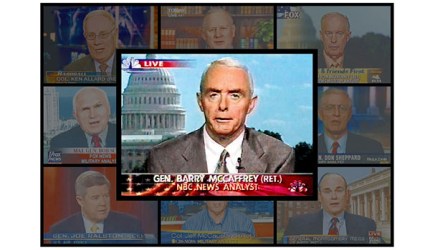
Access like this does not come cheap, but it was an opportunity potentially worth billions in sales, and Defense Solutions soon found its man. The company signed Barry R. McCaffrey, a retired four-star Army general and military analyst for NBC News, to a consulting contract starting June 15, 2007.

Four days later the general swung into action. He sent a personal note and 15-page briefing packet to David H. Petraeus, the commanding general in Iraq, strongly recommending Defense Solutions and its offer to supply Iraq with 5,000 armored vehicles from Eastern Europe. “No other proposal is quicker, less costly, or more certain to succeed,” he said.

Thus, within days of hiring General McCaffrey, the Defense Solutions sales pitch was in the hands of the American commander with the greatest influence over Iraq’s expanding military.

“That’s what I pay him for,” Timothy D. Ringgold, chief executive of Defense Solutions, said in an interview.