FIRST BROADCATCHED January 11, 2008
R.I.P. Tony Snow
First Broadcatched :: May 2007
_


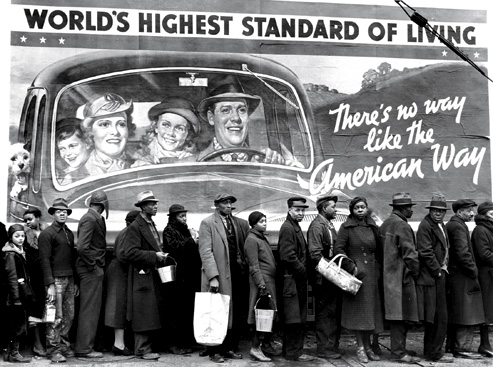
Remember the ownership society? President George W. Bush championed the concept when he was running for re-election in 2004, envisioning a world in which every American family owned a house and a stock portfolio, and government stayed out of the way of the American Dream.
These families were, of course, conservative, or at a minimum traditional and nuclear, consisting of a heterosexual married couple and at least two kids living in a stand-alone home with a yard, a car or two and a multimedia room with a flat-screen television. The latter was a new addition to this 21st-century simulacrum of the 1950s “Leave It to Beaver” idyll. But the dream was the same.
Such a country would be more stable, Bush argued, and more prosperous. “America is a stronger country every single time a family moves into a home of their own,” he said in October 2004. To achieve his vision, Bush pushed new policies encouraging homeownership, like the “zero-down-payment initiative,” which was much as it sounds—a government-sponsored program that allowed people to get mortgages without a down payment. More exotic mortgages followed, including ones with no monthly payments for the first two years. Other mortgages required no documentation other than the say-so of the borrower. Absurd though these all were, they paled in comparison to the financial innovations that grew out of the mortgages—derivatives built on other derivatives, packaged and repackaged until no one could identify what they contained and how much they were, in fact, worth.
As we know by now, these instruments have brought the global financial system, improbably, to the brink of collapse. And as financial strains drive husbands and wives apart, Bush’s ownership ideology may end up having the same effect on the stable nuclear families conservatives so badly wanted to foster.
The dream of a better society through homeownership didn’t originate with George W. Bush. It’s as American as Manifest Destiny. The Homestead Act in 1862 offered acres to anyone willing to brave the Western frontier. During Reconstruction, freed slaves were promised “40 acres and a mule.” And after World War II, with Levittown and its cousins, affordable homes were a reward of victory. But until very recently, those hopes and dreams were connected to actual income and gainful employment. No longer.
The giddiness of the Bush years built on the promise of the New Economy era, a promise perfectly encapsulated by a 1999 billboard advertising a shiny new subdivision in Scroggins, Texas, filled with homes that most of their owners couldn’t really afford: YES, YOU CAN HAVE IT ALL! That dream took a sharp hit with the collapse of the Internet stock bubble in 2000-2001 and then with 9/11, both of which destroyed billions of dollars of wealth. But it came roaring back in 2002, encouraged by Bush’s post-9/11 exhortation that Americans could do their patriotic duty by going shopping and paying lower taxes, even as government spending exploded. Shop they did, and homes they bought.
The spree wasn’t confined to the United States. Britain has its own version of the ownership society, which received a boost from Margaret Thatcher, who promoted “a property-owning democracy” that her Labour successors, Tony Blair and Gordon Brown, endorsed. Blair liked to talk of building a “stakeholder economy” with a big role for the ordinary property-owning citizen. More recently, Brown has spoken of creating a “homeowning, asset-owning, wealth-owning democracy.” Millions were happy to buy into the vision. Tenants of government-owned properties gladly took up Thatcher’s offer to sell them their homes at knockdown prices. More than 70 percent of Britons now own their homes, compared with 40 percent of Germans and 50 percent of French.
In Britain as in the United States, the vision was about more than owning a home. It was about being a better person. With a home came traditional values, an appreciation of hard work, prudent living, civic-mindedness, patriotism and ultimately a more stable society. Or so the rhetoric went.
But eventually, it all went sour. By the turn of the century, the proliferation of easy credit and universal stock ownership combined to create anything but a conservative society of thrift. Average household debt levels are now higher in Britain than in any other major country in the developed world. In the United States, the shift away from corporate pensions to 401(k) retirement accounts plunged millions more into the equity markets and loosened the traditional connection between companies and workers, which was one element of that 1950s dream that conservatives like Bush conveniently forgot. The ownership society of the 1950s was anchored by a labor movement that made sure that workers received something resembling their share—remember Truman’s Fair Deal? The deal for the past eight years has been fair to merchants of capital, and then some. But to the tens of millions on the receiving rather than originating end of those mortgages, fairness has been in short supply.
No, this can’t be reduced to a swindle. We all bear some burden for the current morass. You can’t peddle what people don’t want to buy, and for a while it seemed a decent trade-off: Wall Street got rich, and Main Street got homes. The easy terms—and that is putting it lightly—of mortgages gave many a chance to own a home who never would have qualified for a mortgage in years past. But it also gave others the option to buy, sell and flip. Every speculator a home? That wasn’t supposed to be part of the equation.
The irony is that more homeownership and stock ownership has actually weakened traditional bonds. For the past decade, as homeownership went up, marriages continued to fail. As a percentage of the population, fewer people are getting married now than 10 years ago. Single-parent homes are on the rise. So is unemployment, which has increased to 6.1 percent, up from 4.5 percent in 2000. With foreclosures now running at more than 300,000 a month, and stock portfolios and retirement savings shrinking with the global-equity sell-off, there has been a notable increase in demand for mental-health services—which is a problem, given that many health-care plans, the ones left to the private sector, cover only a few visits. Studies have also shown a link between difficult economic straits and declining health and higher mortality. And as the editor and writer Tina Brown, a sharp tracker of social trends, recently said at NEWSWEEK’s Women & Leadership conference, “I think the financial crisis is going to put a lot of marriages under great stress. There really isn’t enough to go around, and there are choices to be made. When men lose their job they frequently feel a great loss of manly self-confidence, and that has great impact on a marriage.”
The final referendum on the ownership society will be the November election. The rhetoric of both parties and candidates for president suggests that regardless of who wins, the vision of the past eight years is being rejected in favor of hunkering down, paying off debt, regulating the anarchic world of credit and derivatives, and unraveling systemic knots that have assumed Gordian complexity. As Barack Obama recently said, “in Washington they call this the ownership society, but what it really means is, you’re on your own.”
This crisis will pass, eventually, and on the other side there will still be global electronic exchanges and computer-enhanced models; there will still be mortgages; and there will still be a deep cultural yearning for a place of one’s own. There may be less froth and more discipline in the coming years—combined with reduced circumstances and less money. Lean times are their own source of hopes and desires, and drive people to find new ways to satisfy old yearnings. There may be more prudent ways to create a world where families are stable and living in their own homes. But the gap between that dream and messy reality isn’t likely to close any time soon. Let’s hope that we have learned something about how much we can have and how quickly. For Americans in particular, that would be a real revolution.
Karabell is president of RiverTwice Research and senior adviser for Business for Social Responsibility.
Describing how ideology, special-interest pressure, populist politics, and sheer incompetence have left the U.S. economy on life support, the author puts forth a clear, commonsense plan to reverse the Bush-era follies and regain America’s economic sanity.
When the American economy enters a downturn, you often hear the experts debating whether it is likely to be V-shaped (short and sharp) or U-shaped (longer but milder). Today, the American economy may be entering a downturn that is best described as L-shaped. It is in a very low place indeed, and likely to remain there for some time to come.
Virtually all the indicators look grim. Inflation is running at an annual rate of nearly 6 percent, its highest level in 17 years. Unemployment stands at 6 percent; there has been no net job growth in the private sector for almost a year. Housing prices have fallen faster than at any time in memory—in Florida and California, by 30 percent or more. Banks are reporting record losses, only months after their executives walked off with record bonuses as their reward. President Bush inherited a $128 billion budget surplus from Bill Clinton; this year the federal government announced the second-largest budget deficit ever reported. During the eight years of the Bush administration, the national debt has increased by more than 65 percent, to nearly $10 trillion (to which the debts of Freddie Mac and Fannie Mae should now be added, according to the Congressional Budget Office). Meanwhile, we are saddled with the cost of two wars. The price tag for the one in Iraq alone will, by my estimate, ultimately exceed $3 trillion.
BY John Tully
October 8 2002
The Los Angeles Sun—
Politics is not a pretty thing.
Look no further than this week in Washington D. C. Former Vice-president Albert Gore Jr. finally brought up the huge marsupial in the room. Criminy! folks, that’s gonna’ wake the whole herd up mate!
Senate Leader Tom Daschle, who seemed to have stashed his opinions in a lock box this summer finally blew his top on the Senate floor denouncing President Bush’s comment at a recent fundraiser that the “Senate” is more interested in “special interests” than in the Security Of Americans. That very same fundraiser pushed the President past Bill Clinton’s record of $126 million raised in one year and it’s only the last week of September.
Stepping right up to the plate this week was a small group of Senators who have been all too quiet this summer with any dissent of this administration’s dual War On Terrorism and Iraq. In fact the debate on war had bipassed “if” and went straight through to “when” and “who’s with us” by the time Mr. Gore finally cleared his throat Monday in San Francisco. Actual questions were raised about our effectiveness in toppling Saddam and how to proceed post-war in Iraq among others.
Sen. Robert Byrd paced and shook with disdain as he read Bush’s remarks from the newspaper on the senate floor. Sen. Daschle’s voice broke as he defended his colleagues, spoke of members who have served in the military and demanded an apology from the President. He also spoke of not politicizing the nation’s debate. It was a classic case of “too little,too late”
Back in June an internal G.O.P. playbook, authored by White House political strategist Karl Rove got into the hands of the opposition. The Powerpoint presentation suggested Republican candidates play up the “War” to keep the political dialogue on their side of the fence.The relative silence of the Democrats this summer only strengthened the resolve of the true hawks in the administration and a bipartisan resolution for war will almost definitely be passed by both houses. For GOP candidates however, the strategy might not pay off.
A new poll released this week shows that while the majority of Americans are for action against Iraq, three out of five want our allies to sign on. Colin Powell would like to go back to the Security Council soon with a joint resolution from the United States Congress and it looks as if he will have it. Unfortunately for the Republicans, this momentary truce focuses the debate back onto the domestic front where, as usual, it is the Economy…stupid.
Crikey! The bugger just ate his own heed!
Politics is not a pretty creature.

ATLANTA, Sept 30 (Reuters) – Opposing the White House’s Wall Street bailout and letting stocks take a beating was a worthwhile price to pay to keep a “socialist bill” from meddling in the free market, conservative U.S. talk radio said on Tuesday.
Many of the influential hosts strongly oppose the rescue plan proposed last week by U.S. President George W. Bush, once a talk-radio favorite, as inappropriate government intervention in the free market likely to make the situation worse, not better.
Congress will live to regret it if the $700 billion bill were passed hastily, they said, urging lawmakers to spend more time on a search for a solution that adheres to conservative ideals.
“I shouldn’t say this, but I’m going to say it anyway. Screw the market! …. OK, I’ll take that back, not screw the market but let me tell you something,” conservative talk show host Rush Limbaugh said as part of his analysis of Monday’s events.
“When the government fails to pass a socialism bill and the market goes south, let it go south. I don’t want to pass a socialism bill just to protect the stock market,” said Limbaugh, by far the most popular host on U.S. radio.
“This raw deal would make things worse,” he said on Tuesday.
U.S. lawmakers in the House of Representatives rejected the bailout package on Monday after most of House Democrats supported it, but a majority of House Republicans opposed it.
The surprise failure sent the market into a record tailspin and prompted a flood of bickering and fingerpointing from both parties.
Stocks recovered somewhat on Tuesday and Congress will have a chance to vote again or change the bill when it reconvenes on Thursday.
While conservatives said they recognized the seriousness of the market’s fall, they would hold fast to their principles that on the economy include low taxes, small government and fiscal responsibility.
‘NOT PARTICULARLY DISTRESSED’
“I’m not particularly distressed that the bailout bill did not pass. I want to see this thing (the bill) flesh itself out a little over a period of days,” said talk show host Neal Boortz, who describes himself as a libertarian.
Hoping to win more support for the rescue plan, Bush said on Tuesday the U.S. economy was depending on decisive action or the economic damage could be “painful and lasting.”
But part of the problem for some conservatives was a lack of confidence in a president they once saw as a champion of their cause for his commitment to tax cuts and his firm response to the Sept. 11 attacks.
They blame the Democrats for the home mortgage crisis at the root of the problem, saying liberals put pressure on mortgage finance giants Fannie Mae and Freddie Mac to make housing loans to people who could not afford to repay them.
“I don’t trust you (Bush) and when you start screaming now of dire consequences if we don’t get a bailout bill, I don’t trust you. I need convincing and apparently there are a lot of members of Congress who feel the same way,” Boortz said, in a view echoed by several of his listeners.
Some callers to the shows said they did not appreciate what they saw as scare tactics used by Bush and Treasury Secretary Henry Paulson.
“It almost sounds like they are demagoguing and preaching that the sky is falling, which makes me skeptical,” one said.
Tens of millions of conservatives tune in to AM talk radio and trust its nationally syndicated hosts more than media outlets they say have a liberal bias.
Several of the hosts say they are engaged in a long struggle to persuade the Republican Party and the country to return to its conservative roots and they see the bailout bill as an important test of their strength. (Editing by Patricia Zengerle)

The U.S. military is looking for a contractor to patrol cyberspace,
watching for warning signs of forthcoming terrorist attacks or other
hostile activity on the Web. “If someone wants to blow us up, we want
to know about it,” Robert Hembrook, the deputy intelligence chief of
the U.S. Army’s Fifth Signal Command in Mannheim, Germany, told United
Press International.

In a solicitation posted on the Web last week, the command said it was
looking for a contractor to provide “Internet awareness services” to
support “force protection” — the term of art for the security of U.S.
military installations and personnel.
“The purpose of the services will be to identify and assess stated and
implied threat, antipathy, unrest and other contextual data relating to
selected Internet domains,” says the solicitation.
Hembrook was tight-lipped about the proposal. “The more we talk about
it, the less effective it will be,” he said. “If we didn’t have to put
it out in public (to make the contract award), we wouldn’t have.”
He would not comment on the kinds of Internet sites the contractor
would be directed to look at but acknowledged it would “not (be) far
off” to assume violent Islamic extremists would be at the top of the
list.
The solicitation says the successful contractor will “analyze various
Web pages, chat rooms, blogs and other Internet domains to aggregate
and assess data of interest,” adding, “The contractor will prioritize
foreign-language domains that relate to specific areas of concern
… (and) will also identify new Internet domains” that might
relate to “specific local requirements” of the command.
Officials were keen to stress the contract covered only information
that could be found by anyone with a computer and Internet connection.
“We’re not interested in being Big Brother,” said LeAnne MacAllister,
chief spokeswoman for the command, which runs communications in Europe
for the U.S. Army and the military’s joint commands there.
“I would not characterize it as monitoring,” added Hembrook. “This is a
research tool gathering information that is already in the public
domain.”
Experts say Islamic extremist groups like al-Qaida use the Web for
propaganda and fundraising purposes. Although the extent to which it is
employed in operational planning is less clear, most agree that
important information about targeting and tactics can be gleaned from
extremists’ public pronouncements. Hembrook said the main purpose of
the contract is to analyze “trends in information.” The contractor will
“help us find those needles in that haystack of information.”
The solicitor says the contractor’s team will include a “principal
cyber investigator,” a “locally specialized threat analyst” and a
“foreign-speaking analyst with cyber investigative skills,” as well as
a 24/7 watch team.
The contractor will produce weekly written reports, containing “raw
data and supporting analysis.” The addresses of the Web page sources
will be “captioned under alias to preserve access,” says the
solicitation. Experts have noted in the past that publishing the
addresses of some extremists’ sites has led to them being attacked or
moving. However, the contractor will “consider releasing specific (Web
page addresses) on an as-needed basis … if explicit threat
materials or imminent threat to personnel or facilities are
discovered.”
The contractor also will notify the command immediately “upon receipt
of any and all stated or implied threats that contain timing and/or
targeting information relating to personnel, facilities or activities,
and to specifically designated areas of concern.”
While declining to comment on the specific solicitation, Ben Venzke,
CEO of IntelCenter, an Alexandria, Va.-based company that monitors
Islamic extremist propaganda for clients including U.S. government
agencies, said it was “common” for the military or other agencies to
employ contractors “to support their own work on these issues.”
“What most people don’t get,” he said, “is that (each agency or entity)
has their own very specific requirements. … They are looking for
one type of thing in particular.”
Venzke explained that while an analyst for a big-city police department
might be looking at extremist Web sites for certain kinds of
information, their requirements would be different from those of
intelligence analysts looking for evidence of trends in extremist
targeting or ideology, which in turn would be different from those
concerned — like the Fifth Signal Command — with force protection.
“There is some overlap,” he said, “and you always have to work to
minimize that, but generally, there are so many different …
pieces you can look at … it’s not duplication.”



 The New York Herald Sun